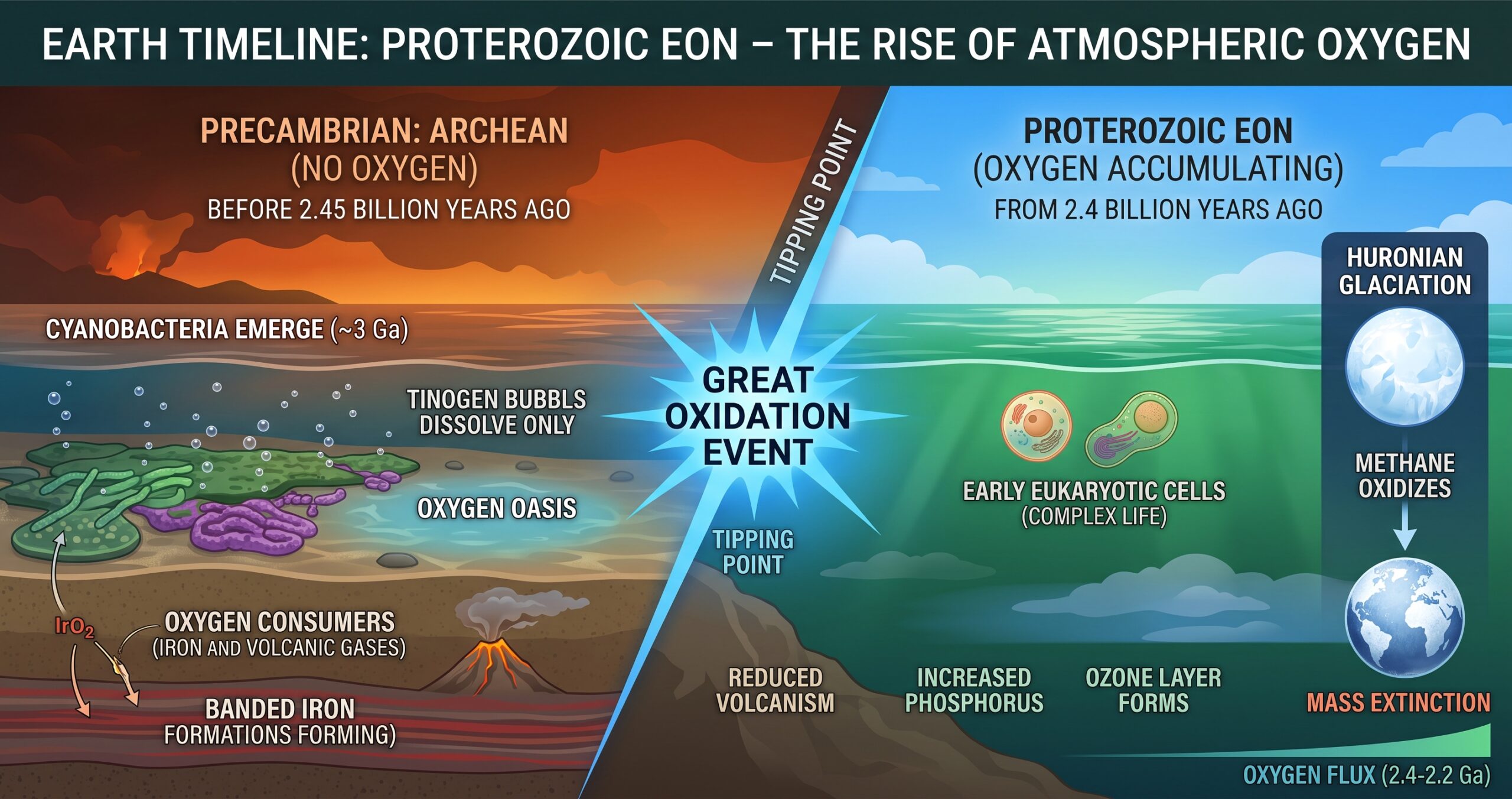
The Proterozoic ran from 2.5 billion to about 539 million years ago, a span of roughly 1.96 billion years. Of Earth’s 4.6-billion-year history, this single division accounts for more than 40 percent.
The Precambrian divides into the Hadean, the Archean and the Proterozoic, with the Proterozoic last. Strictly speaking these three are not periods but eons, a rank above eras; in this timeline series they are placed in the position of periods to keep the sequence aligned.
What happened in the first half of this long span was a change in the contents of the atmosphere. Until then, Earth’s air contained almost no oxygen we could breathe. This article follows when that oxygen entered the atmosphere, and how.
The arrival of microbes that split water
The oxygen was made by cyanobacteria: photosynthesizing bacteria, the same group whose blooms turn summer ponds cloudy green.
Photosynthesis comes in several kinds. Making sugar from carbon dioxide with sunlight requires something to donate electrons, and older forms of photosynthesis used hydrogen sulfide or iron dissolved in water. Cyanobacteria acquired a mechanism for extracting electrons by splitting water itself. With water — available everywhere on Earth — as the raw material, they could multiply without limit wherever light reached. And splitting water leaves the unused atoms over. Those are oxygen.
Atmospheric oxygen began as waste. A discarded by-product that, far later, would come to support animal respiration.
The question is when cyanobacteria appeared. Microbes have neither bones nor shells and rarely fossilize, so tracing them directly is difficult. The available clue is the molecular clock: comparing the genomes of living organisms and, assuming genetic changes accumulate at a roughly constant rate, working backward to when lineages split.
Estimates by this method indicate that water-splitting photosynthesis was most likely in place during the Archean — by around three billion years ago at the latest. That is several hundred million years before oxygen began accumulating in the atmosphere.
In 2025, a further result was reported in Science. An international team including the Okinawa Institute of Science and Technology (OIST) used machine learning on bacterial genomes to estimate whether a given lineage lived an oxygen-using life, and placed the results on a time axis. At least three lineages were using oxygen before it began accumulating in the atmosphere. The earliest went back roughly 900 million years further.
Oxygen, then, had existed locally long before. Microbial mats in a corner of a shallow sea released oxygen that dissolved only in the water around them — a condition known as an oxygen oasis.

A record of the atmosphere preserved in rock
The air of 2.4 billion years ago is preserved nowhere. Judging whether the atmosphere of the time held oxygen is done indirectly, from chemical traces left in rock.
The most effective indicator is sulfur. Sulfur has several isotopes of different mass, and when they separate in chemical reactions the proportions normally scale with the mass difference. But in an atmosphere with neither oxygen nor an ozone layer, solar ultraviolet breaks sulfur dioxide molecules directly, producing offsets that depart from that proportionality. The broken sulfur falls to the surface in several different forms, each carrying its own offset into the strata.
Once oxygen enters the atmosphere, the offset disappears. An ozone layer blocks the ultraviolet, and sulfur dissolves into a common pool of sulfate in the ocean before precipitating, averaging the offsets away.
Examining actual rocks, this offset is found worldwide in strata older than 2.45 billion years and is entirely absent from strata younger than 2.3 billion years. Since it was reported in Science in 2000, it has been regarded as the most reliable evidence for when atmospheric oxygen rose. The oxygen level at which the offset vanishes is estimated at about one hundred-thousandth of today’s atmosphere. Very thin — but decisively different from what came before.
Other evidence points to the same interval. Grains of pyrite and uraninite transported by wind and water — minerals that dissolve en route if oxygen is present — disappear from the strata around this time. Conversely, red beds, strata reddened by oxidized iron, begin to appear, and ancient soils start showing traces of iron having been leached out.
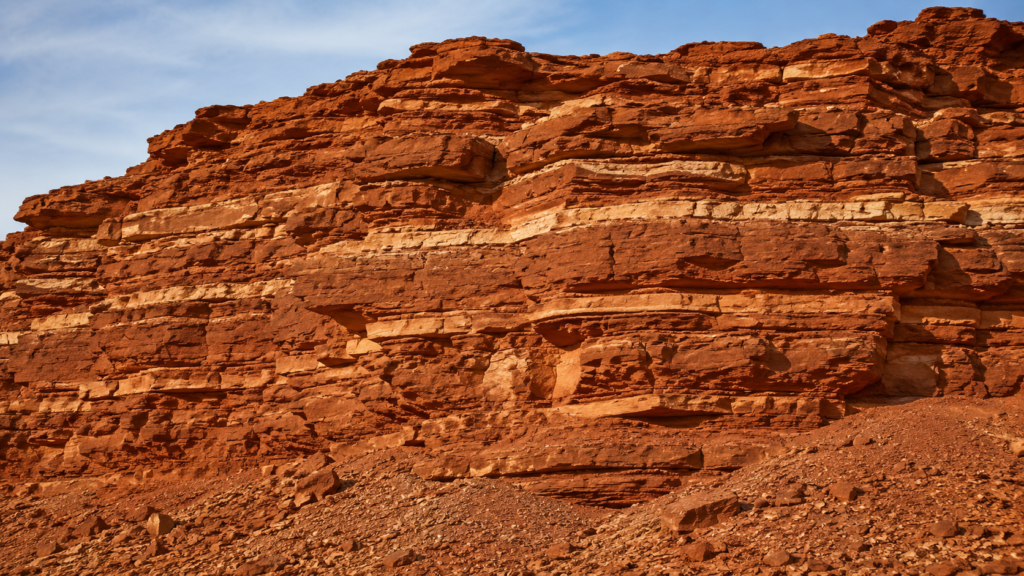
One complication. The start of the Proterozoic is set at 2.5 billion years ago, but that figure is not tied to any event. For strata this old, no reference section defining the boundary has yet been fixed, so the division is simply set at a round number. Atmospheric oxygen is taken to have risen about 2.43 billion years ago, so the boundary and the event are some 70 million years apart.
The iron and volcanic gases that swallowed the oxygen
Here something snags. Microbes making oxygen existed by around three billion years ago, yet oxygen only began accumulating in the atmosphere 2.4 billion years ago. Several hundred million years’ worth of oxygen did not stay in the air.
Whether oxygen remains in the atmosphere is determined not by the amount produced but by the difference between production and consumption. And the Earth of that time had consumers in abundance.
The largest was iron dissolved in the ocean. Iron dissolves readily in oxygen-free water (in the form called ferrous iron), and the ocean then held plenty of it, supplied by seafloor hydrothermal vents. Add oxygen and the iron oxidizes into an insoluble form (ferric iron), turning into fine particles that settle. The oxygen leaves with the iron for the seafloor and never reaches the atmosphere.
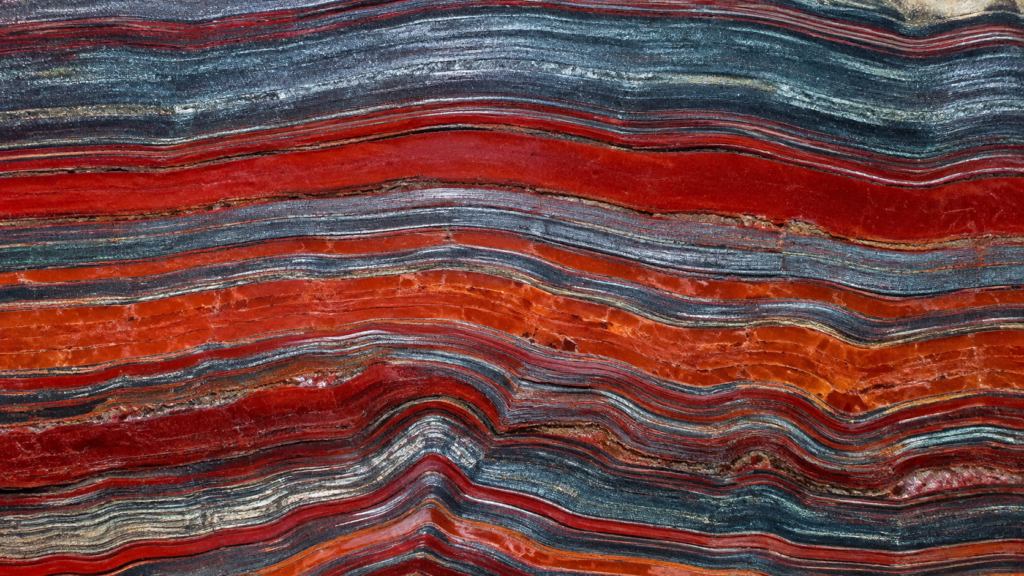
Those precipitates survive as strata: the banded iron formations. Dark iron-rich layers alternate with red-brown or grey silica-rich layers at millimeter to centimeter scale, sometimes stacked hundreds of meters thick, and they formed in concentration between about 2.65 and 1.85 billion years ago. Those in the Hamersley region of Western Australia date to about 2.45 billion years and are among the largest single deposits in the world.
This rock is directly connected to modern life. Most of the world’s iron ore is mined from banded iron formations, so steel frames and railway rails are made from iron that settled in the seas of this age. The agent of the oxidation that precipitated that iron remains under discussion, however. Both oxygen released by photosynthesis and an older form of photosynthesis using iron itself as the electron source are considered, and which contributed how much is unsettled.
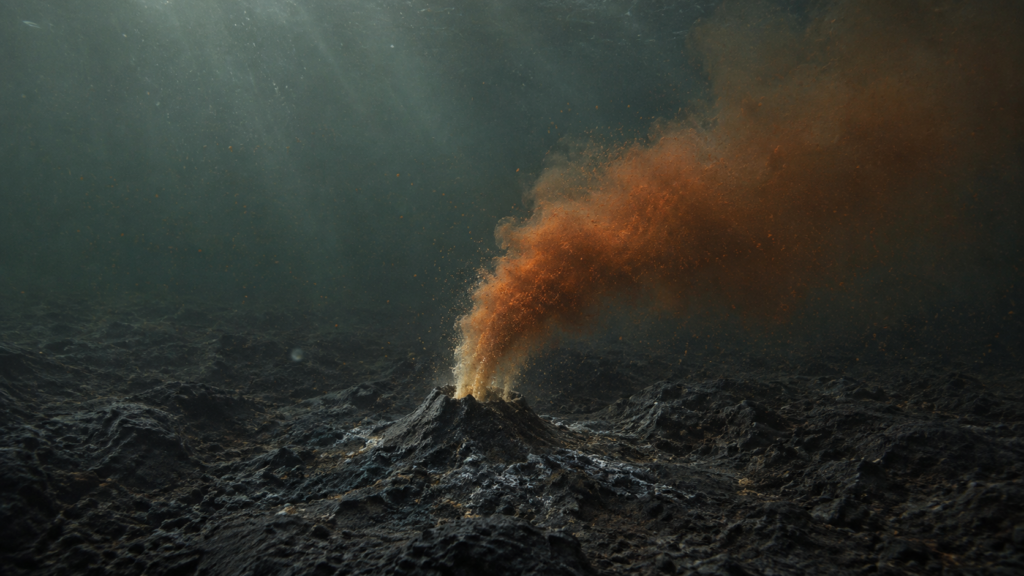
The other consumer was volcanic gas. Hydrogen, hydrogen sulfide, carbon monoxide, methane — all react with oxygen and remove it. Reduced minerals exposed at the surface also consume oxygen as they weather.
Oxygen supplied was being cleared away as fast as it emerged.
The tipping point where the balance shifted
From here, the Great Oxidation Event looks different.
What set the timing of oxygen accumulating in the atmosphere was not when oxygen began to be produced. It was when consumption could no longer keep up with production.
A 2022 paper in Nature Geoscience by Lewis Alcott of the University of Leeds and colleagues explicitly positions the Great Oxidation Event as a tipping point: the moment photosynthetic production and oxygen output exceeded the inflow of oxygen-consuming material. And what set that timing, they argue, was not a biological invention but the supply of the nutrient phosphorus and the behavior of the solid Earth.
Phosphorus is what the team focused on. It is the nutrient governing how far marine microbes and plankton can multiply; without enough of it, photosynthesis does not increase. Analyzing drill core from the Transvaal Supergroup in South Africa, spanning 2.65 to 2.43 billion years, they found traces of phosphorus becoming more readily released within the sediment. Slight oxidation of continental rock sends sulfate into the sea; sulfide then forms on the seafloor, and the phosphorus that had been settling bound to iron is liberated. More usable phosphorus means more photosynthesis and more oxygen. More oxygen oxidizes the land further and produces more sulfate — a positive feedback.
That said, this is not established as the sole factor tipping the balance. Strong candidates stand alongside it. A shift in volcanic activity from the seafloor to land, reducing the supply of oxygen-consuming gases (Nature, 2007). Hydrogen escaping to space as methane, gradually oxidizing the planet as a whole (Science, 2001). Continental growth increasing land area and thus the supply of phosphorus itself. Which contributed how much is not yet decided.
The Great Oxidation Event, in other words, was not the event in which oxygen was born. It was the event in which the side swallowing oxygen became saturated. The timing was set not by a microbial invention but by the flows of matter through the whole planet.
A frozen planet, and an overshoot
The consequences of that shift did not stop at a change in atmospheric composition.
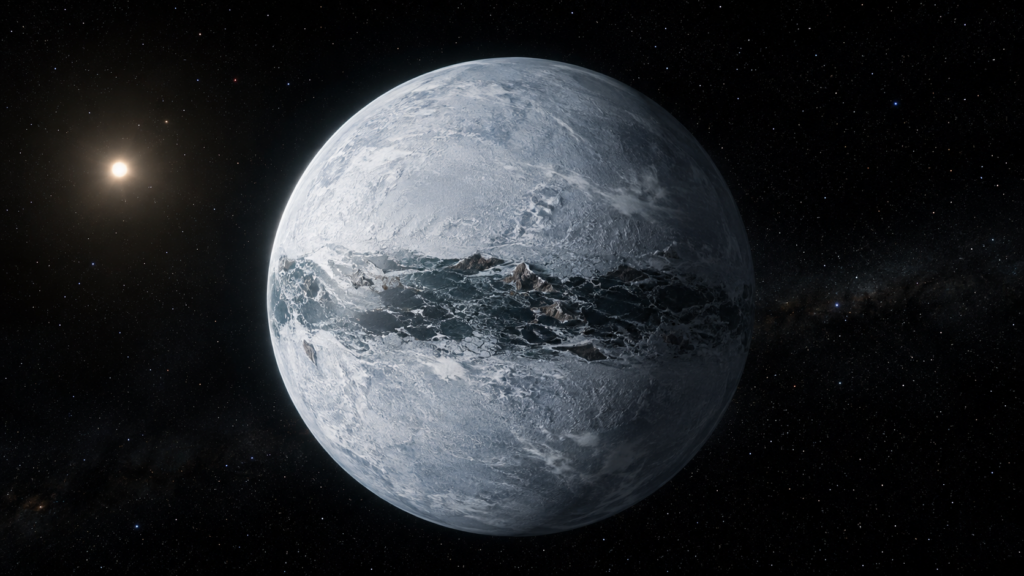
At almost the same time as the Great Oxidation Event, the Earth was covered in ice repeatedly: at least three times between 2.45 and 2.22 billion years ago, or four counting the South African record. They are called the Huronian glaciations, after strata exposed on the north shore of Lake Huron in Ontario, Canada (the Huronian Supergroup). The ice is thought to have reached low latitudes and come down to sea level.
The leading cause is the oxygen itself. The earlier atmosphere is thought to have contained a fair amount of methane, a stronger greenhouse gas than carbon dioxide, warming the surface and compensating for a sun fainter than today’s. As oxygen increased, methane reacted with it and was converted to carbon dioxide and water. The main greenhouse agent was replaced by a weaker one, and surface temperature fell — that is the account.
Life paid a price as well. Oxygen is toxic to microbes without mechanisms for handling it. Many of the anaerobic microbes then widespread are thought to have been lost, and this is sometimes called Earth’s first mass extinction. Microbes rarely fossilize, though, so the means of confirming the scale of that extinction are limited.
Nor did oxygen rise in a straight line. A 2021 study in Nature by Simon Poulton of the University of Leeds and colleagues examined marine sediments from the Eastern Transvaal Basin in South Africa in detail and showed that oxygen levels crossed that one hundred-thousandth threshold up and down repeatedly. Rising, then falling again, for about 200 million years, with oxygen ceasing to fall back only around 2.22 billion years ago — roughly 100 million years later than previous estimates. Co-author Andrey Bekker of the University of California, Riverside, notes that this instability helps explain the four glaciations coinciding with the Great Oxidation Event.
Once it stabilized, it swung too far the other way. Between 2.22 and 2.06 billion years ago, the strata record the longest-lasting positive carbon isotope excursion in Earth’s history. During this interval, called the Lomagundi event, it has been widely argued that oxygen rose to near present levels or beyond — an overshoot. There is no way to measure the concentration of the time directly, however, and how far it rose is not agreed among researchers.
Oxygen then fell, and stayed low for over a billion years.
A transition that took two billion years
“The atmosphere filled with oxygen” sounds like a single event. In fact it was a much longer story.
A study published in Nature in August 2025 used oxygen isotopes in deposited sulfate to reassemble 2.5 billion years of record at fine temporal resolution. It came from an international team centered on Chengdu University of Technology in China, joined by researchers at the University of California, Riverside, and in Australia. What emerged was a rise in three steps. Oxygen spread first through the ocean surface, then the atmosphere, and last the deep sea. Sustained oxygenation reaching the deep ocean, with atmospheric oxygen approaching present levels, came about 410 million years ago — the middle of the Paleozoic, the age when fish were flourishing.
On this view, what happened at the start of the Proterozoic was not the moment the atmosphere filled with oxygen but the first step of a transition that took two billion years. Even as the Proterozoic ended, the deep ocean remained oxygen-poor.
The open questions remain open. What finally tipped the balance? How wide were the swings? How far did oxygen rise during the Lomagundi event? The only clues are drill cores from ancient strata in South Africa, Australia and Canada, and the isotope ratios within them. The air of 2.4 billion years ago is no longer obtainable.
Sources
Divisions and boundary dates follow the International Chronostratigraphic Chart of the International Commission on Stratigraphy (ICS): International Chronostratigraphic Chart (ICS)
Positioning the Great Oxidation Event as a tipping point, focusing on phosphorus recycling: Alcott et al., “Earth’s Great Oxidation Event facilitated by the rise of sedimentary phosphorus recycling” (Nature Geoscience, 2022)
Showing that oxygen fluctuated for about 200 million years, with permanent oxygenation at 2.22 billion years ago: Poulton et al., “A 200-million-year delay in permanent atmospheric oxygenation” (Nature, 2021) / University of Leeds press release: Extra 100 million years before Earth saw permanent oxygen rise
Arguing that oxygenation proceeded in three steps and completed about 410 million years ago: Wang et al., “Two-billion-year transitional oxygenation of the Earth’s surface” (Nature, 2025) / commentary: Two-billion-year oxygen transformation on Earth unveiled (Phys.org)
Showing that oxygen-using bacteria existed before the Great Oxidation Event (Okinawa Institute of Science and Technology press release): Molecular clock analysis shows bacteria used oxygen long before widespread photosynthesis
On the anoxic atmosphere indicated by sulfur isotope offsets: Pavlov & Kasting, “Mass-independent fractionation of sulfur isotopes in Archean sediments” (Astrobiology, 2002)
On the onset date of the Great Oxidation Event and its correspondence with the early glaciations: Gumsley et al., “Timing and tempo of the Great Oxidation Event” (PNAS, 2017)

コメント