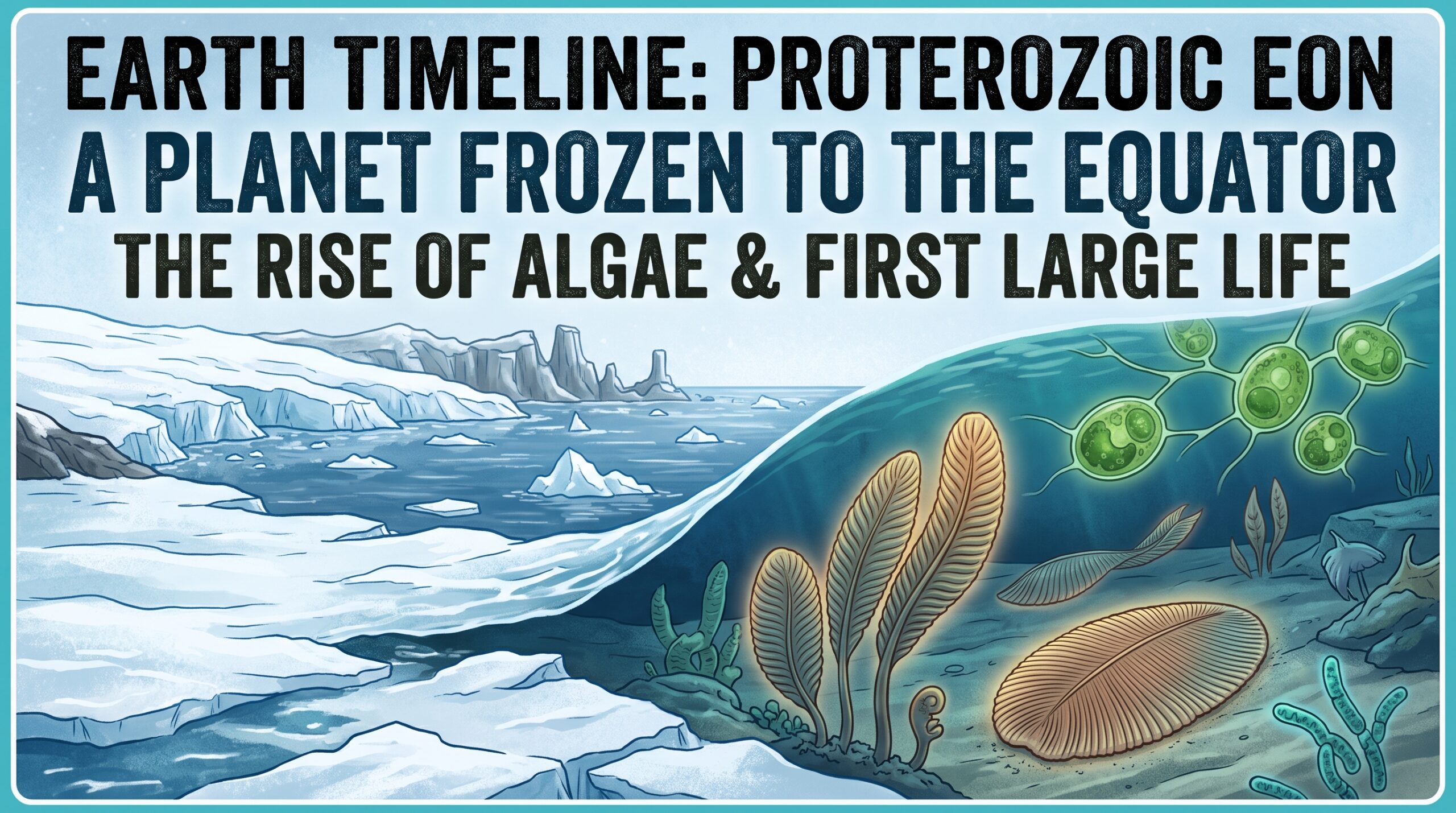
The Proterozoic runs from 2.5 billion to about 539 million years ago, the longest division in Earth’s history. What this article covers is its second half: roughly 460 million years from about one billion years ago to the end of the Proterozoic. This is the Neoproterozoic, subdivided into the Tonian (about 1,000 to 720 million years ago), the Cryogenian (about 720 to 635 million years ago) and the Ediacaran (about 635 to 539 million years ago). Next comes the Cambrian, when the blueprints of animal bodies are completed.
One clarification. The Hadean, Archean and Proterozoic are not, strictly speaking, divisions on a par with periods like the Triassic or Jurassic. They are eons, a rank above eras. Here the Proterozoic is placed in the position of a period simply to keep the timeline series aligned.
Within these 460 million years, the Earth was covered in ice to the equator at least twice. Ice is thought to have reached low latitudes early in the Proterozoic as well, but the clearly preserved record is these two later events. And after the ice lifted, large organisms — living things big enough to see without a microscope — appear in the ocean in numbers. For the preceding four billion years or so, most life on Earth was microscopic, and things visible to the eye were very limited.
Glacial traces left at the equator
How can anyone know the whole planet froze in the first place? The clues are in the rocks.
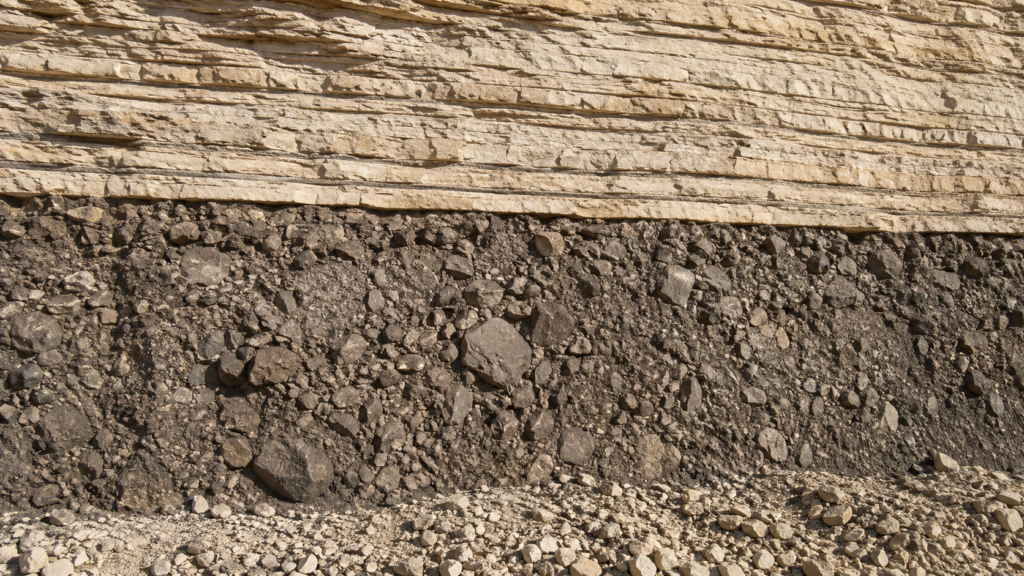
Moving glaciers scrape, crush and carry rock debris of every size together. Where that debris is dropped as the ice melts, it forms a chaotic rock in which fine mud and stones the size of a human head are jumbled without order. Called diamictite, it is essentially impossible to produce outside places where glaciers have worked. Another clear indicator is the dropstone. An iceberg carrying a stone drifts out to sea, melts and drops it; the stone punches into fine layers that had been settling quietly. The layer above is dented downward and the layer beneath is crumpled — a structure that can only form when a stone falls from above through water.
Strata of this kind, dating to 600 to 700 million years ago, are found on nearly every continent in the world today.
So far this amounts to “there were cold intervals in the past.” The story turns strange when you ask where those rocks were at the time. Magnetic minerals in lava and sediment align with the direction of Earth’s magnetic field as they solidify. Because the field’s inclination varies with latitude, the inclination frozen into a rock reveals the latitude at which it formed. Apply this paleomagnetic method to glacial deposits, and at site after site the answer comes back: the tropics. And not on mountaintops — at sea level.
On today’s Earth, the only tropical ice sits on the summits of Kilimanjaro and the Andes. Glaciers flowing down to tropical coastlines is what the rocks were asserting.
There is another oddity. Directly above these glacial deposits, usually with no transition at all, sits carbonate rock tens of meters to over a hundred meters thick. Carbonate forms in warm, shallow seas — the product of places like the shallows of the Bahamas or Australia today. A record of tropical ocean stacked on a record of ice, with nothing in between. This unnatural pairing, called a cap carbonate, was one of the great puzzles in reading rocks of this age.
There is also a strange return. Banded iron formation is a rock in which dark iron-rich layers alternate finely with red-brown silica-rich layers. It records iron dissolved in seawater combining with oxygen and settling out, and it had largely ceased forming after about 1.85 billion years ago, because once oxygen spread through the ocean, the dissolved iron that supplied the material disappeared first. Yet this rock turns up mixed into the glacial deposits of the Sturtian glaciation, after a gap of more than a billion years. A record that reads as an ocean capped by thick ice losing its oxygen and returning to a state where iron could dissolve again.
In 1992, Joseph Kirschvink of Caltech used the term Snowball Earth for a scenario tying all of this together. In 1998, Paul Hoffman of Harvard University and colleagues systematized it on the basis of strata in Namibia, and the discussion expanded rapidly. The name Cryogenian itself is built from the Greek for ice and for birth — the character of the period turned into its name.
Fifty-seven million years of ice, and how it ended
The Cryogenian contained two major glaciations. The older is the Sturtian, from about 717 to 661 million years ago. The younger is the Marinoan, from about 650 to 635 million years ago.
The problem was the length of the Sturtian: about 57 million years. The human lineage split from the chimpanzee lineage roughly 7 million years ago, so this is eight times that. Longer than the interval from the extinction of the dinosaurs to today. The Earth was locked in ice for that entire span.
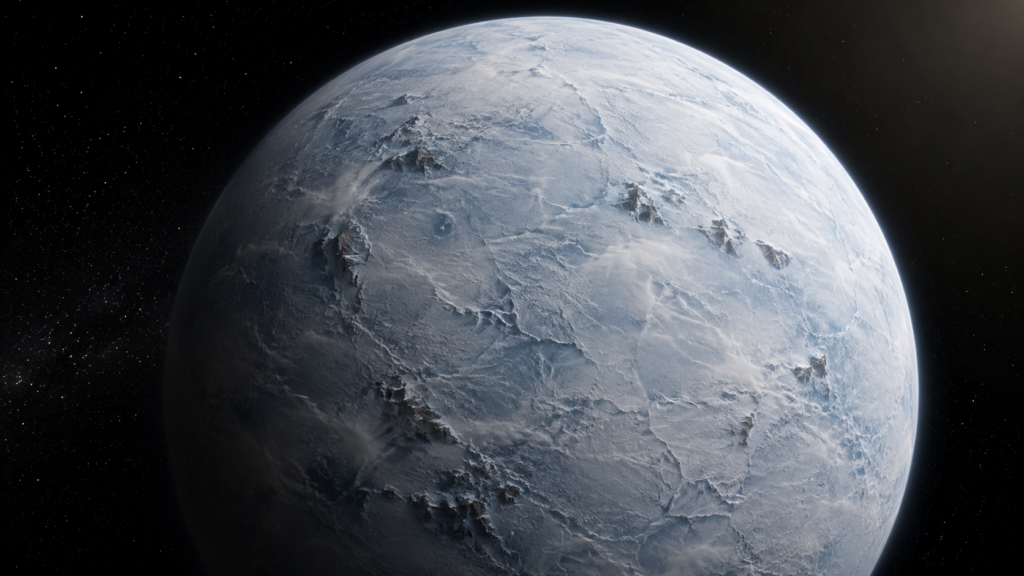
Why is this awkward? Because the Earth has a mechanism for bringing temperature back. Atmospheric carbon dioxide is drawn down when rock weathers and released by volcanism. Warm conditions bring more rain, accelerate weathering, lower carbon dioxide and cool things down. Cold conditions slow weathering, let the volcanic contribution accumulate and warm things up. Over long spans, this balance acts as a thermostat pushing temperature back into a certain range. Why could a planet with that thermostat stay frozen for 57 million years?
In 2024, Adriana Dutkiewicz of the University of Sydney and colleagues reported in Geology that the answer lay in an abnormally weak supply side. The team coupled a plate-motion model tracking the breakup of Rodinia, the supercontinent of the time, with a model calculating carbon dioxide release from mid-ocean ridges, where new crust is created on the seafloor. The onset of the Sturtian glaciation coincided precisely with the lowest ridge outgassing in the calculable range — and that low state persisted throughout the glaciation, at a level of roughly nine million tons a year (measured as carbon). As a trigger, they also point to the Franklin Large Igneous Province, enormous volcanism about 718 million years ago in what is now northern Canada. Freshly erupted basalt weathers readily and draws carbon dioxide efficiently from the atmosphere.
There is a caveat worth stating plainly. The team compared two plate-motion models, and this conclusion emerged from only one of them. With the other, outgassing and sea level both exceed Cretaceous warm-period values, and a major glaciation could not occur at all. The answer changes depending on which continental reconstruction you adopt — that is the current stage.
The mechanism for escaping, by contrast, is relatively tidy. Once the surface is covered in ice, rain and rivers stop and rock weathering all but ceases. With the side that draws carbon dioxide down halted, volcanoes keep exhaling. Over millions to tens of millions of years, carbon dioxide accumulates in the atmosphere until the greenhouse effect finally beats the reflectivity of the ice. Once melting starts, white ice retreats, land and ocean surface are exposed and absorb solar heat, and the rest runs downhill.
What remains after the ice withdraws is a fiercely greenhouse planet holding tens of times today’s carbon dioxide. Acid rain strips the land violently, flushing enormous amounts of calcium and magnesium into the sea. Precipitated all at once, that becomes the carbonate rock sitting directly on the glacial deposits. The pairing that looked so odd was the record of ice and scorching heat running continuously into each other.
As for the younger Marinoan glaciation, a 2025 study in PNAS traced 26 sections across 18 kilometers of outcrop in Namibia. The interval of ice cover came out at about four million years, far shorter than the Sturtian. Even as snowball events, the two appear to have differed considerably in character.
In any case, once the ice melted, the sea received a flood of ground-up continental rock and the nutrients it carried. That supply is the groundwork for what happens next.
When the lead in photosynthesis changed hands
A study published in Nature in 2017 by Jochen Brocks of the Australian National University and colleagues looked at the sea of this period not through fossils but through molecules.
Cell membranes use molecules called sterols; in humans, cholesterol is the familiar example. Even after an organism dies and its organic matter breaks down, the carbon skeleton of such a molecule can survive in rock for hundreds of millions of years. And the shape of that skeleton differs slightly between groups of organisms. Which means that even for an age leaving no body shapes at all, the kinds of organisms present can be inferred from molecules in the rock.
The trouble is contamination: old rock is easily fouled after excavation by younger petroleum-derived compounds, whose signal drowns out the real one. The team applied a strict removal protocol before measuring rock collected from central Australia and elsewhere.
The result was clear. In seas before the Cryogenian, energy from photosynthesis was, in effect, produced by bacteria alone. Steroids derived from eukaryotes — cells with nuclei, the side that includes us, plants and fungi — appear only in trace amounts. The base of the ocean had been supported consistently by cyanobacteria for close to two billion years.
But in the short interval between the two glaciations — about 659 to 645 million years ago — steroids produced by eukaryotic algae increase sharply, and their variety diversifies rapidly. Within roughly 14 million years, the lead in ocean photosynthesis changed hands.
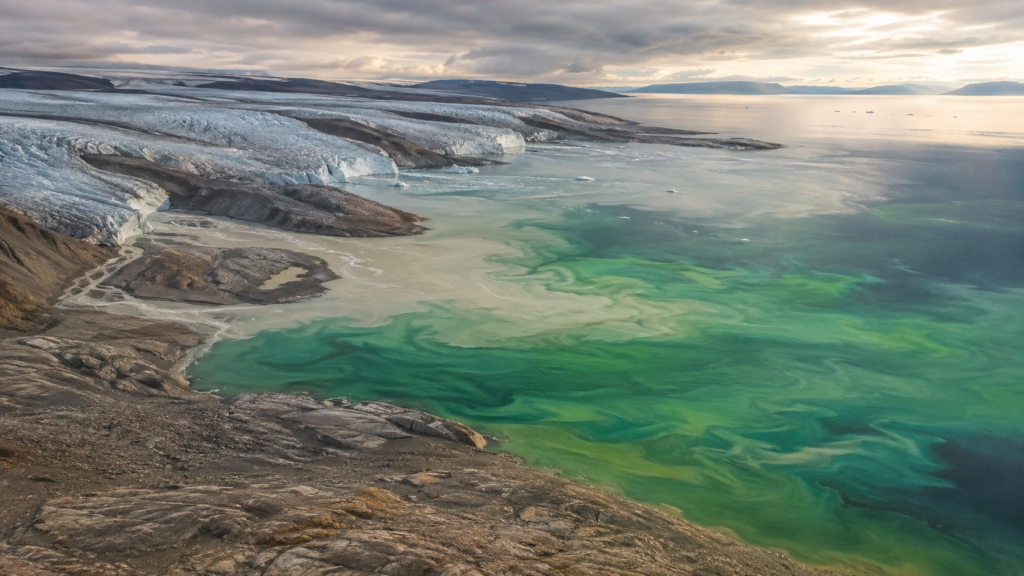
The reason the team proposed was glaciers. Glaciers grind continental rock to powder. When the ice melted, that powder and the nutrients in it, phosphorus above all, flushed into the sea together. The entrenchment of the cyanobacteria that had monopolized the ocean was broken by that flood of nutrients.
And here is where it tells. Algal cells are orders of magnitude larger than cyanobacteria and denser in organic matter. Gathering vast numbers of tiny particles and eating large, substantial ones differ completely in how efficiently energy is received. Energy can climb from eater to eater without losing too much along the way. A large body requires that much more energy every day. Put the other way, unless the quality of the food underpinning it changes, growing large does not pay.
The largest change Snowball Earth brought, then, was not the swing in temperature but the replacement of what was on the ocean’s table. Food capable of sustaining a large body was prepared in the sea for the first time — that is the picture this study draws.
One addendum. The 2017 paper also noted that sponge biomarkers appear in the same interval. In 2020, however, the same group reported that the molecules taken as sponge indicators most likely form from algal sterols altered by geological processes. Evidence for animals in the Cryogenian has, in effect, been withdrawn. The rise of algae stands, but animals appear with confidence somewhat later.
Organisms nobody can name
In 1956, in Charnwood Forest in the English Midlands, fifteen-year-old Tina Negus spotted what looked like a fern frond on a rock surface. When she mentioned it at school, her geography teacher would not take it up: those strata were Precambrian, and fossils could not come from them. The following year, 1957, Roger Mason and other boys climbing rocks at the same spot noticed the same impression, and through Mason’s father it reached Trevor Ford, a geologist at the University of Leicester. Ford published a description in 1958 and named it Charnia masoni.
At the time, the received view for over a century had been that Precambrian strata contained no large fossils. This was the moment it collapsed. Negus’s discovery was publicly acknowledged in 2007, the fiftieth anniversary of the find.
What is now called the Ediacaran biota is broadly divided into three intervals. The Avalon assemblage, about 575 to 560 million years ago, is represented by sites such as Mistaken Point in Newfoundland, Canada, where frond-shaped organisms stood in stands on a deep seafloor beyond the reach of light. Charnia belongs here. The White Sea assemblage, about 560 to 550 million years ago, is preserved in shallow-marine strata in Australia, Russia and China; it is the most diverse, and includes well-known forms such as Dickinsonia and Kimberella. In the Nama assemblage, about 550 to 538 million years ago, diversity declines, but shell-building forms such as Cloudina appear.
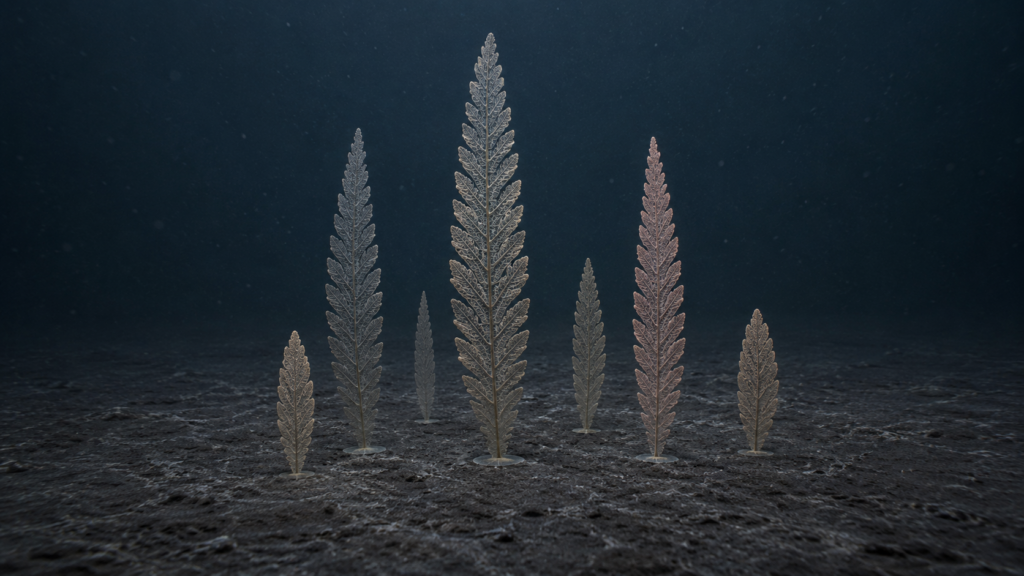
A point of terminology should be settled here. The Ediacaran biota is often introduced as the first large organisms, but fossils visible to the naked eye are known from far older strata. Grypania, a coiled ribbon from beds about 1.87 billion years old, is the emblem. From black shale about 2.1 billion years old in Gabon, Africa, structures up to 12 centimeters across were found in numbers and reported in 2010 as fossils of multicellular organisms. Objections that these are merely patterns produced by microbial mats continue, however, and the matter is unresolved.
“First,” then, cannot be claimed on size alone. Bodies from a few centimeters to over a meter, dozens of differently shaped kinds sharing the same seafloor, functioning as an ecosystem — that combination came together for the first time here. The significance lies in being both large and complex.
The troublesome thing about these organisms is that none of them fits neatly into any group alive today.
Take Dickinsonia: a flat oval body with fine partitions arranged regularly on either side. Its thickness is under a few millimeters, and it survives only as an impression on a sandstone surface. Large ones exceed a meter, with specimens reported up to 1.4 meters. Since it was found in Australia in 1947, every conceivable interpretation has been proposed — jellyfish, polychaete relative, sea anemone, lichen, fungus, giant single-celled organism. Its form settled nothing.
A study published in Science in 2018 came at it from another angle. A 558-million-year-old Dickinsonia collected from cliffs on the White Sea coast of Russia retained a thin organic film on the fossil surface. Extracting and measuring molecules from it, most turned out to be cholesteroids — cholesterol altered within the strata. The surrounding sediment yields mainly algal steroids, while the fossil itself had a clearly different composition. Only animals use cholesterol as a main membrane component, so the conclusion is that Dickinsonia is an animal.
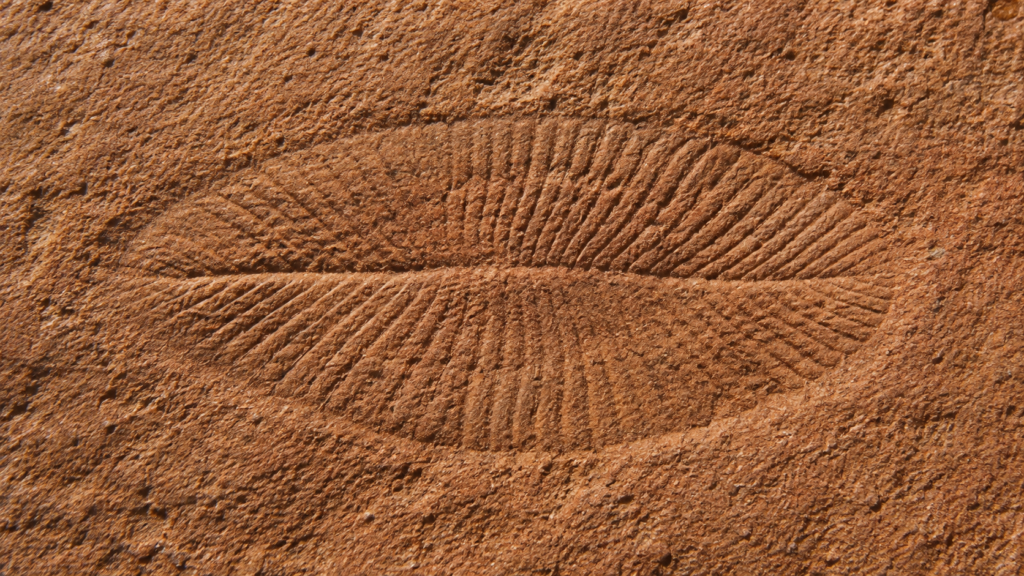
That has not settled it, though. The three-dimensional configuration of the extracted molecules has been noted to differ from that obtained from other fossil animals, and interpretations as a lichen are still being put forward. What form could not determine, molecules might — that is how far things have come.
Three unresolved questions
The first is whether it was really frozen the whole time. In April 2026, a modeling study by Charlotte Minsky of Harvard University and colleagues in PNAS showed that the 56 million years of the Sturtian glaciation may not have been continuous ice but a state oscillating repeatedly between global freezing and intense greenhouse conditions, with weathering of the Franklin Large Igneous Province forcing the climate into that oscillating mode. This view explains both why it lasted so long and how oxygen-using organisms survived. It is, however, a hypothesis presented through a box model coupling climate and the carbon cycle, not something read directly from strata.
The second is not confusing sequence with causation. Ice lifts, algae increase, large organisms appear — the order is indeed that, but coinciding in time and being the cause are different things. And the gaps are substantial. The Marinoan glaciation ended about 635 million years ago; large organisms appear in numbers about 575 million years ago. That is a 60-million-year separation, and what happened in between is not well understood.
The third is oxygen. Moving a large body takes oxygen. Through the middle Proterozoic, atmospheric oxygen is thought to have stayed low and the deep ocean to have remained poorly oxygenated for over a billion years. Multiple indicators show oxygen rose in the Neoproterozoic, but when, by how much, and triggered by what remain matters on which researchers differ. Early in the Ediacaran, about 580 million years ago, there was a cold interval called the Gaskiers glaciation, but it lasted under 340,000 years and is thought not to have reached global freezing. Since the Avalon assemblage appears immediately afterward, some treat it as a trigger and others as coincidence.
A frozen planet, the ocean that followed, and organisms nobody can name. Whether these three connect along a single line is still unknown. Most of the Ediacaran biota disappears at 539 million years ago, and in appearance has almost no point of contact with the Cambrian animals that follow.
Sources
Divisions and boundary dates follow the International Chronostratigraphic Chart of the International Commission on Stratigraphy (ICS): International Chronostratigraphic Chart (ICS)
Linking the length of the Sturtian glaciation to a drop in mid-ocean ridge CO₂ outgassing: Dutkiewicz et al., “Duration of Sturtian ‘Snowball Earth’ glaciation linked to exceptionally low mid-ocean ridge outgassing” (Geology, 2024) / University of Sydney press release: Australian researchers discover what turned Earth into a snowball 700m years ago
Molecular fossils showing the rise of algae between the two glaciations: Brocks et al., “The rise of algae in Cryogenian oceans and the emergence of animals” (Nature, 2017)
Showing that “sponge biomarkers” may be algal in origin, pushing back the oldest evidence for animals: Bobrovskiy et al., “Algal origin of sponge sterane biomarkers negates the oldest evidence for animals in the rock record” (Nature Ecology & Evolution, 2021)
Identifying Dickinsonia as an animal from molecules: Bobrovskiy et al., “Ancient steroids establish the Ediacaran fossil Dickinsonia as one of the earliest animals” (Science, 2018)
Modeling suggesting the Sturtian glaciation oscillated between snowball and hothouse states: Minsky et al., “Repeated snowball–hothouse cycles within the Neoproterozoic Sturtian glaciation” (PNAS, 2026) / free author version: ESS Open Archive
Estimating the Marinoan glaciation at about four million years from Namibian outcrops: “Four-million-year Marinoan snowball shows multiple routes to deglaciation” (PNAS, 2025)
Precisely dating the Gaskiers glaciation and its duration: Pu et al., “Dodging snowballs: Geochronology of the Gaskiers glaciation and the first appearance of the Ediacaran biota” (Geology, 2016)
A review of the Snowball Earth hypothesis as a whole: Hoffman & Schrag, “The snowball Earth hypothesis: testing the limits of global change” (Terra Nova, 2002)
The story of the discovery of Charnia: Discovering Charnia (Charnwood Forest Geopark)
コメント