
The Archean is the second division of Earth’s history, running from about 4.031 billion to about 2.5 billion years ago — roughly 1.53 billion years. Of Earth’s 4.6 billion years, a third falls within it.
The boundary with the preceding eon is set by the age of the oldest rock on Earth, the Acasta Gneiss exposed in northwestern Canada. The figure was ratified by the International Commission on Stratigraphy (ICS) in 2023. Put another way, the Archean is also the beginning of the age for which rock survives on Earth.
Strictly speaking, the Archean is not a period. The Hadean, Archean and Proterozoic are eons, the same rank as the Phanerozoic that gathers the Paleozoic through the Cenozoic. In this series they are placed in the position of periods for consistency of format.
And the rocks of this eon contain what are taken to be traces of life.
An oxygen-free atmosphere and a faint sun
The Archean Earth differed first of all in the contents of its air. There was almost no oxygen. The atmosphere was mainly nitrogen and carbon dioxide, with methane mixed in. A human standing in it would not last minutes.
The ocean differed too. With no oxygen, iron could remain dissolved in seawater as ions. When that iron oxidized and settled for one reason or another, it produced banded iron formations, in which iron-rich and silica-rich layers alternate. Many of the world’s iron mines work strata formed in this eon and the next. The iron we use today is also a record of an ocean without oxygen.
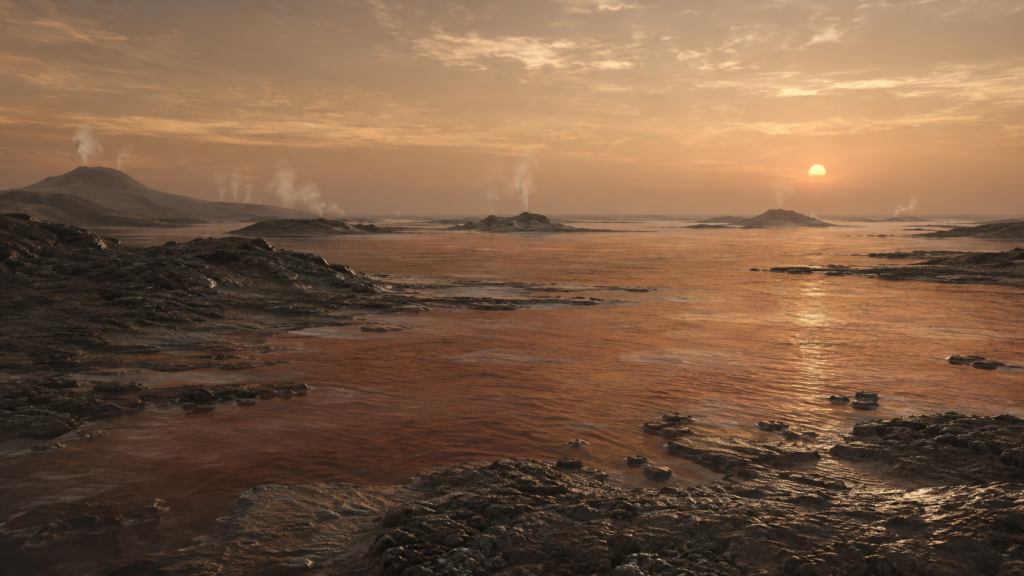
The sun differed as well. Stars brighten as they age, so the Archean sun must have been fainter than today’s. Standard stellar evolution models give solar input to Earth at around 80 percent of the present value during this eon. Had the atmosphere’s greenhouse effect and the surface’s reflectivity matched today’s, that input would have left the whole planet frozen.
Yet traces of Archean glaciers are extremely scarce. What the strata indicate is that the ocean stayed liquid — and possibly warmer than today. Proposals include a strong greenhouse effect from carbon dioxide and methane, or good absorption of sunlight because there was little land and therefore little cloud, but which contributed how much is undecided. The faint young sun paradox, raised by Carl Sagan and colleagues in 1972, remains an open assignment.
The extent of land bears no comparison to today either. The cratons that form the foundations of continents began forming in this eon, but land remained small throughout the Archean, and the Earth is thought to have been nearly ocean-covered. Internal heat was far greater than now, and volcanism correspondingly vigorous.
The oldest traces that draw little argument
The most widely accepted traces of life are in the Pilbara region of Western Australia.
One is the stromatolites in the Dresser Formation, about 3.481 billion years old. Stromatolites are structures built by microbial mats trapping grains of sand and carbonate while stacking layer upon layer upward. Domed or conical bulges appear as fine banding in cross-section. The same things are still being built today, in places such as Shark Bay in Western Australia, which is the strength of this case: modern examples are available for comparison.
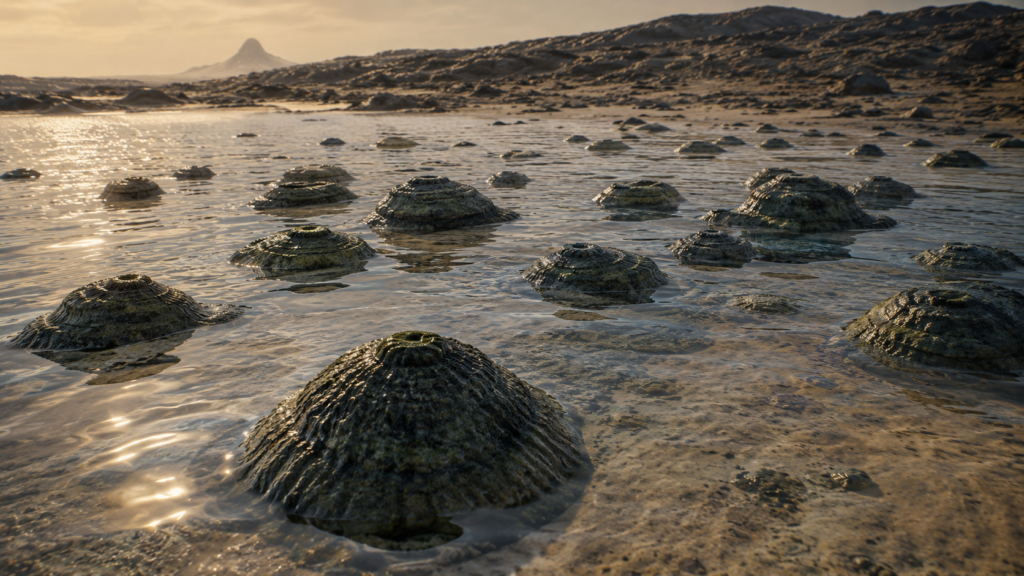
For the Dresser Formation, a team from the University of New South Wales reported in 2017 evidence that the setting was not marine but a hot spring on land. The clincher was precipitates of geyserite, a mineral that forms only from silica-rich water near boiling. The previous record of terrestrial hot springs reached back about 400 million years, so this pushed it back three billion years at a stroke. Then in 2019, organic matter preserved within sulfide was found inside stromatolites from the same formation — a case where the content backs up the form.
The other is the slightly younger Strelley Pool Formation, about 3.43 billion years old. This is the remnant of a carbonate platform (a calcareous rise developed in shallow water) extending several kilometers, with a wide variety of stromatolite forms and good preservation. Even trends in how the forms change with local environment can be read from it.
With these two, that microbes existed by around 3.4 billion years ago is essentially not disputed. The problem begins beyond that.
Two yardsticks for reading life
Reading traces of microbes, which have neither bones nor shells, from rock billions of years old divides broadly into two methods.
One is form. Look for visible structures like stromatolites, or for filamentous and tubular microfossils visible only under a microscope. If the form matches what modern microbes build, the same kind of builder can be inferred.
The other is the weight of carbon. Carbon comes in a slightly heavier form (carbon-13) and a lighter one (carbon-12). When an organism takes in carbon dioxide to build its body, enzymes tend to favor the lighter one slightly, so organic matter of biological origin is depleted in carbon-13. This offset is expressed as a value called δ13C, in units of ‰ (per mil, one part per thousand). Organic matter regarded as biological generally falls on the light side of about −20‰. Even where neither bones nor forms survive, the offset in carbon weight can — and that is the mainstay for an age without fossils.
What matters here is that both methods look for things life can produce. Neither looks for things that only life can produce. That difference weighs more heavily the older the rock.
Where the yardsticks stop working
With rocks older than 3.4 billion years, both yardsticks become hard to use.
Take form first. In 2016, Allen Nutman of the University of Wollongong and colleagues reported in Nature conical structures found in rocks about 3.7 billion years old in the Isua region of Greenland. If these were stromatolites, the discovery would push the record back 200 million years.
In 2018, however, Abigail Allwood of NASA’s Jet Propulsion Laboratory and colleagues cut a somewhat larger sample from the same site and published a paper overturning the conclusion. Stromatolites grow upward toward the sun, so the cones should all point the same way. But some of the Isua structures pointed downward. Allwood and colleagues concluded these were patterns produced by deformation, unrelated to biology. Nutman and colleagues published a rebuttal, and the two views remain divided.
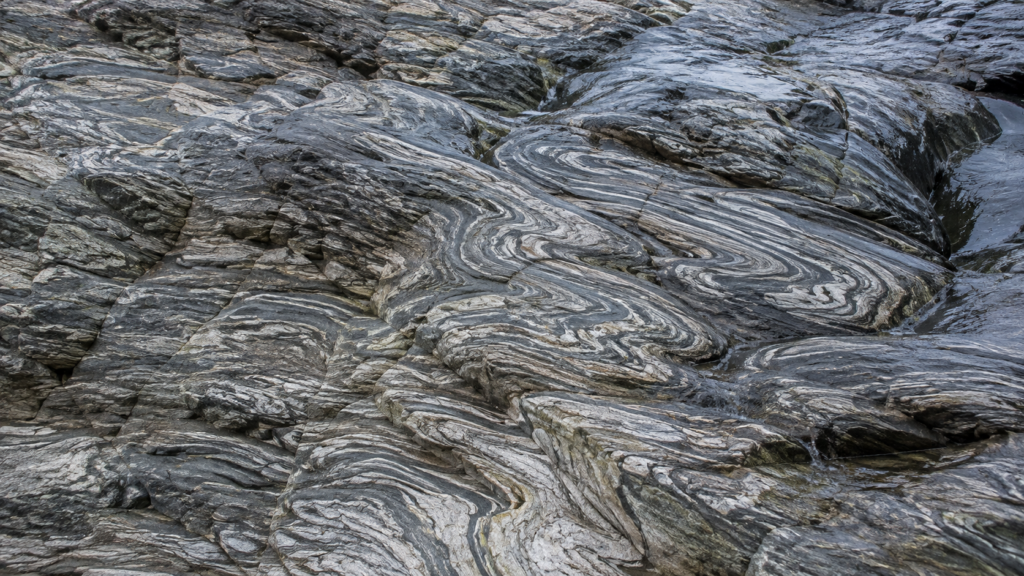
This disagreement did not arise because one side was careless. Old rock has without exception been subjected to heat and pressure, stretched, folded and had its minerals reorganized. Deform layered rock strongly and bands and cones closely resembling microbial products appear. In 1994, Donald Lowe of Stanford University even argued that all stromatolites claimed to be older than 3.2 billion years are inorganic in origin. The tubular structures found at Nuvvuagittuq in Quebec, Canada (reported at over 3.77 billion years, and up to 4.28 billion years) have likewise drawn criticism that inorganic precipitation from strongly alkaline water can produce similar forms.
Carbon weight is not decisive on its own either, because carbon depleted in carbon-13 can be produced by reactions that never pass through an organism. Fischer–Tropsch-type reactions making hydrocarbons from carbon monoxide and hydrogen; processes making haze-like organics from carbon dioxide and methane; the reduction of carbonates — inorganic routes like these can reach as light as about −60‰. So the fact that δ13C is lighter than −20‰ does not by itself prove biological origin. The carbon weights preserved in Archean rocks fall within a range explicable by either life or chemistry.
The argument does not always fall the same way, however. The microfossils from the Apex Chert in the Pilbara, about 3.465 billion years old, were reported in 1993 by William Schopf of UCLA as the oldest cellular fossils, and from 2002 onward faced continuing objections that they were patterns produced by minerals. But in 2018, when Schopf and colleagues re-measured carbon weight region by region at microscopic scale, δ13C differed systematically according to the type of form. If the patterns were inorganic, there is no reason for form and carbon weight to correspond. The measurement has been received as support for biological origin.
So the older the evidence the more valuable it is, and the older it gets the less it can be declared to be life. The oldest Archean traces remain unsettled not because the search has been insufficient. It is because the information left in rock of this age has been worn down to a level explicable by life or by chemistry alike.
A molecular clock pointing older than the rocks
If attacking from the rock side is difficult, one can work backward from organisms alive today.
In 2024, Edmund Moody of the University of Bristol and colleagues published a study in Nature Ecology & Evolution estimating the age of the last universal common ancestor (LUCA) by comparing the genomes of 700 microbial species. The method converts accumulated genetic change into time, calibrated against fossils.
The answer that came out was about 4.2 billion years ago (with an estimated range of roughly 4.1 to 4.3 billion). And LUCA was not a simple entity: the reconstruction gives it a genome of about 2.5 million base pairs carrying roughly 2,600 protein genes, with a metabolism making acetate from carbon dioxide and hydrogen without using oxygen — an organism that would not look out of place beside modern microbes. The team also writes that LUCA was already part of an ecosystem exchanging materials with other organisms.
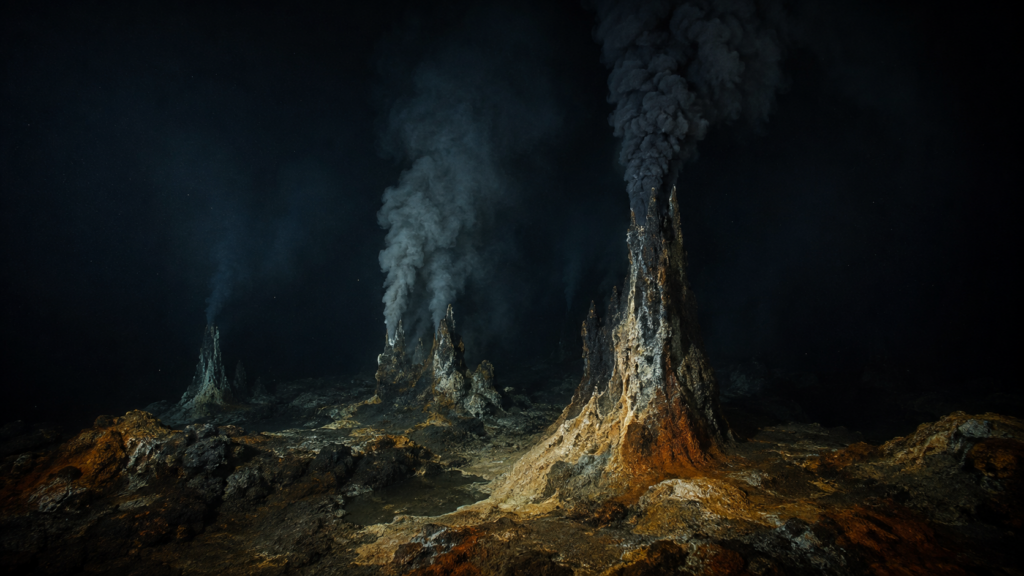
That figure of 4.2 billion years is older than the start of the Archean (4.031 billion years). Older than the oldest rock on Earth. If the estimate is right, the last universal common ancestor lived in an age from which not a single rock survives. There is, in principle, no way to confirm its presence from rock.
This number will of course move. Molecular clocks depend on genome comparisons and calibration, so different genes or assumptions give different dates. An estimate around 3.8 billion years was widely used previously. The 4.2-billion-year figure is one estimate produced by current methods, not a settled date.
An unsettled “oldest”
Summing up what can be said: the Pilbara traces in the 3.4-billion-year range are essentially undisputed. Every candidate older than 3.7 billion years is interpretively divided and unsettled. And the origin of life, worked backward from genes, falls before the rock record begins.
There is no agreed answer among researchers to the question of which is the oldest evidence of life. The candidates people name vary because each weighs different criteria. Whether to prioritize matching form or carbon weight, and how much metamorphism to tolerate. Different criteria, different rankings.
Toward the end of the Archean, microbes performing oxygenic photosynthesis are thought to have appeared. Exactly when remains under discussion, and oxygen only begins accumulating in the atmosphere later still.
The Archean is the eon in which rock finally begins to survive on Earth. That rock also holds traces of life. How long after the beginning of life those traces are, though, nobody yet knows.
Sources
Divisions and boundary dates follow the International Chronostratigraphic Chart of the International Commission on Stratigraphy (ICS): International Chronostratigraphic Chart (ICS)
On evidence for terrestrial hot springs in the Dresser Formation (University of New South Wales): Oldest evidence of life on land found in 3.48 billion-year-old Australian rocks
The reassessment of the Isua structures (Nature, Allwood et al., 2018): Reassessing evidence of life in 3,700-million-year-old rocks of Greenland (may be paywalled)
An accessible account of the same dispute (Quanta Magazine): World’s Oldest Fossils Now Appear to Be Squished Rocks
On the tubular structures at Nuvvuagittuq (Nature, Dodd et al., 2017): Evidence for early life in Earth’s oldest hydrothermal vent precipitates (free to read)
Re-measurement of the Apex Chert microfossils (PNAS, Schopf et al., 2018): SIMS analyses of the oldest known assemblage of microfossils
Estimating the age and genome of LUCA (Nature Ecology & Evolution, Moody et al., 2024): The nature of the last universal common ancestor and its impact on the early Earth system
News coverage of the LUCA study (Science): Our last common ancestor lived 4.2 billion years ago
The faint young sun paradox and an explanation based on albedo (Nature, Rosing et al., 2010): No climate paradox under the faint early Sun (may be paywalled)

コメント