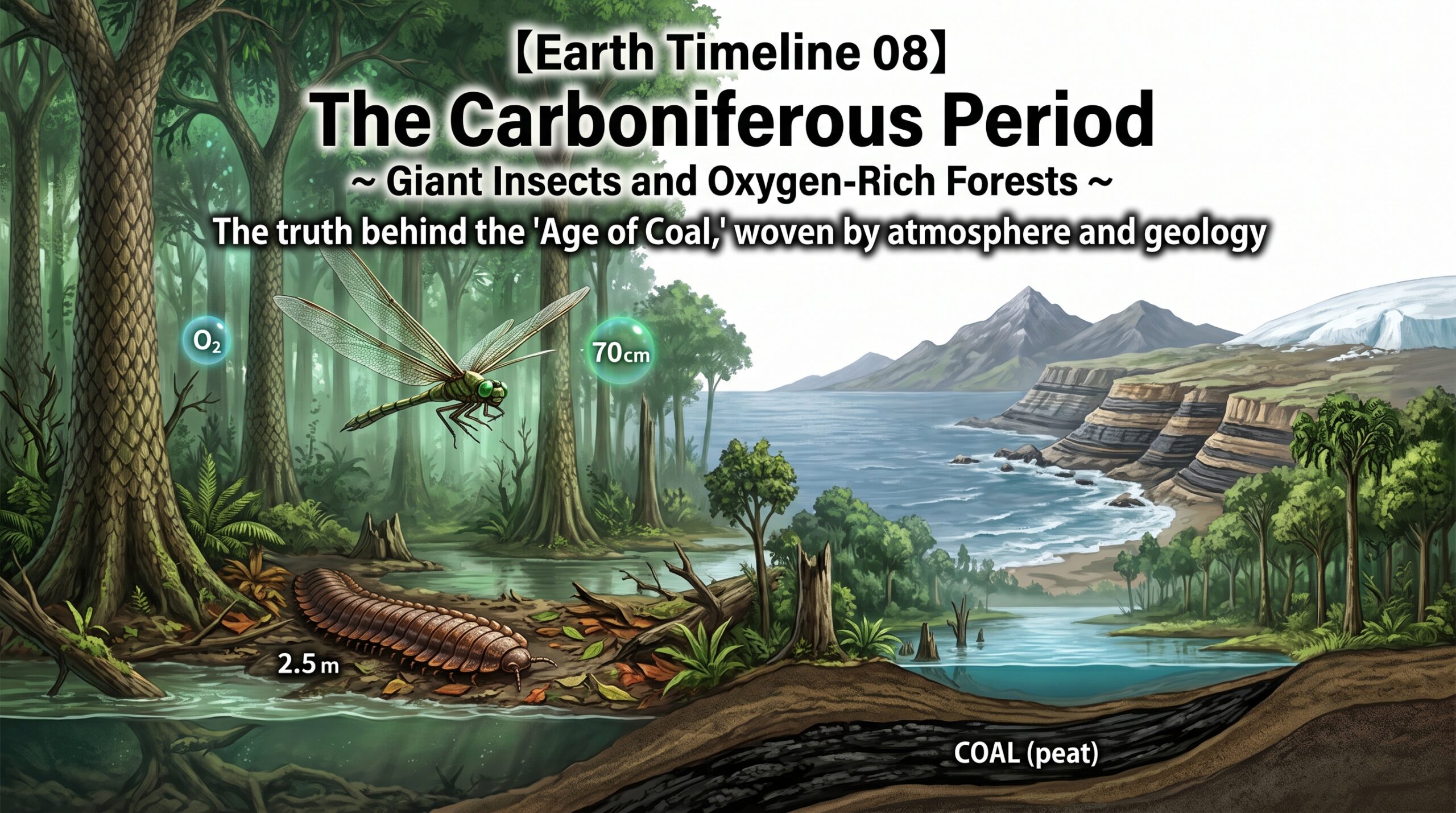
The Carboniferous ran from about 359 million to about 299 million years ago, lasting some 60 million years. It is the fifth of the six periods making up the Paleozoic Era, with the Devonian before it and the Permian after. After this, only one period of the Paleozoic remains.
The name comes straight from coal. In 1822, William Conybeare and William Phillips of Britain applied it to the group of strata containing coal. In North America there is a convention of splitting it into the Mississippian for the first half and the Pennsylvanian for the second, so if you see those two names in a geology book, they refer to the earlier and later Carboniferous.
More than 400 million years have passed since land plants appeared, yet most of the coal humanity digs up comes from this period and the Permian that follows. The mechanism by which coal forms is still operating today, and yet the quantity is extremely skewed toward this one interval. A single 60-million-year block on the timescale carries that skew.
Swamp forests straddling the equator
During this period the continents were gathering into one place. Laurussia to the north and Gondwana to the south approached and collided, pushing up mountains between them on the way to the shape of the supercontinent Pangaea. The lowlands spreading out at the foot of those mountains sat right on the equator: land where it rained year-round and poorly drained swamp went on and on.
The forest growing there had a cast quite unlike today’s. The tallest were the scale trees (Lepidodendron and relatives), 30 meters high with trunks over a meter thick in some cases. They look like trees, but in lineage they are lycopsids — a tree-sized branch of the group that includes today’s quillworts and club mosses. The trunk surface was covered in a scale-like pattern, the scars of fallen leaves. Their internal construction differs considerably from modern trees too, but that comes up later.
Below them grew Sigillaria, the horsetail relative Calamites, large ferns and seed ferns, and in the later part, the conifer-like cordaites. There were no flowers yet. A forest all in green, with damp air held close.

Meanwhile, ice sheets covered Gondwana to the south. This was the Late Paleozoic Ice Age, one of the longer cold intervals in Earth’s history. More ice means lower sea level; less ice, higher. The equatorial swamps were repeatedly drowned and re-exposed, and that history is clearly recorded in the strata. These are the cyclothems: limestone, sandstone, mudstone and coal stacked in that order, repeated dozens of times. In the coalfields of the American Midwest and Britain you can count the bands one by one.
Oxygen-rich air and oversized arthropods
When large quantities of plant matter are buried without decaying, that much oxygen goes unused and remains. The age when coal accumulated was also the age when atmospheric oxygen rose.
How far it rose depends on the model. The long-quoted figure is a maximum of 35 percent, based on calculations working back to oxygen from sulfur and carbon budgets. A revised version published in 2023 by Benjamin Mills of the University of Leeds and colleagues, reconciling several methods, gives over 25 percent for the Carboniferous through the Permian. The range is wide, but every estimate agrees on two things: it was higher than today’s 21 percent, and this was the maximum across the whole Phanerozoic — the 500-odd million years in which life can be tracked through fossils.
Flying through that air was Meganeura, a relative of dragonflies with a wingspan of about 70 centimeters. The largest dragonfly today is just under 20 centimeters, an order of magnitude apart. On the ground was Arthropleura, reaching 2.5 meters in length — a millipede relative and the largest land arthropod known.

Our understanding of what Arthropleura looked like advanced considerably in October 2024. Mickaël Lhéritier of the University of Lyon 1 and colleagues published a description of the head in Science Advances. The material was two juveniles sealed inside iron-rich concretions from strata about 305 million years old at Montceau-les-Mines in France. Imaging the interiors with micro-CT and synchrotron radiation, without splitting the rock, brought out the head that had eluded searchers for 170 years.
What it showed was an odd combination: seven-segmented antennae like a millipede’s, mandibles like a centipede’s, and eyes on stalks like a crab’s. From the body plan, it is thought to have eaten leaf litter and fallen wood rather than hunting prey. The stalked eyes have been suggested to be a holdover from an aquatic juvenile stage, but that remains unexplained.
Why could they grow this large? Insects deliver air deep into the body through tracheae rather than lungs, so richer oxygen makes larger bodies easier — that explanation is well known. But it does not close the matter. In 2012, Matthew Clapham and Jered Karr of the University of California, Santa Cruz, assembled more than 10,500 fossil wing-length measurements and set them against estimated oxygen concentrations. Maximum size tracks oxygen closely from the Carboniferous to the end of the Jurassic; in the Cretaceous, size falls even as oxygen rises. Since the timing coincides with the appearance of birds, the two authors write that once flying predators existed, agility may have mattered more than size. It is an argument built from correlation, but it shows that oxygen alone does not close the explanation.
An egg that left the water’s edge
Another change on land in this period concerned the construction of the egg.
Amphibian eggs can only be laid in water: they have no shell, and drying ends them. But somewhere in the Carboniferous, an egg appeared with membranes and fluid surrounding the embryo. Called the amniotic egg, it is in effect a portable pond. The lineage that acquired it — the amniotes — no longer had to return to water to breed. Reptiles, birds and mammals all come from this lineage.
The oldest evidence for it was long taken to be Hylonomus, found at Joggins in Nova Scotia, Canada: a lizard-like animal about 20 centimeters long, some 318 million years old. The place the fossils come from is unusual — inside the hollow, tube-like stumps of Lepidodendron that had fallen and rotted out inside. The animals are thought to have gone in chasing insects and been unable to get out again.

That date shifted substantially in May 2025. John Long of Flinders University in Australia and colleagues reported in Nature on a sandstone slab about 35 centimeters across, found on the bank of the Broken River near Mansfield in Victoria, Australia. Two local amateurs found it; alongside raindrop impressions, its surface carried a series of five-toed footprints.
The clincher was the claws. Scratch marks at the toe tips were clearly preserved, and such claws are almost exclusive to amniotes. The strata date to the very beginning of the Carboniferous, about 355 million years ago — 35 to 40 million years older than Hylonomus. The same paper also reported footprints about 330 million years old from Silesia, Poland.
Push the origin of amniotes back this far and the divergences before it go older still, into the Devonian. The interval between fish coming ashore and eggs leaving the water was far shorter than previously thought. Only tracks have been found, with no bones, so this awaits further testing.
The explanation that it survived because it did not rot
Back to the coal.
Why is coal concentrated in this period? The explanation long and widely accepted ran like this. Carboniferous trees contained large amounts of lignin, a tough substance that stiffens cell walls and is hard to break down. And the white rot fungi that can break it down had not yet evolved. So fallen trees piled up without rotting, were buried, and became coal. In the Permian the fungi finally caught up, and the age of coal ended.
It is coherent, and it makes a good story: carbon accumulating conveniently for the planet during the window before the decomposers caught up.
What appeared to confirm it was a 2012 study. David Hibbett of Clark University and colleagues compared the genomes of 31 fungal species and used a molecular clock to estimate when the enzymes involved in lignin degradation (class II peroxidases) arose. The answer was about 290 million years ago — the end of the Carboniferous into the early Permian — coinciding neatly with when coal begins to decline. After that result, the explanation came to be treated as near-settled and is often presented in textbooks and science programs.
Facts that do not fit the explanation
Then in 2016, Matthew Nelsen and Kevin Boyce of Stanford University, William DiMichele of the Smithsonian National Museum of Natural History, and Shanan Peters of the University of Wisconsin–Madison published a paper in PNAS rejecting the idea. The title says it outright: delayed fungal evolution did not cause the Paleozoic peak in coal production.
The most telling point concerns the tissue the coal came from. Coal starts as peat, and the peat was made mainly by lycopsids. Those plants have very little tissue corresponding to wood. Most of their volume is taken up by the thick periderm on the outside of the trunk — the part corresponding to bark in modern trees — which in some layers accounts for 80 percent of the organic matter entering the peat. And analyses examining cell walls one by one using synchrotron radiation found this periderm was not lignified, and most likely made of a cork-like, suberin-type material.
In other words, the lignin first suspected as the main component of coal was a supporting player in the peat of this period. Not only that: within the same fossils, what survives undecayed is the lignin-free periderm, while the lignin-bearing wood has broken down first — the reverse of the order the standard story predicts.

If a tug-of-war between fungi and lignin determined how much coal formed, then a change in the forest cast should change the rate of accumulation. And the cast did change: in the later Carboniferous there was an interval when the lignin-rich cordaites gained ground, and later still the lycopsids nearly disappeared and tree-fern-like plants took the lead. The chemistry of the incoming organic matter shifted substantially each time. Yet as far as North American data show, the rate of coal accumulation stays roughly the same across every one of those turnovers.
Nor were fungi absent. Carboniferous strata yield diverse fungal fossils, and Late Devonian wood already preserves decay traces that look like white rot. Examining coal balls — Carboniferous peat turned to stone in bulk — the amount of above-ground material relative to roots is abnormally low: evidence that branches, leaves and trunks were being decomposed away in quantity.
And the numbers do not work. Even assuming terrestrial productivity at the time was a quarter of today’s and that 20 percent of it was lignin, that gives some three billion tons of lignin produced per year. Had that gone on being buried undecayed for 100 million years, atmospheric carbon dioxide would have vanished in under a million years. No trace of that exists. In Chinese strata, coal keeps accumulating in quantity into the late Permian, long after the fungi supposedly caught up.
A wet equator and a basin that kept sinking
So what made the coal?
Accumulating organic matter requires two simple things: production exceeding decomposition, and submersion so that oxygen cannot reach. The first is maximized in the warm, rainy tropics; the second holds in swamps with a high water table. The Carboniferous equator satisfied both at once.
That alone does not make coal, though. For peat to stay where it is, the ground itself has to keep sinking. Without subsidence, it is eventually eroded and carried away.
This is where the assembly of Pangaea came in. Continental collisions push up mountains, but they also flex the crust in front of them under the load, creating broad, shallow basins. Called foreland basins, they often subside at a rate close to the rate peat accumulates, making them good places for thick coal seams. In the Carboniferous, these basins happened to line up along the humid equatorial belt. Sea-level swings driven by the waxing and waning ice sheets repeatedly laid a lid over the peat.

Coal from a much later period supports this view. In the Paleogene, when the Rocky Mountains rose in western North America, the same kind of basin formed in front of them. The rate of coal accumulation there is essentially the same as in the Carboniferous — 200 million years after white rot fungi unquestionably existed. If the presence or absence of fungi set the amount of coal, this should not be the case.
What made the coal was not the absence of decomposers but a wet equator and a continuously subsiding basin arriving in the same place. And that combination came together on a global scale exactly once in the past 400 million years: when Pangaea assembled. The coal that gave the Carboniferous its name formed where the arrangement of continents and a climatic belt happened to overlap, not because of anything about the organisms.
When the forests broke up
That overlap failed once within the Carboniferous itself.
About 305 million years ago, the waxing and waning of the Gondwanan ice sheets intensified, and long intervals of drying began in the equatorial tropics. The perpetually wet lowland forests fragmented rapidly, surviving only where water remained. The event is called the Carboniferous rainforest collapse.
It hit land animals. As Sarda Sahney and Michael Benton of the University of Bristol and Howard Falcon-Lang of Royal Holloway, University of London reported in Geology in 2010, tetrapod extinction rates peaked at this time, and the number of families found per locality fell from 20 to 7. And faunas that had been similar across regions began differentiating into distinct local assemblages — the mark of forests broken into islands, with movement between them cut off.
The hardest hit were amphibians, which must return to water to breed. Conversely, amniotes, able to lay eggs in dry places, gained relative advantage. The starting point of the process by which reptiles and synapsids (the lineage leading to mammals) came to occupy Permian land lies in this fragmentation of the forests. The invention of the amniotic egg only really told long after it arose, once the environment turned dry.
What remains unsettled
It has not been proven that fungi were irrelevant.
In 2016, the same year as Nelsen and colleagues’ paper, Hibbett and colleagues published a rebuttal in Current Biology. Their argument: the molecular clock estimates are not inconsistent with white rot fungi spreading around the Permian, and judging from modern ecosystems it is natural to think the appearance of fungi able to break down lignin efficiently affected the rate at which organic carbon was buried. Even if topography and climate were the leads, a supporting role remains possible.
The poor preservation of fungal fossils complicates matters further. It has become clear in recent years that standard specimen preparation tends to destroy traces of fungi, and the decay marks visible in Devonian wood do not preserve the features needed to attribute them to basidiomycetes. Molecular clock estimates carry range too, leaving room to push the acquisition of lignin degradation back into the Devonian.
What is clear is only this much: a single explanation resting on the absence of decomposers is not enough. Carboniferous coal looks less like the product of a gap when evolution happened not to have caught up, and more like material that accumulated where equatorial rain and continuously sinking ground overlapped. That is where the reading stands for now.
Sources
Boundary dates in this article follow the International Chronostratigraphic Chart of the International Commission on Stratigraphy (ICS). stratigraphy.org
Nelsen et al., “Delayed fungal evolution did not cause the Paleozoic peak in coal production”, PNAS (2016) (full text PDF)
Hibbett et al., “Climate, decay, and the death of the coal forests”, Current Biology (2016)
Scientific American (coverage of the 2012 fungal genome study)
Long et al., “Earliest amniote tracks recalibrate the timeline of tetrapod evolution”, Nature (2025)
Flinders University press release (the Mansfield tracks)
UC Santa Cruz press release (insect body size, oxygen and predators)
コメント