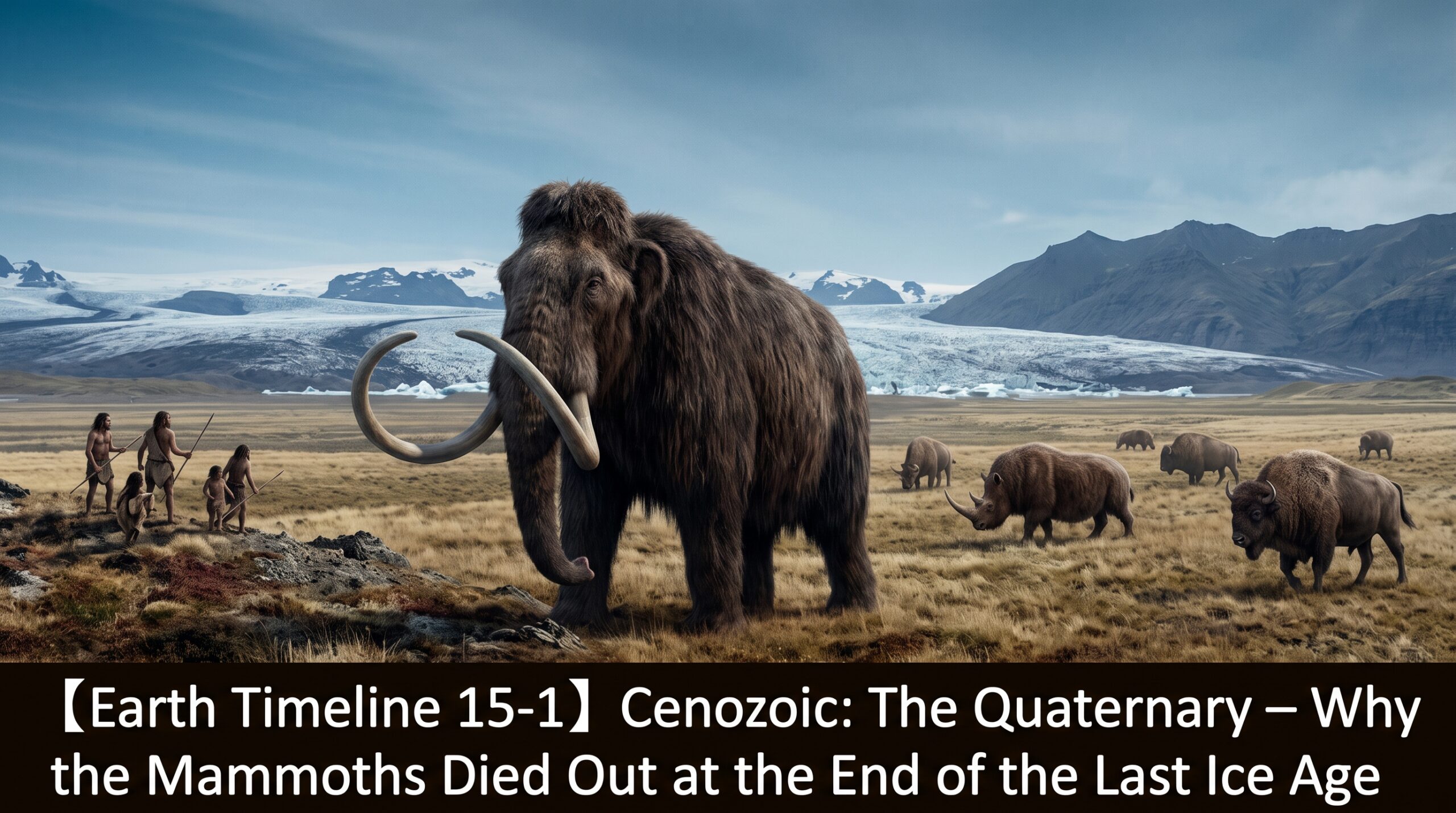
The Quaternary Period spans from about 2.58 million years ago to the present day. It is the third period of the Cenozoic Era and the very last on the geological timescale — which means that right now, as you read this, you are living in the middle of it. It is an age of ice, with dozens of cold glacial phases alternating with warm interglacials. But the ice is not the main character. That role belongs to the enormous animals that walked through that frozen world without appearing to mind it at all.
I’ve split the Quaternary into two articles. This one covers the animals of the ice ages; the other follows the human story.
The mammoth steppe — the largest pasture Earth has ever had
At the height of a glacial phase — say, about 20,000 years ago — the northern half of North America and the north of Europe lay beneath ice sheets kilometers thick. But south of that ice was not a frozen wasteland. A vast grassland stretched from Europe through Siberia all the way to Alaska, running clean across Eurasia. Dry and cold, yet remarkably productive in grass, it was an ecosystem with no modern equivalent anywhere on Earth. It is called the mammoth steppe.
As the name suggests, the animal on the signboard was the woolly mammoth. About three meters at the shoulder, it endured the cold with long hair and thick fat, sweeping snow aside with its great curved tusks to reach the grass beneath, and moved across the steppe in herds. Around it lived the woolly rhinoceros, a shaggy rhino built for the cold; the giant deer, whose antlers spanned more than three meters; steppe bison, wild horses, and reindeer traveling in great numbers. And stalking those herds was the cave lion, larger than any lion alive today. The northern lands of the ice ages were as crowded with large animals as the African savanna is now.

Japan was no exception. Naumann’s elephant walked the glacial-age archipelago, and Yabe’s giant deer grazed alongside it. At Lake Nojiri in Nagano Prefecture, their fossils have been excavated in quantity together with stone tools — a record of people in ice-age Japan facing down elephants.
The stranger giants of the Americas
Turn to the Americas and the cast becomes still more distinctive. In North America, Smilodon — the sabertooth cat, with canines as long as knives — pinned its prey with heavily muscled forelimbs. There was also the mastodon, a mammoth relative that browsed on leaves in the forests.
South America was odder still. Megatherium, a giant ground sloth, ran six meters long and weighed several tons. Reared up on its hind legs it stood over three meters tall, hooking branches down with long claws to strip the leaves. Beside it lumbered Glyptodon, a relative of the armadillo carrying a domed shell about the size of a small car. South America had been an isolated continent for a very long time, and it held evolutionary results found nowhere else.

Dozens of ice ages, and they shrugged them off
The point worth holding onto is that these giants — collectively, the megafauna — were extremely good at surviving the upheavals of the ice ages.
Quaternary glacials and interglacials have traded places on cycles of tens of thousands to a hundred thousand years, triggered by slow changes in Earth’s orbit and axial tilt, the Milankovitch cycles. Ice sheets grew and melted, sea level rose and fell by more than a hundred meters, and grassland and forest swapped places. This wholesale rebuilding happened dozens of times over 2.58 million years. Part of that record is written into strata in Chiba Prefecture, incidentally: in 2020 the interval from about 774,000 to about 129,000 years ago was given a Japanese place name, the Chibanian.
The animals rode out these swings by shifting where they lived. South when it turned cold, north when it warmed. Cold-adapted species and warm-adapted species traded places, and the cast as a whole persisted stubbornly. In fact, as far as the fossil record shows, no past transition from glacial to interglacial left a trace of large animals going extinct en masse. Mammoths and woolly rhinos lived through warm interglacials again and again, and each time recovered their numbers in the glacial that followed.
Only the last one took the giants away
And yet. Around the end of the most recent glacial period, roughly 10,000 years ago, the giants that had weathered dozens of such swings began disappearing across the world, one after another.
The scale was extraordinary. Over roughly the past 120,000 years, an estimated half of all large mammal species weighing more than 45 kilograms vanished from the planet. North America lost about 70 percent of its large mammal genera; South America more than 80 percent. Mammoths, woolly rhinos, giant deer, Smilodon, Megatherium, Glyptodon, Naumann’s elephant — nearly every animal in this article exits here. For tens of millions of years a world packed with enormous animals had simply been what Earth looked like, and in geological terms that normal state ended in an instant.
It is tempting to blame the climate shift at the end of the last glacial, but that runs into the wall described above: they had come through comparable warmings dozens of times without trouble. Why was only the last one fatal? Stranger still, the extinctions were not simultaneous worldwide. Australia lost its giants more than 40,000 years ago; the Americas around 10,000 years ago — tens of thousands of years apart, continent by continent. Climate changes in step across the whole planet, yet the extinctions arrive piecemeal. And that staggering lines up, uncomfortably closely, with when Homo sapiens reached each continent.
For this reason, recent research increasingly points to human impact — hunting above all — as the principal cause. Other researchers weigh climate more heavily, arguing that the last warming differed in character from earlier ones, and a debate now two centuries old remains unsettled. In practice it was probably a combination: populations shaken by climate change, with humans added on top. But how much each factor contributed is still one of the great arguments of the Quaternary.

The last mammoths died without ever hearing of the pyramids
The extinction was not a single curtain fall. After vanishing from the mainland, mammoths hung on in small numbers on remote islands such as Wrangel Island in the Arctic Ocean, and the last herd died out only about 4,000 years ago. While the pyramids were being built in Egypt, mammoths were still walking in one corner of the planet.
Even so, the end was the end. The giants took the mammoth steppe with them; that ecosystem disappeared from the Earth and has never returned. The grasslands and forests we think of as nature in its untouched state are in fact an emptied stage, set after the leads had walked off. In the long history of the planet, eras with this few large animals are rare. Why the true stars of the ice ages disappeared is a question still being chased, through bones and through strata.

Sources
Boundary dates follow the International Chronostratigraphic Chart of the International Commission on Stratigraphy (ICS). On the late Quaternary megafauna extinctions, this article draws on a review published by the Cambridge Philosophical Society (Svenning et al., 2024), a global analysis in Proceedings of the Royal Society B (Sandom et al., 2014), and the review by Koch & Barnosky (2006).


コメント