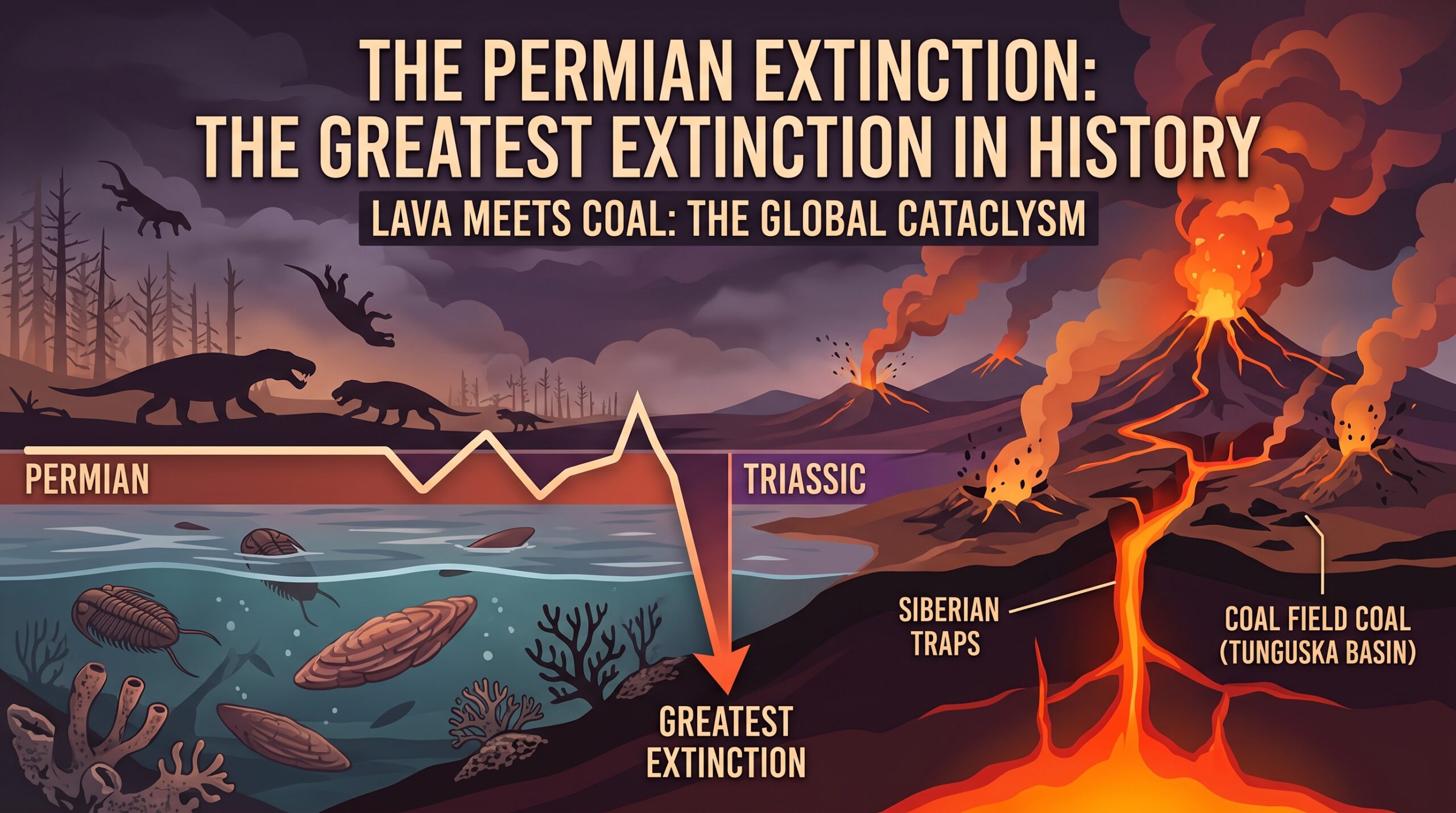
At the end of the Permian, life on Earth took the heaviest blow of the Phanerozoic. The Paleozoic Era closes here, and the Mesozoic begins with the following Triassic. Among the great extinctions known as the Big Five, this one stands apart in both scale and in how long its aftermath lasted.
The reference section for the boundary is at Meishan in Zhejiang Province, China. The International Commission on Stratigraphy designated it the Global Boundary Stratotype Section and Point (GSSP) and places the boundary at 251.902 million years ago, with an uncertainty of 24,000 years.
What vanished from the sea and the land
Start with the roll call of the departed.
Trilobites. A group that had appeared in the Cambrian and survived extinction after extinction for some 290 million years — they end here. Fusulinids were wiped out entirely: large foraminifera shaped like grains of rice, sometimes packed densely through limestone, and among the signature fossils of the later Paleozoic.
Corals were replaced as well. The rugose and tabulate corals that built Paleozoic reefs both end at this point. The scleractinian corals in today’s oceans emerged afresh from a different lineage in the Triassic, after the extinction. Crinoids and brachiopods (a separate group that looks superficially like bivalves) also largely disappeared. So did the eurypterids.

Land did not escape either. The therapsids, which had held the large-animal roles until then, mostly disappeared, and the gorgonopsians with their saber-like canines died out completely. Forests were lost over wide areas. And this is, as far as is known, the only mass extinction in which insects declined at the level of major groups. Insects are usually resistant to extinction; this one time they were not.
The record of the open ocean at that time survives even in the mountains of Japan. Accretionary complexes in Gifu and Ōita Prefectures, among others, contain bedded chert deposited in the deep Panthalassa. That rock formed from the accumulated shells of radiolarians, tiny plankton — and at the end of the Permian the chert breaks off and gives way to black carbonaceous mudstone. It is one line of evidence for the “superanoxia” reported in Science in 1997 by Yukio Isozaki of the University of Tokyo, indicating that the deep ocean of the time fell into a prolonged oxygen-poor state. Interpretation of this horizon, however — whether radiolarians declined or terrigenous input increased — has remained under discussion in subsequent work.

Revisiting the ninety percent figure
Accounts of this extinction often cite figures like “over 90 percent of marine species disappeared” or “96 percent went extinct.” Those numbers have a source, and they have been revised.
The value of 96 percent comes from an estimate published by David Raup in 1979. It was derived by working backward statistically from family- and order-level records to species-level loss (the rarefaction method), a reasonable calculation for its time. But there was a problem: it lumped the Middle Permian and Late Permian extinctions together.
The Permian extinction was not a single event. A substantial extinction also occurred at the end of the Middle Permian, around 262 to 259 million years ago. Known as the Capitanian extinction, it has been linked to the Emeishan flood basalts erupted in southwestern China. Add the two together and the figure naturally inflates.
In 2016, Steven Stanley of the University of Hawaii recalculated after estimating and subtracting the extinction that occurs sporadically in normal times (background extinction) and correcting for the fact that extinction falls unevenly on particular groups. The result was about 81 percent, and 56 to 69 percent at the genus level. Saying that life nearly vanished was an overstatement, was his conclusion. Ninety orders and more than 220 families of marine animals survived.
Even so, 81 percent remains the largest value of the entire Phanerozoic. A smaller number does not demote this extinction.
What happened in sixty thousand years
How fast the extinction proceeded is decisive for narrowing down the cause. Something that unfolds over five million years and something that unfolds over 50,000 have entirely different lists of suspects.
In 2014, Seth Burgess, then at MIT, and colleagues dated zircons from five volcanic ash beds interbedded in the Meishan section by the uranium–lead method and reported the results in PNAS. The extinction ran from 251.941 to 251.880 million years ago: a span of 60,000 years, with an uncertainty of 48,000. On the geological scale that is very nearly instantaneous.
The same study also showed that from about 10,000 years before the extinction began, the carbon isotope ratio in carbonates turned sharply lighter. Large amounts of light carbon had entered the ocean. Carbon of biological origin is skewed toward the light isotope, so this suggests organic carbon was released into the atmosphere and ocean over a short interval.
On land, though, events appear to have been drawn out somewhat longer. A study reported in Current Biology in 2023 found that a large gorgonopsian from the Karoo Basin of South Africa turned out to be Inostrancevia, previously known only from Russia. After the local large predators went extinct before the boundary, this animal arrived from some 11,300 kilometers away, as if filling the vacancy. The team reports that the role of apex predator on land changed hands four times within less than two million years spanning the boundary. The top of the ecosystem was that unsettled.
Not the lava, but what lay beneath it
The cause long favored is the Siberian Traps: volcanism of extraordinary scale in central Russia at the end of the Permian. Basalt stacked into plateaus still covers an enormous area.

There is an awkward point here, however. Volcanism on this scale — called a large igneous province — has occurred repeatedly through Earth’s history, and not all of it caused mass extinction. Moreover, activity in the Siberian Traps continued for millions of years, while the extinction was over in 60,000. The timescales do not match. Lava flowing on and on cannot account for that speed.
In 2017, Seth Burgess of the U.S. Geological Survey, James Muirhead of Syracuse University and Samuel Bowring of MIT answered this discrepancy in Nature Communications. What they focused on was not the volume of eruption but the moment the style of magma emplacement changed.
Siberian Traps activity had a distinct switchover. In the first phase, flood basalts poured out onto the surface. In the second, magma no longer reached the surface and instead intruded laterally between underground sedimentary rocks, solidifying as sills. The onset of the extinction coincides with that switchover — not with the period when lava was flowing, but with the period when magma began burrowing into the ground.
Why is that more dangerous? What mattered was what lay where the magma burrowed.

Beneath the Siberian Traps lies the Tunguska Basin coal field, covering roughly 1.2 million square kilometers. It is one of the world’s largest coal deposits, with layers containing rock salt and petroleum stacked in as well — a vast savings account of carbon that living things had stored underground from the Carboniferous through the Permian.
Into that, magma at over 1,000 degrees intruded as sheets. Coal, salt and oil were baked at the contacts, broken down by heat, and turned to gas: carbon dioxide, methane, and halogen compounds containing chlorine and bromine. Gas with nowhere to go blasted to the surface, opening explosive vents (diatremes) in many places. An estimate published in 2018 attributes 77 percent of the carbon dioxide released at this time not to the magma itself but to organic carbon in the baked sediments.
What caused the largest extinction in history, in other words, was not the volume of lava but the ground that lava happened to pass through. With an eruption of the same size, had ordinary igneous rock lain beneath instead of coal, it might never have come to this. Burgess and colleagues close their paper by noting that sill-dominated large igneous provinces are more likely to trigger global catastrophe than those dominated by lava flows and dikes. The bad luck of location decided the fate of life.
Five million years of heat
This view connects not only to the extinction itself but to what came after.
Even when carbon dioxide is released in bulk, the Earth has mechanisms for clearing it: chemical weathering of rock, and burial of organic carbon in strata. Normally, concentrations and temperatures should return to previous levels within about 100,000 years.
In fact, extreme heat persisted for roughly five million years through the Early Triassic. The eruptions had long since ended, yet temperatures would not come down. The reason for that persistence was long a puzzle.
In July 2025, a team centered on the University of Leeds in the UK and the China University of Geosciences (Wuhan) offered an answer in Nature Communications. Combining fossil data accumulated by several generations of geologists across China with climate indicators preserved in the rocks, they redrew maps of plant productivity for successive intervals. The result: the loss of tropical forests was what did it.
When forests go, less carbon is drawn down by photosynthesis. On top of that, the work tree roots do in breaking up rock and assisting weathering is lost too, so the rate at which rock absorbs carbon dioxide falls as well. With both carbon-removing mechanisms weakened at once, and vegetation failing to recover, the team concludes, the super-greenhouse state was prolonged. There was a threshold in the climate–carbon system beyond which it could not return on its own.

That said, the whole planet did not die. A study reported in Science Advances in 2025 found a continuous record of diverse plant fossils across the boundary in strata at Nantaidonggou in Xinjiang, China. Refugia where conifers and seed ferns survived did exist. And in that region, an ecosystem including tetrapods was up and running roughly 75,000 years after the extinction.
Much remains unknown. Estimates of gas release carry wide ranges, and the dating of Siberian Traps activity is not as precise as that of the extinction itself. Ocean anoxia, rising water temperature, ocean acidification, destruction of the ozone layer — several killing mechanisms have been proposed, and which acted on which organisms, and how strongly, is still being sorted out. Work also continues on what separated the survivors from the lost.
One thing is certain: the cast of the oceans was replaced wholesale at this boundary. The shells picked up on a beach today, the corals seen in the sea — all are residents of the world that begins here.
Sources
Burgess, Bowring & Shen, “High-precision timeline for Earth’s most severe extinction”, PNAS (2014) (full text, free)
Stanley, “Estimates of the magnitudes of major marine mass extinctions in earth history”, PNAS (2016) (full text, free)
Xu et al., “Early Triassic super-greenhouse climate driven by vegetation collapse”, Nature Communications (2025) (University of Leeds press release)
Kammerer et al., “Rapid turnover of top predators in African terrestrial faunas around the Permian-Triassic mass extinction”, Current Biology (2023) (Field Museum press release)
コメント