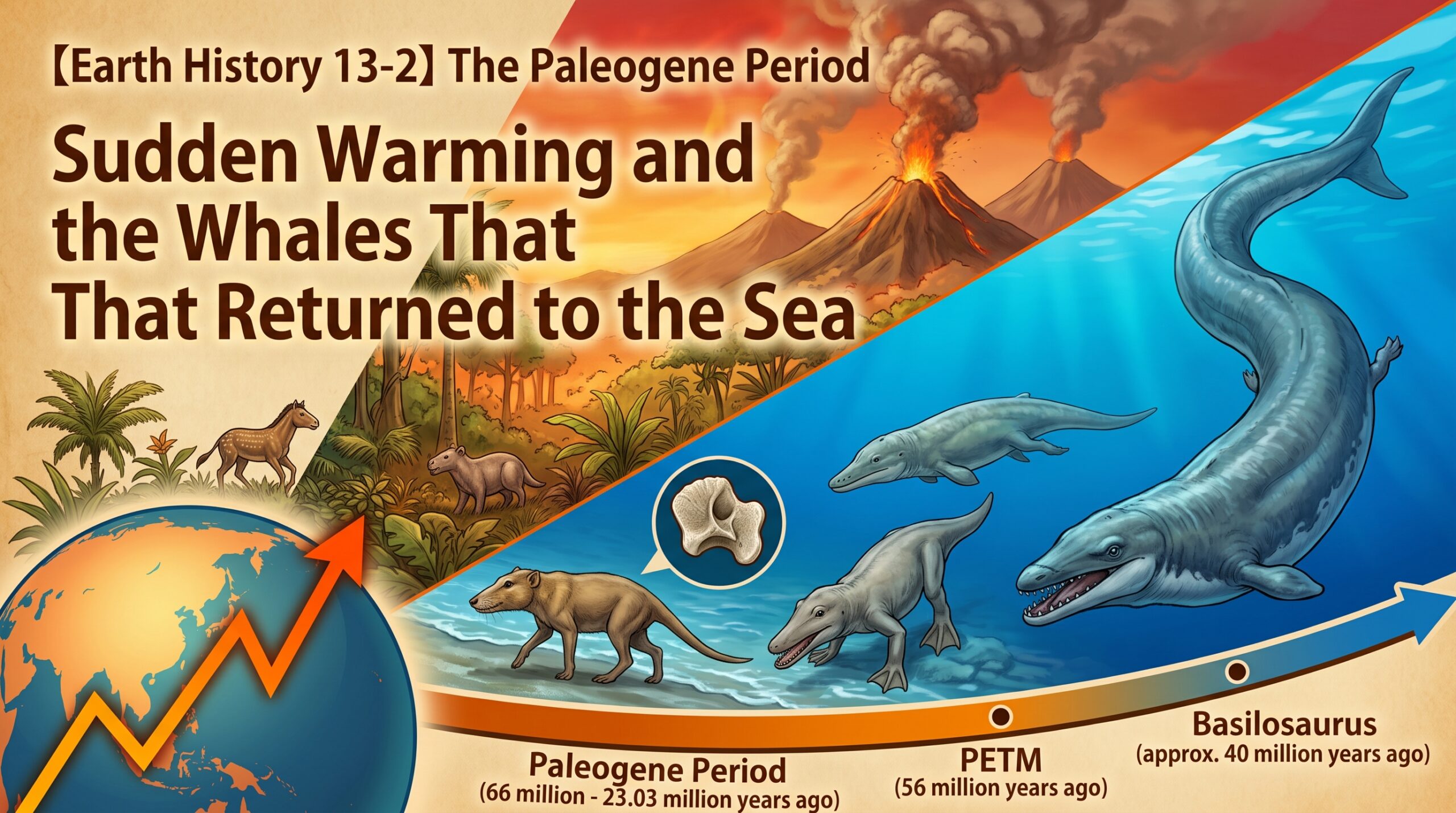
The Paleogene is the first period of the Cenozoic Era, running from 66 million to about 23.03 million years ago. It divides, from oldest to youngest, into three epochs: the Paleocene, the Eocene and the Oligocene.
This article follows two events from around the middle of it. One is an abrupt warming that struck the Earth 56 million years ago, among the sharpest recorded anywhere in the geological record. The other is the boldest relocation in mammal history, which unfolded in that hothouse world — the story of how the ancestors of whales abandoned the land and went back to the sea.
A sudden fever 56 million years ago
At the Paleocene–Eocene boundary, 56 million years ago, an enormous quantity of carbon poured into the atmosphere and ocean. The release took place over a few thousand years — an instant on the geological clock — and is estimated at roughly 3,000 to 4,500 gigatons of carbon. Global mean temperature rose by 5 to 8 degrees, and the hot conditions lasted more than a hundred thousand years. The event is called the Paleocene–Eocene Thermal Maximum, or PETM.
In the ocean, seawater absorbing that carbon turned acidic, and on the deep seafloor calcium carbonate shells and sediments dissolved. Among the foraminifera, small organisms living on the bottom, 30 to 50 percent of species vanished. On land, by contrast, the damage fell short of a mass extinction; instead, the distributions and the bodies of animals were thoroughly stirred up. Where the carbon came from is still unsettled — volcanic activity in the North Atlantic and seafloor methane hydrates are among the candidates.

The first horse, shrunk by the heat
Almost exactly as the PETM begins, animals that had not been there before appear all at once in the strata of North America and Europe. Perissodactyls, the odd-toed group that includes horses; artiodactyls, leading on to cattle and deer; and primates. The principal cast of today’s mammals expanded its range as if riding the warming.
At the front of that group was Sifrhippus, known as one of the oldest horses. It was a forest horse weighing only a little over five kilograms to begin with, about the size of a small dog — and during the PETM it shrank further. A study tracking Wyoming fossils by tooth size found that over the first 130,000 years or so of the warming, body mass fell by about 30 percent, down to roughly the size of a smallish house cat. Then, as temperatures began to drop, body size climbed back up. Temperature and body size moved like two lines on the same graph. Comparable dwarfing is thought to have occurred in about a third of mammal species during the same interval.

The whale’s closest relative has hooves
In this hothouse world, one group of mammals was heading for the sea: the whales. That whales are mammals that returned from land to water has been suspected since Darwin’s day, but which land animal they set out from was long a question with little to go on. Comparing DNA gives an unexpected answer. Among living animals, the closest relative of whales is the hippopotamus. Whales, in other words, arose from within the artiodactyls — the group of hoofed herbivores.
On the fossil side, the animal considered closest to that starting point is Indohyus, found in roughly 48-million-year-old strata in the Kashmir region of India. It looked like a small deer, about the size of a cat, with hooves at the ends of slender legs. But examine the bones and the walls turn out to be unusually thick and heavy — a feature common in diving animals, serving as ballast to keep the body down. Tooth analysis suggests a plant diet. Indohyus seems to have already been living in rivers and wetlands much as a hippo does, fleeing into the water when danger approached.

An ear bone that gave away the family line
What tied this small deer-like animal to whales, though, was neither the hooves nor the heavy bones. It was the ear.
Whales have a structure called the involucrum, in which part of the bone enclosing the middle ear is swollen unusually thick. Thought to be involved in receiving sound through bone underwater, it is a kind of family crest: only the whale lineage has it, fossil species included. In a lab examining an Indohyus skull, the bone covering the specimen’s ear chipped away during preparation, and that thickened bone appeared underneath. A hoofed animal that walked on land had a whale’s ear sitting in its head. The discovery was reported in Nature in 2007 and became the evidence that anchored the base of the whale family tree.
The same is true of the earliest whales themselves. Pakicetus, found in roughly 50-million-year-old strata in Pakistan, is called the first whale, but it was a land animal about the size of a wolf, able to run on four legs. Even so, its skull has an involucrum: the ear was already a whale’s. At a stage with no flippers and no blowhole, the features that make a whale a whale had begun forming first, in a life spent at the water’s edge. The whale lineage started not with a talent for swimming, but with an ear for sound underwater.

A move completed in ten million years
The transformation from here on is textbook material as a worked example of evolution, because the fossils survive stage by stage. Ambulocetus, from about 48 million years ago, was roughly three meters long. True to its name, meaning “walking whale,” it could both swim and walk on large webbed feet, and is thought to have ambushed prey at the water’s edge much as a crocodile does. The protocetids that followed put out into the open ocean, spreading along the warm waters of the Tethys Sea to Africa and to the Americas.
Then, around 40 million years ago, Basilosaurus appears: a whale over 15 meters long that lived entirely at sea. It could no longer come ashore. Even so, small hind legs only tens of centimeters long dangled at the back of its body — a leftover from the days of running on land. From Pakicetus to Basilosaurus is roughly ten million years. As a remodeling of the mammalian body plan it is exceptionally fast, and the fossils let you follow even the intermediate stages as the nostrils migrate from the tip of the snout to the top of the head.

The end of the hothouse
The greenhouse age that raised the whales did not last forever. At 33.9 million years ago, at the end of the Eocene, the climate cooled sharply and a full ice sheet formed on Antarctica. In the cold, nutrient-rich seas of the Oligocene, whales split into a lineage that caught prey with teeth and one that strained it from the water itself — the toothed whales and the baleen whales.
The PETM, from the first half of the period, is an event frequently set against the present day. Compare the two, though, and the difference in rate stands out more than the difference in scale. Carbon release during the PETM, as estimated from sediment records, did not reach 1.1 billion tons a year even at its peak, whereas release from human activity runs at roughly 10 billion tons a year — close to ten times as much. The fever of 56 million years ago was the largest carbon release event of the past 66 million years, but in speed the present exceeds it, and researchers conclude there is simply no comparable precedent preserved in the strata. Work on the PETM continues, including on what triggered the carbon to spill out in the first place.
Sources
On Indohyus and the origin of whales: Thewissen, J. G. M. et al. (2007) “Whales originated from aquatic artiodactyls in the Eocene epoch of India,” Nature. DOI: https://doi.org/10.1038/nature06343
On PETM versus modern carbon release rates: Zeebe, R. E. et al. (2016) “Anthropogenic carbon release rate unprecedented during the past 66 million years,” Nature Geoscience. DOI: https://doi.org/10.1038/ngeo2681
On the dwarfing of Sifrhippus: Secord, R. et al. (2012) “Evolution of the Earliest Horses Driven by Climate Change in the Paleocene-Eocene Thermal Maximum,” Science. DOI: https://doi.org/10.1126/science.1213859
Boundary dates in this article follow the International Chronostratigraphic Chart of the International Commission on Stratigraphy (ICS).

コメント