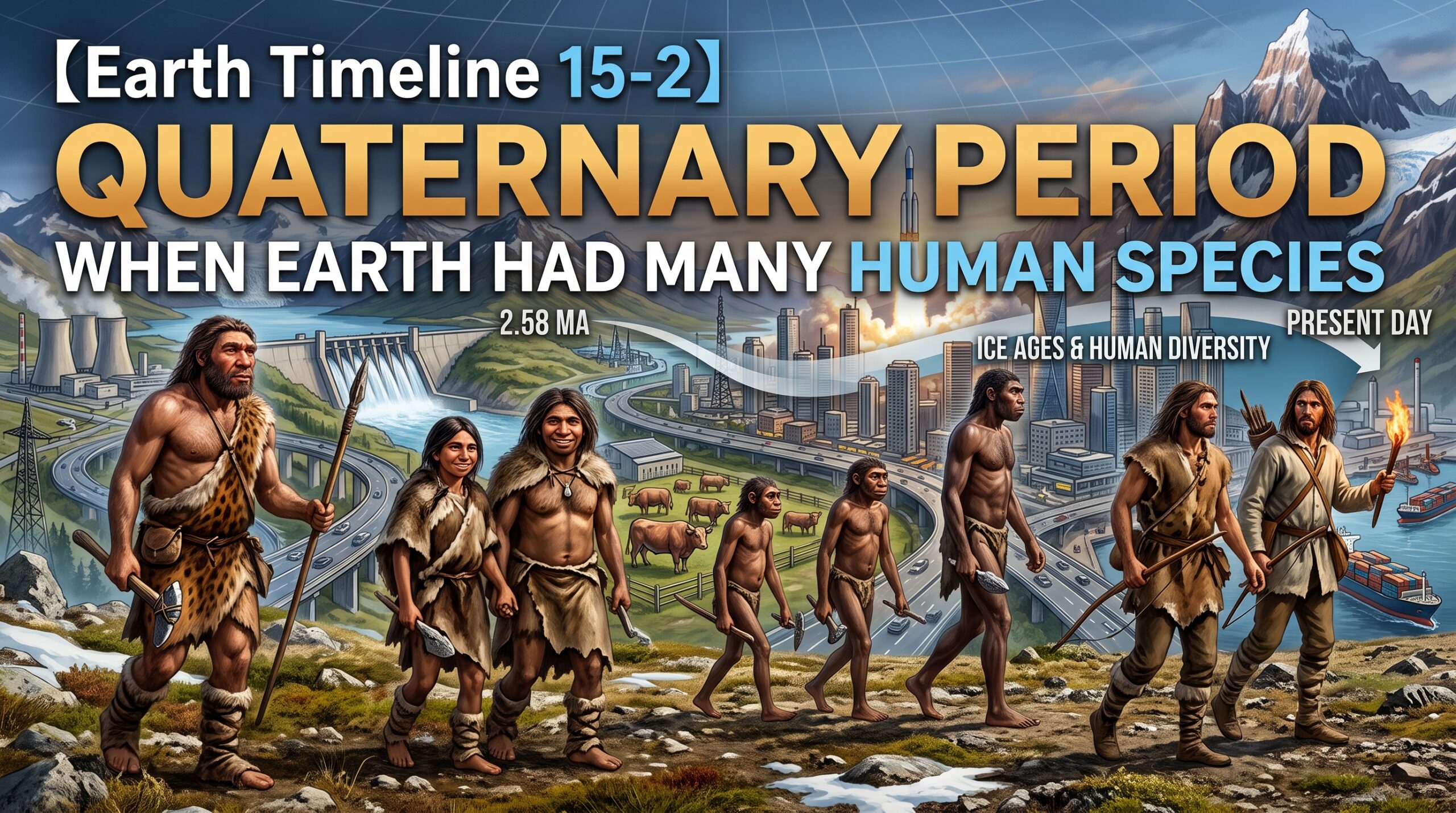
The Quaternary Period spans from about 2.58 million years ago to the present day. Placed at the end of the Cenozoic Era, it is a period still underway. It was an age of violent climate swings, with glacial and interglacial phases alternating again and again. But it has another face as well: it is the age of a creature called humanity. Though for most of that time, “humanity” did not mean a single species.
I’ve split the Quaternary into two articles. This one covers the humans; the other deals with the animals of the ice ages.
A newcomer appears in Africa 300,000 years ago
The oldest known fossils of our own species, Homo sapiens, come from the Jebel Irhoud site in Morocco and date to roughly 300,000 years ago. The face was already close to that of modern humans, but the back of the skull remained elongated — the rounded braincase we have today came much later. Sapiens did not arrive as a finished product. Hunting and gathering across African grasslands and coastlines, our ancestors became “us” gradually, over hundreds of thousands of years.
Eventually sapiens left Africa: into Eurasia, across the sea to Australia, and finally over the Bering land bridge, exposed during glacial periods, into the Americas. Along the way they hunted giants like mammoths and giant deer, devised clothing and shelter to match the cold, and became the first humans to leave footprints on nearly every continent.

The Earth was crowded with humans
What matters here is that the lands sapiens spread into were not empty. During the Quaternary, several kinds of humans — different in appearance and in how they lived — were alive at the same time.
Across Europe and into Central Asia lived the Neanderthals. Shorter than us but deep-chested, with heavy bones and a robust build suited to cold climates. Their brains were as large as ours, or larger. They made stone tools with skill, mastered fire, and hunted mammoths and woolly rhinos with thrusting spears at close range — a dangerous way to make a living. They also left traces suggesting they buried their dead.
Inland Asia was home to the enigmatic Denisovans. For a long time they were known only from a finger bone and a few teeth from a Siberian cave. Then in 2025, a well-preserved skull found in Harbin, China, was confirmed to be Denisovan, finally revealing a broad face, a heavy jaw, and a large brain. They are also known to have reached the high altitudes of the Tibetan Plateau — a people undeterred by cold and thin air.
The islands held stranger neighbors still. Homo floresiensis, which survived on Flores in Indonesia until about 50,000 years ago, stood only about a meter tall as an adult. Despite their small size they made stone tools and are thought to have hunted Stegodon, an elephant relative living on the island. This is regarded as the human version of insular dwarfism, the shrinking that happens over generations on isolated islands. On Luzon in the Philippines lived Homo luzonensis, another small-bodied human whose foot bones retained primitive features suited to climbing. And the last populations of Homo erectus, which had flourished across Africa and Asia for nearly two million years, persisted into the later Quaternary. For most of the history of sapiens, Earth was a planet shared by multiple human species.

Having only one human species is the strange part
We take for granted a world in which “human” means Homo sapiens and nothing else. But looking at the Quaternary as a whole, the picture inverts. It is our present situation that is abnormal.
Of the roughly 300,000 years since sapiens appeared, we shared the world with other humans for nearly all of it. Neanderthals vanished around 40,000 years ago. The last record of floresiensis is about 50,000 years old. How long the Denisovans lasted is still unclear. Either way, humanity has been reduced to sapiens alone only within the last few tens of thousands of years. Measured against the millions of years of human evolution, the stretch during which only one species exists is a sliver at the very end. On the long scale, we are living through an exceptional period of solitude.
And why we alone remain is, in fact, not well understood. There is no evidence that sapiens directly wiped out the others. Climate change, competition for resources, differences in population size, infectious disease — all remain candidates, and none has proved decisive. That one of the great extinction mysteries closing out the geological timescale concerns our own relatives is an irony worth sitting with.

The vanished neighbors are inside us
That said, “vanished” is only half accurate. As techniques for reading DNA from ancient bones improved, it was confirmed that sapiens and Neanderthals met and had children together. The genomes of modern people with roots outside Africa contain roughly 1 to 2 percent Neanderthal DNA. Denisovan DNA has likewise been passed down in populations across Asia and Oceania.
In other words, our former neighbors did not go extinct completely. Part of them dissolved into our own bodies and remains there. Some of those inherited genes are still at work: the tolerance of Tibetan populations for thin air at high altitude is thought to come from a Denisovan gene. Every modern person carries traces of human lineages that supposedly ended tens of thousands of years ago. Quaternary human history looks less like a branching tree than a net of tangled branches.

The debate over carving a name into the strata
About 11,700 years ago, the last glacial period ended and the warm Holocene began. From there, the pace of the lone surviving sapiens accelerated sharply. Agriculture began, settlements spread, and cities and civilizations emerged. Set against 4.6 billion years of Earth history, the history of civilization is no longer than a blink. Even so, in that brief span humans have altered the composition of the atmosphere, reshaped the land surface, and begun leaving marks deep enough to register in the rock record.

Given the scale of that impact, there has been a long-running proposal to formally establish a new geological epoch meaning “the age of humans” — the Anthropocene. The idea was to start the new epoch in the mid-twentieth century, using markers such as radioactive fallout from nuclear tests. In 2024, however, the international body governing geology rejected the proposal, judging it premature to draw such a line. Officially, we still live in the Quaternary Period, Holocene Epoch.
Still, what was rejected was whether to draw a line on the timescale — not the fact that humans are profoundly changing the planet. A newcomer that appeared in one corner of Africa 300,000 years ago survived the ice ages, outlived its neighbors, and eventually became significant enough that geologists debate redrawing their own timescale around it. The story of the Quaternary is the story of that one animal, and it is still being written.
Sources
Boundary dates follow the International Chronostratigraphic Chart of the International Commission on Stratigraphy (ICS). The timeline of human evolution draws on an explainer in Smithsonian Magazine, and the material on coexistence and interbreeding with other human species on a commentary in The Conversation. The rejection of the Anthropocene proposal can be confirmed in news coverage from Nature and in the joint statement issued by the IUGS and ICS.
コメント