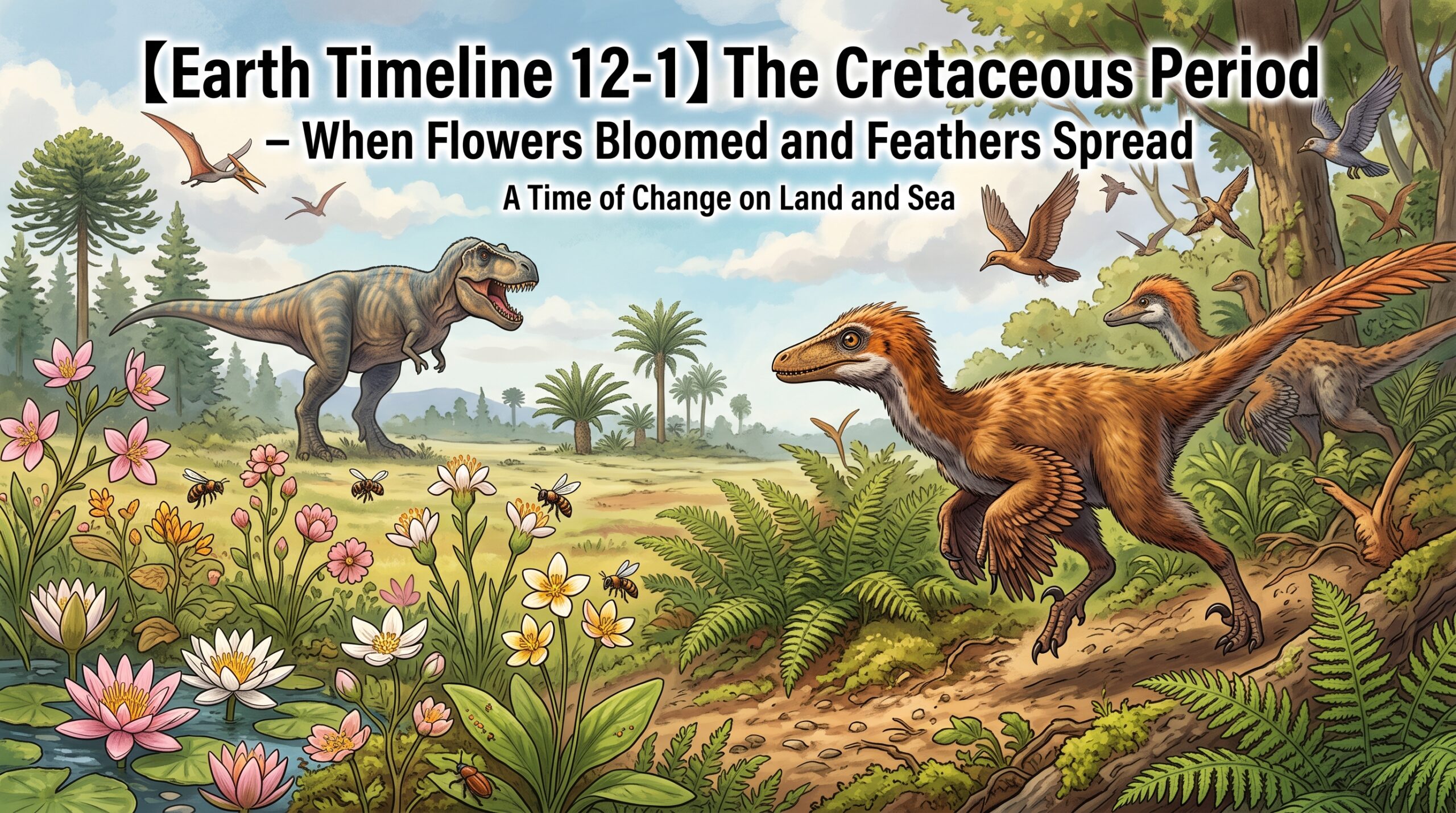
The Cretaceous runs from about 143 million to 66 million years ago. It is the last period of the Mesozoic Era and lasted some 77 million years. In terms of the age of dinosaurs, the entire second half falls inside it.
The name comes from creta, Latin for chalk — the white rock that gives us chalk sticks. It is what those brilliant white cliffs exposed along European coasts are made of, and this was precisely the period when that rock accumulated in vast quantities around the world. The end is marked by an asteroid falling in Mexico.
Continents scattering, and a rock called chalk
Pangaea, once a single mass, broke apart during the Cretaceous into roughly the prototype of today’s arrangement. The southern landmass of Gondwana split, the South Atlantic opened between South America and Africa, India and Madagascar separated, and Australia and Antarctica began to move.

Continents separating means new seafloor is continuously created between them. The ridges that generate seafloor are hot, raised features standing higher than their surroundings, so the longer they extend, the shallower the ocean basin itself becomes. Seawater with nowhere to go spilled onto the land. Cretaceous sea level was far higher than today’s, and shallow seas reached into continental interiors. The Western Interior Seaway, running north to south across North America, is the prime example: what is now Kansas lay on the seafloor. There was no ice at the poles, and forests extended across both Antarctica and Alaska.
In those shallow, warm seas, phytoplankton called coccolithophores flourished enormously. They armor themselves in small discs of calcium carbonate, and when they die the discs scatter and settle to the seafloor. Compacted, that material becomes chalk. In the long history recorded in strata, no period produced chalk like the Cretaceous. The name of the period comes from this rock.
Dinosaurs covered in feathers
On land, dinosaurs continued in the leading role. Tyrannosaurus and Triceratops, herds of hadrosaurs, armored ankylosaurs. On the southern continents, giant sauropods such as Argentinosaurus survived. Pterosaurs were in the air; mosasaurs and plesiosaurs were in the sea.

What rewrote our picture of dinosaurs in this period was the Jehol Group in Liaoning Province, China. These are fine-grained strata mixed with volcanic ash, laid down on a lake bed about 125 million years ago, and because organisms were buried rapidly after death, traces of soft tissue survive alongside the bones. Since the mid-1990s, feathered dinosaurs have emerged from there one after another. Sinosauropteryx, covered in fine filament-like structures; Microraptor, with long feathers on both arms and legs; and primitive birds. From the same group, even large tyrannosauroids nine meters long have been found with traces of feathers.
The important point is that feathers did not arise for flight. Non-flying dinosaurs had feathers first, using them for insulation and display, and only later did some lineages discover that these things could push against air. That is the sequence the fossils show. Cretaceous land was less a world of scaly reptiles than a world with fuzzy creatures all over it.
The first flowers were unremarkable water plants
The plants, meanwhile, were still quiet. When the Cretaceous began, the land was covered by conifers, cycads, ginkgoes, ferns, and an extinct gymnosperm group called the Bennettitales. There were no flowers yet.

Pollen of angiosperms — plants that flower and wrap their seeds in fruit — appears clearly in the strata from about 134 million years ago. Among the oldest body fossils is Montsechia, a water plant found in Spain, at about 130 million years. The Jehol beds in China have also yielded a water plant, Archaefructus, at about 125 million years. Both lived submerged in lakes and ponds, with neither petals nor sepals — inconspicuous plants. Anyone walking past would not have thought a flower was blooming.
And yet that same lineage was the leading player in the world’s vegetation by the end of the Cretaceous. Tens of millions of years is short on the geological clock, and that was the problem. In an 1879 letter to the botanist Hooker, Darwin called the abrupt appearance and spread of the angiosperms an abominable mystery. Evolution was supposed to proceed by small steps, and here it seemed to be moving at an inexplicable speed.
The answer long offered to this mystery was the relationship with insects. Flowers attract insects, which carry the pollen; fruits attract animals, which carry the seeds. That does explain why angiosperms branched into so many fine divisions. But it does not answer a different question: how did they push aside the ferns and gymnosperms that had occupied the land for hundreds of millions of years? The side already holding the ground should not yield easily.
A shrunken genome and densely packed stomata
In 2018, Kevin Simonin of San Francisco State University and Adam Roddy, then at Yale, offered a candidate answer. The reason for the displacement was not flowers or insects, but the construction of the leaf.

For a leaf to photosynthesize quickly, it needs many pores (stomata) to take in carbon dioxide and a fine network of veins to deliver water. But leaf area is limited, so adding stomata and veins leaves no room for the cells that actually do the photosynthesizing. The only way to add more is to make the cells that form stomata and veins smaller.
This is where genome size comes in. A cell nucleus is a container for DNA, so the more DNA there is, the larger the nucleus, and no cell can be smaller than its own nucleus. Genome size, in other words, sets the lower limit on cell size for an organism.
The two researchers assembled genome size, the length of the cells forming stomata, stomatal density and vein density for about 400 species of ferns, gymnosperms and angiosperms. Genome size and cell size turned out to be linked by a single relationship across all lineages. Adding dates to the phylogenetic tree and tracing back into the past, they found that in the Early Cretaceous the angiosperm lineage alone had rapidly shrunk its genome. Over the same interval, neither ferns nor gymnosperms changed genome size. Stomatal size and vein density did not move either.
Follow the reason flowers could cover the world, then, and you arrive at neither flowers nor insects. You arrive at how small a cell can be built — a constraint invisible even when you hold a leaf up to the light. Only lineages that shrank their genomes could shrink their cells; only lineages that shrank their cells could pack stomata and veins into a leaf; and as a result, the speed at which they drew up water and photosynthesized jumped. Fast-growing plants enter disturbed ground first, grow tall first, and drop seed first. Sharing the same site and the same light, that difference told.
Vegetation replaced, but still no grasslands
In the second half of the Cretaceous, angiosperms moved from marginal habitats — waterside and disturbed ground — into the interior of forests. By the end of the period they were numerically dominant in the vegetation of North America and Europe.

Overlay today’s landscape on that, though, and it comes out slightly wrong. Conifers were still widespread, and above all there were no grasslands. Grasses themselves existed by the end of the Cretaceous — phytoliths characteristic of grasses have been found in fossil sauropod dung from India. Even so, an ecosystem with grass covering the ground everywhere does not come together until the middle of the Cenozoic, much later. The Cretaceous ground was ferns, fallen leaves and bare soil.
Did the spread of flowers change the cast of dinosaurs? It is a tempting connection, but the test came back flat. Analyses matching species counts for herbivorous dinosaur groups against species counts for plant groups, aligned in both time and place, found almost no clear correspondence to support coevolution. The times when many herbivorous dinosaur groups diverged fall either before or after the angiosperm expansion. While the plant cast was being replaced underfoot, the numbers show no particular response on the dinosaur side. The spread of angiosperms is thought to have owed far more to insects and small mammals than to dinosaurs.
Caveats on interpretation
The genome-downsizing explanation is one strong hypothesis, not a settled answer. What was shown is a tight relationship among genome size, cell size, and stomatal and vein density, plus a reconstruction indicating those values moved during the Cretaceous — not an experimental demonstration of cause. How much faster photosynthesis actually mattered in real competition is also not something fossils measure directly.
And why angiosperms alone were able to shrink their genomes remains unanswered. It has been suggested that repeated whole-genome duplications followed by rounds of pruning are responsible, but this is not yet confirmed.
Discrepancies also remain over when angiosperms originated. Methods that work backward from the rate of DNA change place their origin far earlier than the fossils indicate, reaching into the Jurassic or before. Yet no corresponding fossils have turned up. The abominable mystery survives, in altered form.
One more thing: the phrase “the first flower” does not strictly hold either. Montsechia and Archaefructus are only among the oldest currently known; nothing guarantees they were first.
Sources
On genome downsizing and the rise of angiosperms: Kevin A. Simonin and Adam B. Roddy, “Genome downsizing, physiological novelty, and the global dominance of flowering plants” (PLOS Biology 16(1): e2003706, 2018). The full text is free to read: the paper at PLOS Biology. For a general-audience account, the article in Quanta Magazine is an easy read.
On the angiosperm phylogeny and divergence dates: A. R. Zuntini et al., “Phylogenomics and the rise of the angiosperms” (Nature 629, 843–850, 2024): the paper at Nature.
On Montsechia, among the oldest angiosperms: coverage of the research announcement (Phys.org) from Indiana University and collaborators.
On the presence of grasses at the end of the Cretaceous: Vandana Prasad et al., “Dinosaur Coprolites and the Early Evolution of Grasses and Grazers” (Science 310(5751), 1177–1180, 2005): the abstract at PubMed.
On testing dinosaur–angiosperm coevolution: Richard J. Butler et al., “Testing coevolutionary hypotheses over geological timescales: interactions between Cretaceous dinosaurs and plants” (Biological Journal of the Linnean Society 100(1): 1–15, 2010): the paper at Oxford Academic.
Dates in this article follow the International Chronostratigraphic Chart of the International Commission on Stratigraphy (ICS): stratigraphy.org/chart.
コメント