The Paleogene is the first period of the Cenozoic Era, running from 66 million to about 23.03 million years ago. Immediately before it came the asteroid impact at the end of the Cretaceous, which removed every dinosaur except the birds. The Paleogene divides, from oldest to youngest, into three epochs: the Paleocene, the Eocene and the Oligocene.
What this article follows is the very beginning of that span: how the survivors filled the seats left empty in the ecosystem after the impact. It is a scene usually summarized in a single line — the dinosaurs went, and the age of mammals arrived — but trace the actual steps through the fossils and the story turns out to be less simple than that.
Recovery began in the ash
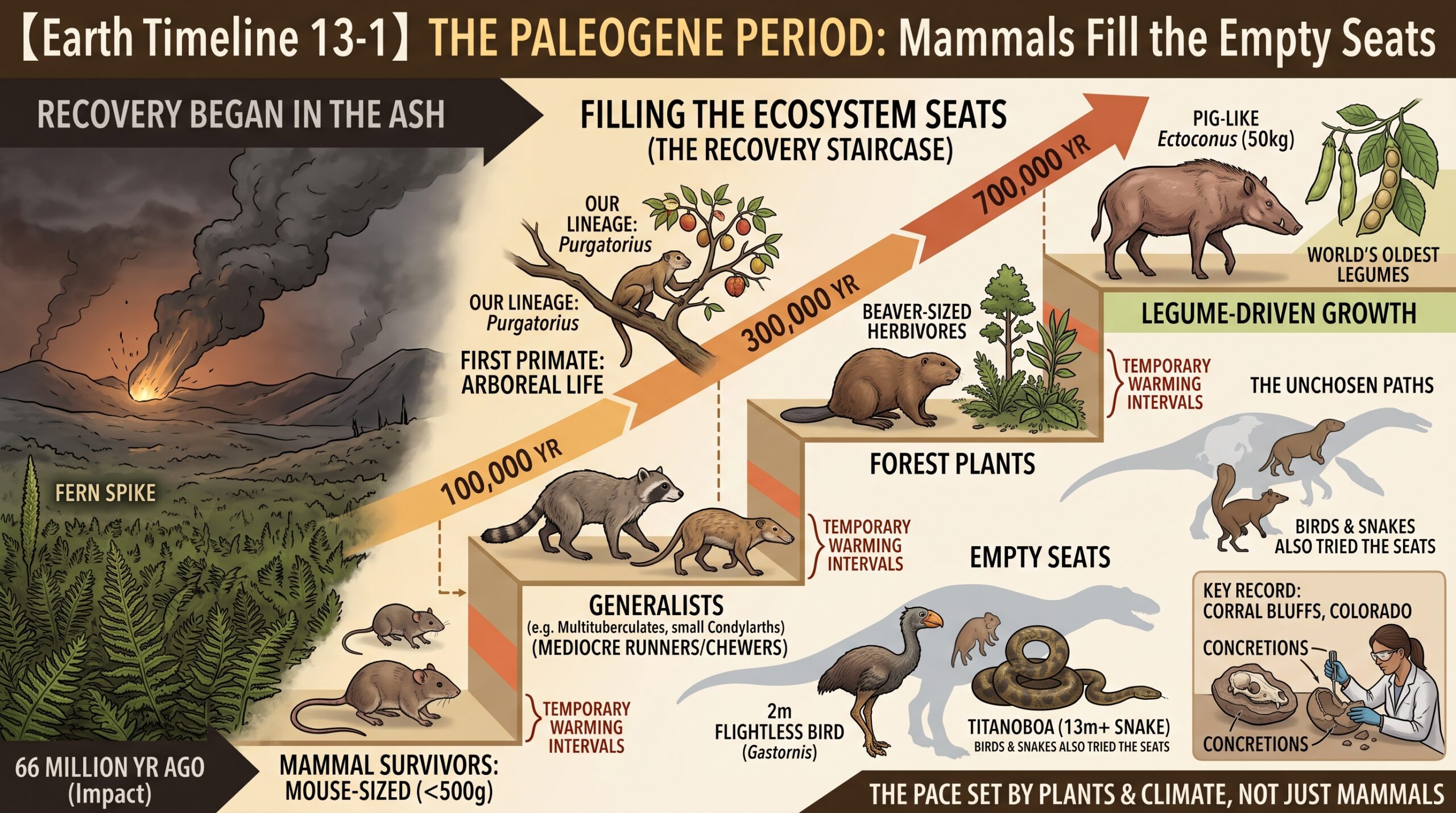
Immediately after the impact, the landscape on land had changed completely. In strata around the world, fern spores appear in abnormal proportions right above the boundary. This is the trace of an interval when ferns alone carpeted the burnt ground where forests had collapsed, and it is known as the fern spike. In North America, about half of all plant species were lost at this point.
Among animals, the survivors were turtles, crocodilians, lizards, birds and small mammals. Mammals escaped a fatal blow in terms of species numbers, but the larger-bodied species were almost entirely wiped out. The mammals that made it through the impact weighed at most about 500 grams. An animal only a little bigger than a mouse was the largest of the survivors.

Mammals were not the only ones filling the seats
The cast of Paleocene mammals was an elusive assortment, hard to connect to anything you would see in a zoo today. There were the multituberculates, holdovers from the age of dinosaurs that gnawed plants with rodent-like incisors. There were the condylarths, an omnivorous and herbivorous group standing as distant relatives of the hoofed mammals. All of them plain-looking, mediocre at running and mediocre at chewing — generalists, to put it kindly.
Nor did mammals simply slide into the large-animal seats. Paleocene strata in Europe and North America yield fossils of Gastornis, a flightless bird standing close to two meters tall, with a head as large as a horse’s and an enormous beak. It was long regarded as a predator hunting mammals, but analysis of calcium isotopes preserved in its bones now favors a plant diet. In Colombia, in South America, a snake more than 13 meters long and over a ton in weight — Titanoboa — has been found in rainforest deposits about 58 million years old. It is the largest snake ever known. For a while after the dinosaurs were gone, there were places on land where the most conspicuous large animals were birds and snakes.


The first million years, asleep in a Colorado bluff
So at what pace did mammals fill those seats? The place that recorded it at exceptional resolution is a bluff in Colorado called Corral Bluffs, where strata from the moment of impact through roughly the following million years survive in a continuous sequence.
When the team from the Denver Museum of Nature & Science began working the site, they found only scraps of bone and little to show for it. The turning point was changing how they looked. They stopped searching for bone and started cracking open the rounded rock masses called concretions — and mammal skulls came out one after another. In the end nearly 1,000 vertebrate fossils were collected. Plant leaves and pollen came with them, and combined with precise dating from volcanic ash, the site became a record with almost no equal in the world: one that lets you lay out, stage by stage, what was living how many tens of thousands of years after the impact. The results were published in Science in 2019.

It was the plants that set the steps
The mammalian recovery that emerged from the Corral Bluffs record was not a smooth upward slope but a distinct staircase. Immediately after the impact, the largest were mouse-sized. By 100,000 years later, omnivorous mammals about the size of a raccoon (around 6 kilograms) had appeared, roughly back to the maximum size seen before the impact. By 300,000 years, herbivores the size of a beaver (in the 20-kilogram range) were on the scene, and by 700,000 years a 50-kilogram grazer called Ectoconus, stocky and pig-like, was walking around. That is about a hundred times the weight of the survivors.
Here is the interesting part. Every time the body-weight step rose, it lined up precisely with a change on the plant side. The jump at 300,000 years coincides with a period when forest plant diversity increased sharply, and the strata recording the largest jump at 700,000 years yielded some of the world’s oldest fossils of legumes. Legumes are rich in protein, in both leaves and beans — high-value food for animals. The research team raised the possibility that this upgrade in the food supply drove the increase in body size. Each step also coincided with an interval of temporary global warming.
In other words, the seats the dinosaurs vacated were not seized by mammals rushing in first. Plants recovered, forests grew rich, climate gave a push, and each time the ceiling on mammalian body size was raised another notch. What set the pace of recovery was less the effort of the mammals themselves than the vegetation under their feet.

Our own lineage, up in the trees
Our own line already makes an appearance within this recovery. Purgatorius, found in strata in Montana, is considered one of the earliest members of the primate group. It shows up only about 100,000 years after the impact. Its body was no larger than a mouse’s, but its ankle bones are shaped for gripping branches and climbing, and its teeth were suited to grinding fruit.
While a recovery race measured in body weight was running on the ground, the primate lineage chose a different seat very early on — the trees — and began living on fruit. Monkeys, apes and humans all trace back to this small arboreal animal.

How long the change of lead actually took
Behind the one-line version — the dinosaurs went and the age of mammals arrived — lies a patient recovery that climbed a staircase in steps of a hundred thousand years, keeping pace with plants and climate. The change of lead in the ecosystem was not an overnight coup but a long reconstruction that started with the food supply. That is what Corral Bluffs has to teach.
That said, this precise record comes from one region of Colorado. Whether the same staircase was cut worldwide, or whether each place moved at its own pace, is still unknown, because records of comparable resolution are almost nonexistent elsewhere. There is also a remaining gap between dates estimated from DNA and the fossil record when it comes to when and where the major modern mammal groups (the placental lineages) diverged. The full picture of how those empty seats were filled is still only half drawn.
Sources
On the Corral Bluffs recovery record: Lyson, T. R. et al. (2019) “Exceptional continental record of biotic recovery after the Cretaceous–Paleogene mass extinction,” Science. DOI: https://doi.org/10.1126/science.aay2268
Research overview from the Denver Museum of Nature & Science: Rise of the Mammals (Denver Museum of Nature & Science)
Boundary dates in this article follow the International Chronostratigraphic Chart of the International Commission on Stratigraphy (ICS).
コメント