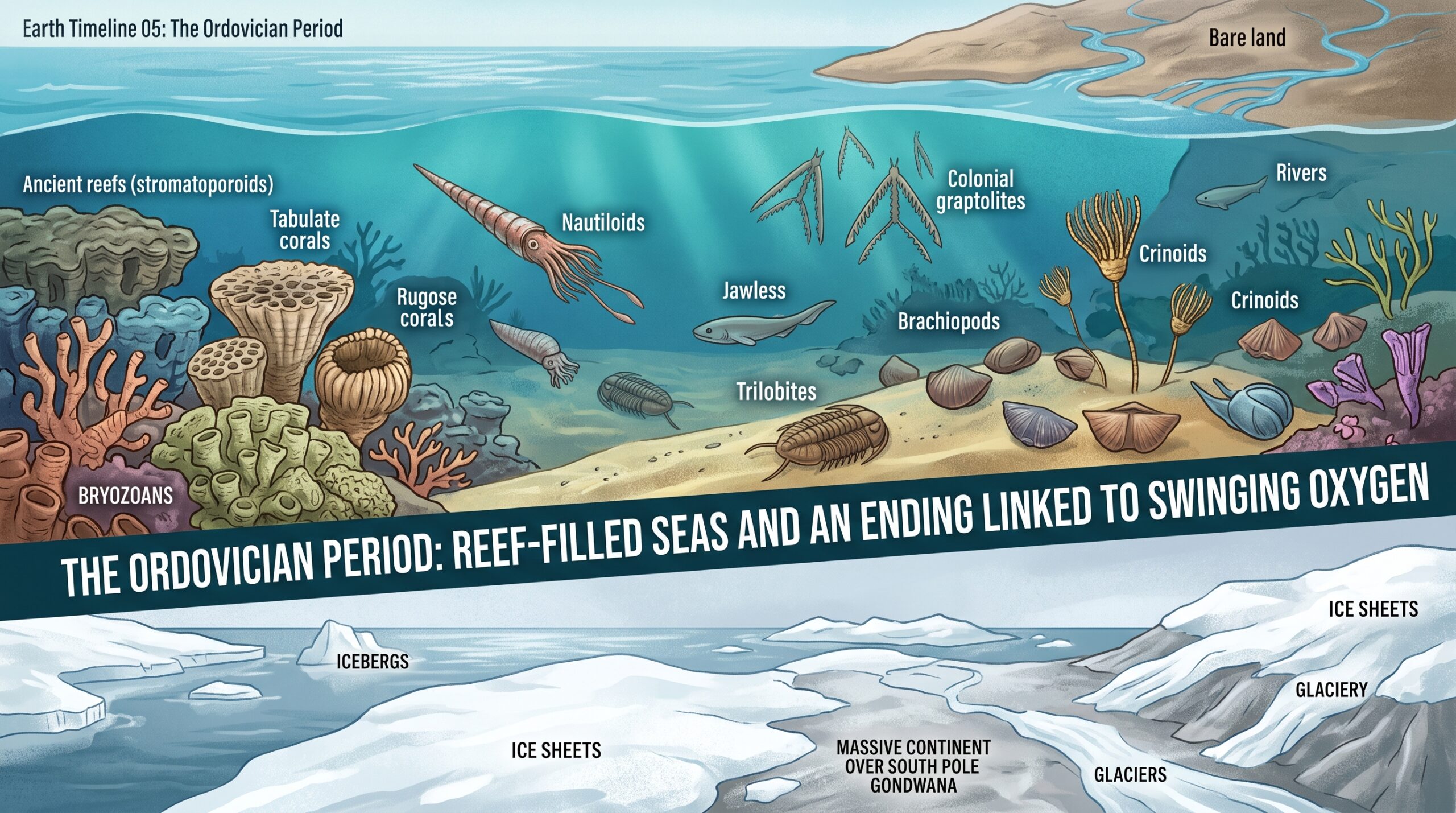
The Ordovician ran from about 487 million to about 443 million years ago, lasting some 44 million years. It follows the Cambrian and precedes the Silurian, sitting second among the six periods that make up the Paleozoic Era.
The world map of the time looks nothing like today’s. Most of the land was clustered in the Southern Hemisphere, and the Northern Hemisphere was almost entirely ocean. Atmospheric carbon dioxide is estimated at 3 to 16 times present levels, and the seas near the equator were warm. Sea level, moreover, was among the highest of the entire Phanerozoic — the span since 539 million years ago, from which fossils of hard-shelled and bony organisms are abundant. The sea pushed into continental interiors, and broad shallow seas spread across many regions.
Conditions were good for life. The number of marine species increased dramatically over these 44 million years. Then, in roughly the final million years, many of them disappeared. The first of the five mass extinctions of the Phanerozoic — the Big Five — occurred at the end of this period.
A world with the continents in the south
In this period, present-day Africa, South America, Antarctica, Australia and India were joined as a single enormous continent, Gondwana. Gondwana drifted slowly southward throughout the Ordovician, and by the end of the period the part corresponding to present-day North Africa sat over the South Pole. A continent parked over a pole accumulates snow and grows ice readily. This arrangement matters for what follows.
The other landmasses — Laurentia (present-day North America), Baltica (northern Europe) and Siberia — floated near the tropics as separate continents. All straddled the equator, and calcareous mud accumulated vigorously in the shallow seas around them. That is why Ordovician limestone is widespread in the American Midwest and Scandinavia.
And the land was essentially bare. No trees, no grass, almost no soil. Rain stripped rock directly, and rivers carried sand and mud to the sea. The world of living things was still, in effect, contained entirely within the ocean.
Reefs built by a different cast
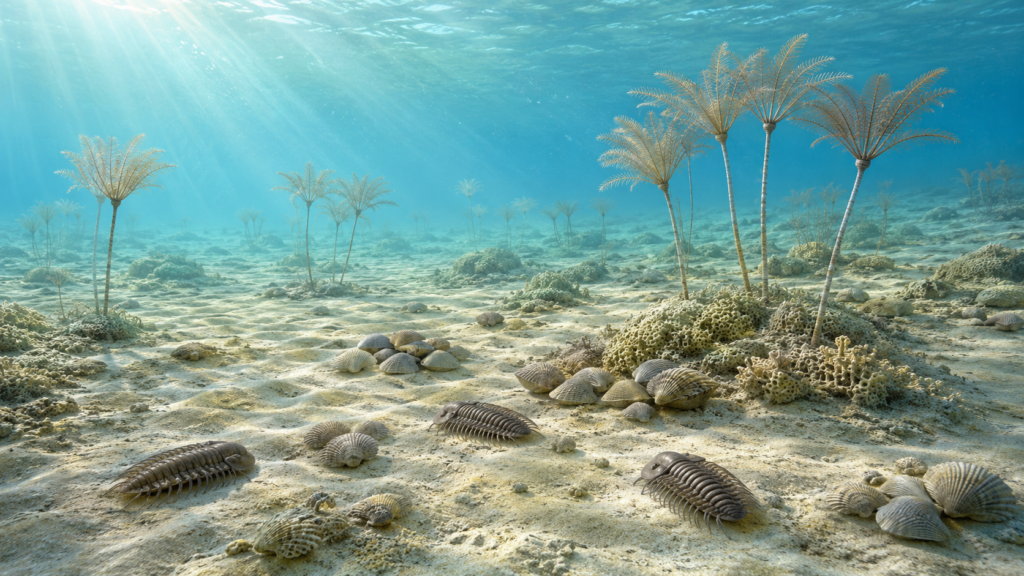
Broad, shallow, warm seas make reefs. In the first half of the Ordovician the reef builders were still microbes: microbial mats growing in layers while trapping lime, forming raised structures. From the middle into the later part of the period, those were replaced by reefs built by animals.
Those animals, though, were a different cast from today’s. The framework was built by stromatoporoids (a sponge group), tabulate corals, rugose corals, and bryozoans and red algae with calcareous skeletons. Stromatoporoids and tabulate corals formed massive colonies several meters across, with bryozoans filling the gaps and binding the whole together. Down to the division of labor, a mechanism much like a modern coral reef was in operation.
But the reef corals of today — the scleractinians, or stony corals — are not among that membership. Scleractinians appear in the fossil record only in the Triassic of the Mesozoic, from about 240 million years ago. The tabulate and rugose corals that built Ordovician reefs died out completely in the end-Permian extinction. So when we say coral reefs spread in the Ordovician, the animals there were not the ancestors of today’s corals but a separate lineage that was cut off.
Those reefs were also less robust than modern ones. They did not form the thick, breakwater-like structures that take the waves and mark the boundary with the open ocean. That becomes possible only from the Silurian; Ordovician reefs were patchy features scattered across relatively calm shallows.
On the apparent sudden assembly of reef-building animals in the middle of the period, an objection was raised in PNAS in 2025. The Dapingian Age of the Middle Ordovician (about 471 to 469 million years ago) was a time of major sea-level fall, so limestone itself was not deposited and the record has a hole in it. When sea level returned, organisms that had already diversified came back into the shallows at once, which may only make it look like a sudden increase. Gaps in the strata distorting the graph of evolution is a problem that always accompanies reading the fossil record.
A threefold increase in ten million years
The increase in Ordovician life has a name: the Great Ordovician Biodiversification Event (GOBE). The rise continued steadily from the beginning of the period to the end, but within roughly ten million years centered on the Darriwilian Age of the middle Ordovician, global marine species numbers are estimated to have roughly tripled.
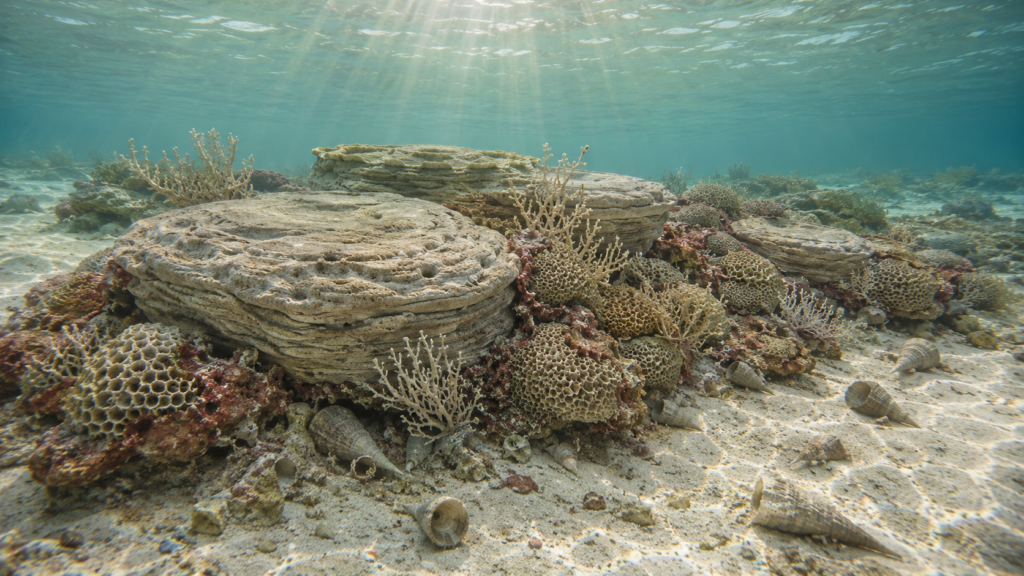
It was not merely that the numbers rose; the increase came in a sequence. First organisms drifting in the water column, then those living on the seafloor, and last the reef builders. There is a reason for that order. Phytoplankton diversified first, zooplankton that fed on them followed, and eventually even the larvae of seafloor animals came to spend time drifting in the water. Once food was suspended in the water column, a place to live opened up at mid-depth, and food began raining down to the seafloor below.
One of the leading players in the water column was the graptolite: an animal forming colonies of many slender tubes, living adrift near the surface, with an exceptionally rapid turnover of species. Thanks to that, Ordovician strata from any country can be correlated by their graptolite assemblages. Research on this period has advanced in such fine detail because of this fossil clock.
The seafloor was packed with brachiopods (a separate group with shells resembling bivalves) and bryozoans, crinoids stood like a forest, and trilobites walked on the mud. Trilobites are famous as the leads of the Cambrian, but in species numbers the Ordovician has more. Their relative presence in the sea, however, had already declined.
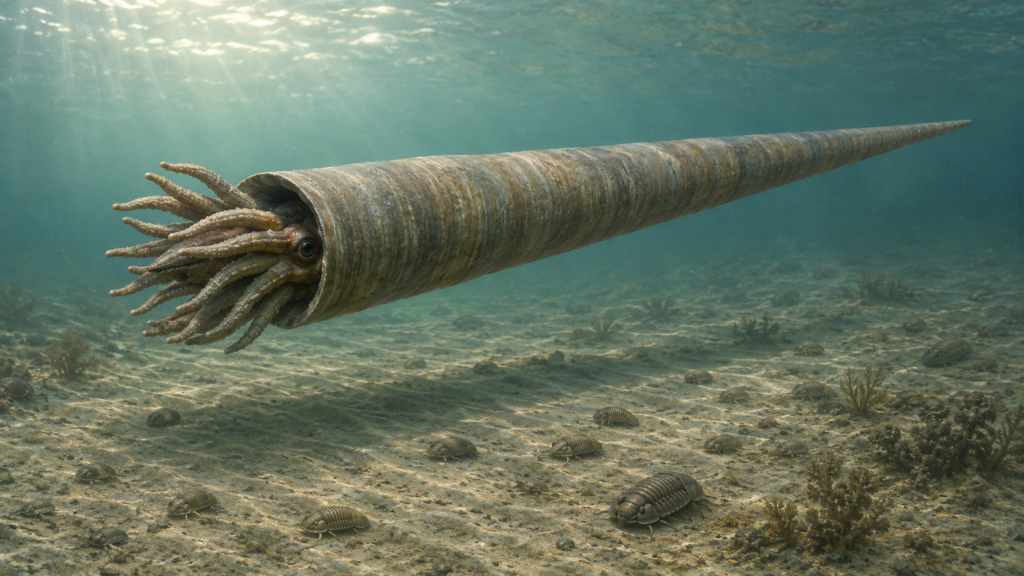
Standing above them were the nautiloids with straight conical shells. They adjusted buoyancy through chambers inside the shell, swam by jetting water, and cracked prey with a beak. The largest shell reconstructed from reliable specimens is close to six meters (figures of nine and eleven meters have long circulated, but rest on reports of unclear provenance). Even so, they were without question the largest animals in that sea.
Vertebrates were still bit players. The first fish with bone — jawless, with nothing but bony plates covering the head, a few tens of centimeters long — are found in strata in Bolivia, Australia and North America. In this sea they were not the eaters but the eaten.
A million years of spreading ice
Then comes the last age of the period, the Hirnantian, lasting roughly one million years — a very short division by the standards of the geological timescale.
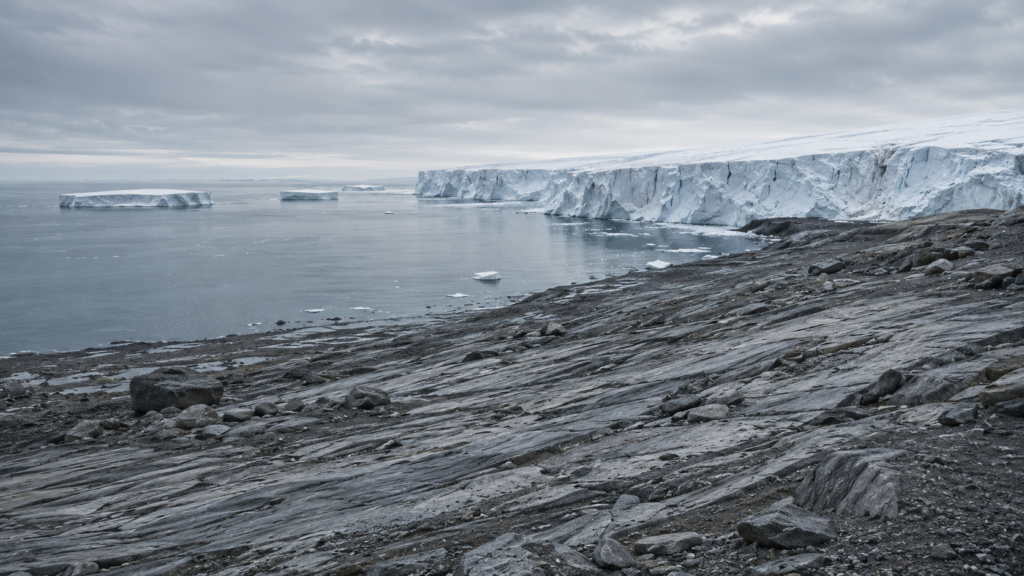
Ice sheets grew on Gondwana, sitting over the South Pole. The traces are unmistakable: beneath the Sahara, grooves where glaciers scoured the rock and sediments carried by glaciers lie buried as they were. And in Poland, rock debris dropped by icebergs has been found at around 30 degrees south — a drift of more than 3,000 kilometers.
Ice piling up on land means less water in the sea. Sea level fell by 70 to 100 meters during this interval. Those broad shallow seas reaching into continental interiors dried out entirely. The places where life was most densely concentrated vanished wholesale.
The extinction came in two pulses. The first at the start of the Hirnantian, with cooling and falling sea level. The second about a million years later, near the end of the age, as the ice melted, sea level returned and the ocean warmed. Together, roughly 85 percent of marine species were lost. It is the first of the Big Five, and in scale is usually placed second only to the end-Permian.
The textbook account ends there. An ice age arrived, it got cold, the shallow seas disappeared, and life died. But that account has always snagged on something. The other four of the Big Five are all tied to large-scale volcanism and warming. Only the end-Ordovician stands apart as the one extinction caused by cold.
A record of oxygen swinging up and down
A different explanation for that outlier came from metal isotopes preserved in seafloor mud.
In 2022, an international team centered on Florida State University analyzed black shale from two sites in southern China and from Dob’s Linn in Scotland — the international reference outcrop defining the Ordovician–Silurian boundary — and measured the isotope ratio of the metal thallium. Thallium is buried on the seafloor attached to manganese oxides, and those manganese oxides form only when there is oxygen in the bottom water. Track the thallium isotope ratio, then, and you can see how much oxygen there was on the world’s seafloor.
The strength of this method is speed. Uranium and molybdenum, commonly used for the same purpose, remain in the ocean an average of about 450,000 years before settling, so any variation shorter than that is smoothed away. Thallium remains about 18,500 years, capturing swings on scales of hundreds of thousands of years as they were.
The record that emerged was not what was expected. Ocean oxygen fell, recovered, fell again, recovered again, and fell once more at the end.
And the first decline happened before the ice age began. In the later Katian, before the Hirnantian started, oxygen-poor water spread globally over about 900,000 years. That interval coincides with the disappearance of brachiopods and trilobite groups living in the deep sea, and the beginning of decline in several graptolite lineages. Life, in other words, had already begun declining before the ice spread.
Next, around the start of the Hirnantian, oxygen recovered over about 370,000 years, because the ocean cooled. Cold water dissolves oxygen well, and as sea level fell and seafloor area shrank, so did the places where oxygen-poor water could pool. In this sense, cooling worked to return oxygen to the ocean.
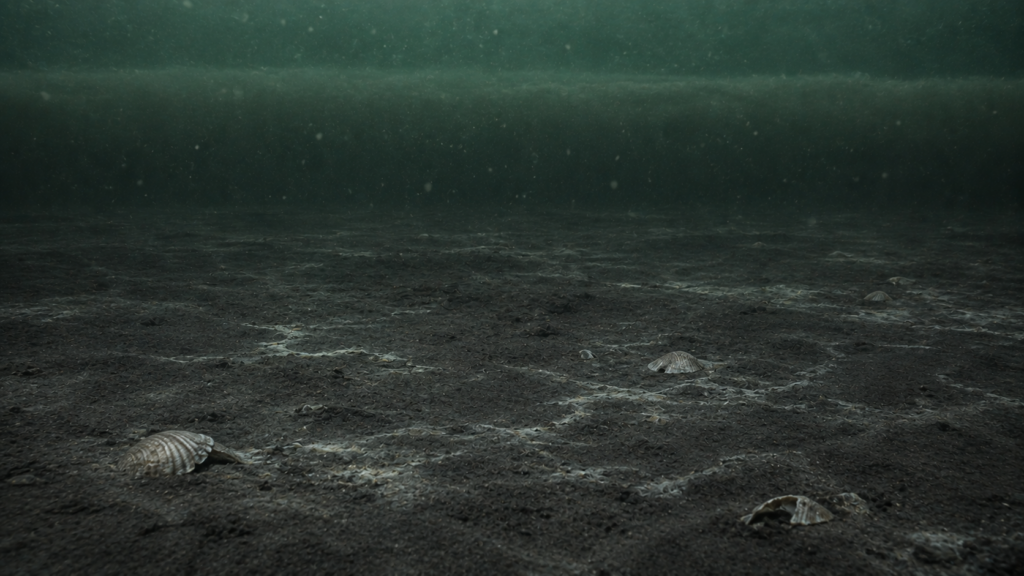
Oxygen then fell again mid-age, recovered once more over about 345,000 years in step with the final ice sheet expansion, and was then lost rapidly, within roughly 150,000 years, as the ice melted and sea level rose. An ocean that went as far as generating hydrogen sulfide persisted into the early Silurian. The second extinction pulse occurs here.
The team’s conclusion: what caused this extinction may have been less the scarcity of oxygen itself than the fact that the amount swung back and forth at short intervals. The recovery phases were a burden for life too. For species adapted to low-oxygen conditions, water suddenly “cleaning up” meant losing their habitat outright. Neither the cooling nor the loss of oxygen was the sole culprit; what told was the instability itself.
What drove those swings in the first place, however, is contested. In 2020, a paper in Geology argued from mercury anomalies that massive volcanism caused warming and anoxia, and that these produced both extinction pulses — which would fit the end-Ordovician into the same mold as the other four. The thallium team does not adopt that interpretation, citing the scarcity of geological evidence for large-scale volcanism at the Katian–Hirnantian boundary, and pointing out that the mercury anomalies may reflect local seafloor conditions and iron sulfide accumulation rather than volcanoes. Looking at the same strata, the answers have not converged.
The hard problem of what triggered the ice age
Why did the ice age begin at all? This is the least resolved part.
As noted at the outset, carbon dioxide at the time is estimated at 3 to 16 times present levels. Continental ice sheets growing with greenhouse gases that concentrated happened only this once in the entire Phanerozoic. Either something pulled carbon dioxide down sharply, or factors other than carbon dioxide were at work.
One candidate is plants beginning to come ashore. Spores thought to be from plants have been found in strata in Argentina about 473 to 471 million years old (this date is disputed; a more secure record comes from Saudi Arabia at about 465 million years). All are from small liverwort-like plants with neither roots nor stems. Even so, merely spreading thinly over rock surfaces accelerates weathering. More weathering draws atmospheric carbon dioxide into rock and lowers it. Small plants cooled the planet, on this account.
Other proposals invoke increased burial of organic matter sinking in the ocean, volcanic activity, or a large tilt of the continents relative to the pole. On organic burial, though, data published in 2025 indicate it actually decreased during the glaciation, so the story is no longer simple.
What is clear is that this extinction cannot be settled with the single line that it got cold and things died. Life began declining before the ice arrived, and declined sharply again after the ice melted. In between, ocean oxygen went up and down repeatedly. The cause cannot be narrowed to one thing while the record only gets finer — that is where Ordovician research stands now.
The thallium team closes its paper by noting that oxygen in today’s ocean has fallen by at least 2 percent over the past fifty years or so, and that this period may be instructive with regard to the speed of change. The scale, the pace and the background 440 million years ago and now are entirely different, so the two cannot simply be overlaid. But it is true that the strata of this period show, in concrete numbers, how strongly ocean oxygen bears on life.
Sources
Reconstructing oxygen variability from thallium isotopes: Kozik et al., “Rapid marine oxygen variability: Driver of the Late Ordovician mass extinction” (Science Advances, 2022; full text free to read)
Detecting ocean anoxia from uranium isotopes: Bartlett et al., “Abrupt global-ocean anoxia during the Late Ordovician–Early Silurian detected using uranium isotopes of marine carbonates” (PNAS, 2018)
Sulfidic seas persisting into the early Silurian: Stockey et al., “Persistent global marine euxinia in the early Silurian” (Nature Communications, 2020; full text free to read)
The competing volcanic hypothesis: Bond & Grasby, “Late Ordovician mass extinction caused by volcanism, warming, and anoxia, not cooling and glaciation” (Geology, 2020)
Definition and course of the Great Ordovician Biodiversification Event: Servais & Harper, “The Great Ordovician Biodiversification Event (GOBE): definition, concept and duration” (Lethaia, 2018)
The argument that the sudden appearance of reefs is an artifact of missing strata: Preservation bias obscures gradual Ordovician reef evolution (PNAS, 2025)
The oldest land plant spores: Rubinstein et al., “Early Middle Ordovician evidence for land plants in Argentina (eastern Gondwana)” (New Phytologist, 2010)
コメント