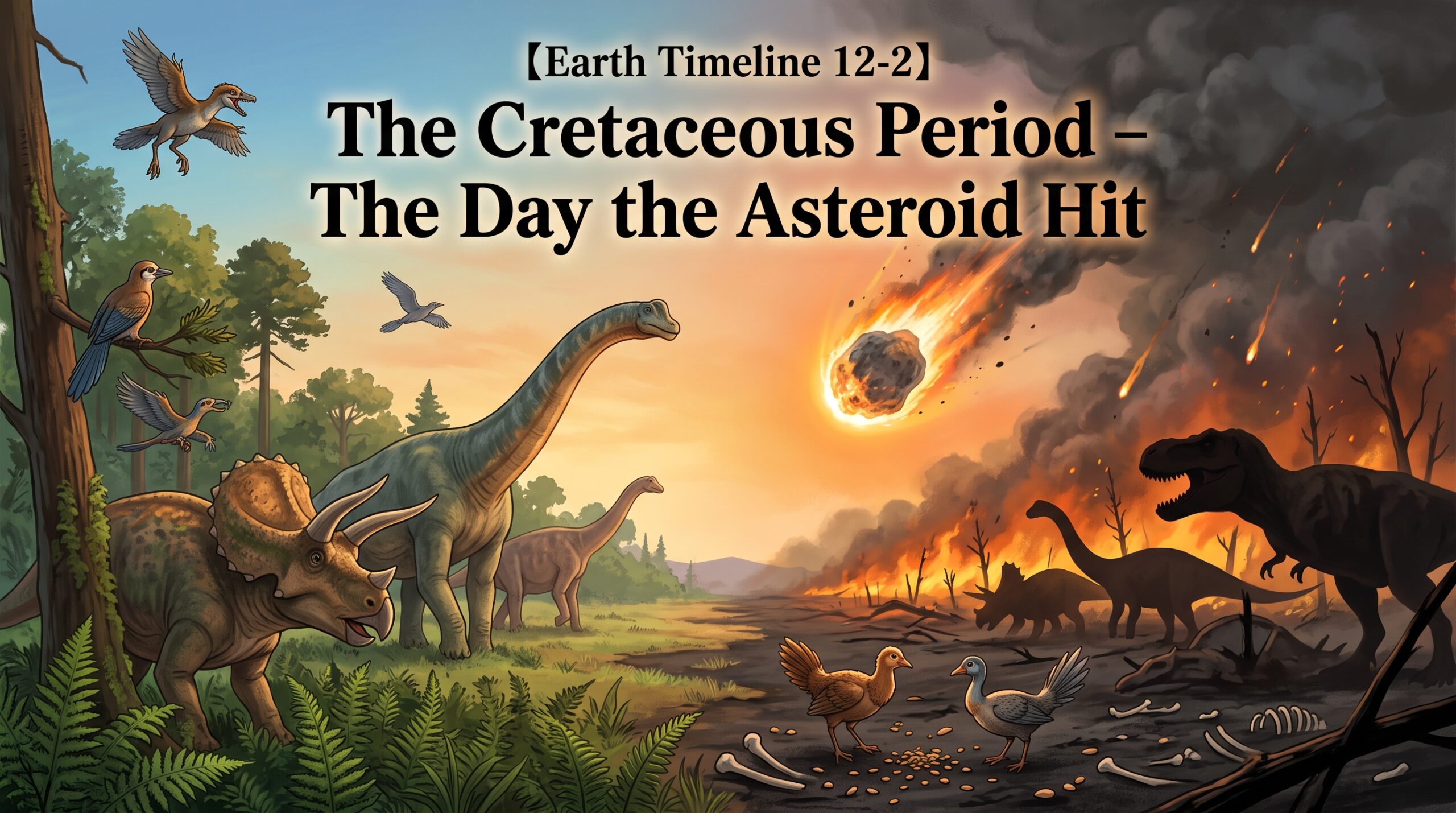
About 66 million years ago, an asteroid 10 to 15 kilometers across fell into the sea off what is now the Yucatán Peninsula in Mexico. The crater it left measures 180 to 200 kilometers across. That single blow ended the Mesozoic Era, and the leading roles on land and in the sea changed hands.
The trace is preserved in strata worldwide. At the boundary between the Cretaceous and the Paleogene, wherever you dig, there is a thin clay layer a few millimeters to a few centimeters thick, unusually rich in the metal iridium — an element scarce in Earth’s crust and abundant in asteroids. Across that layer, an estimated 75 percent of species disappear.
Dinosaurs were thriving right up to the impact
There is an argument to settle first. For a long time, one view held that dinosaurs had already been declining before the asteroid arrived, and that the impact merely finished them off.

That view arose for a reason. The best-studied record of the very end of the Cretaceous on land has been the Hell Creek Formation, spread across Montana and the Dakotas. Tyrannosaurus and Triceratops both come from there. But that formation contains no long-necked giant sauropods. A lineage that had once flourished so thoroughly was gone from North America — and from that, a picture formed of terminal dinosaurs reduced in variety.
In 2025, another window opened onto that picture. A team led by Andrew Flynn of New Mexico State University redated the Naashoibito Member in the San Juan Basin of New Mexico with precision. Using both changes in the direction of magnetism frozen into the rock and radiometric ages from minerals in the sand grains, they established that the unit was deposited between 66.4 and 66.0 million years ago — the final 380,000 years or so of the Cretaceous. Until then it had been thought to date to around 70 million years, millions of years older than the impact.
Once the ages line up, comparison becomes possible. In North America at the same moment, two dinosaur worlds with entirely different casts existed side by side. To the north, Hell Creek had crestless hadrosaurs and no sauropods. To the south, New Mexico had Alamosaurus, a large sauropod, and crested hadrosaurs. And both had Tyrannosaurus. This was not a declining, homogenizing assemblage but a rich ecosystem with regionally distinct casts. On this analysis, the dinosaurs were not nudged while already rolling downhill; they were knocked over while standing firmly.
A darkened sky and a collapsed food web
The asteroid struck the floor of a shallow sea, and the rock there was rich in sulfur and carbonates. Vaporized rock and droplets of melted rock were blasted skyward, and friction as they fell back through the atmosphere scorched the surface. Earthquakes and tsunamis, then wildfires. That much covers the first few hours.

What came next was more lethal for living things. Fine dust thrown into the air, together with soot from the fires, covered the sky and cut off sunlight from the surface. For months — or, on the longer estimates, for something on the order of a thousand years; the range is wide — the Earth was dark and cold. Stop photosynthesis and the plants die, then the animals that ate the plants, then the animals that ate those. The order of collapse propagates straight up the chain. The same happened in the sea, starting with the damage to photosynthetic plankton. Ammonites, mosasaurs and plesiosaurs all end here.
Around the same time, massive lava eruptions known as the Deccan Traps were under way in India — volcanism that buried an area about the size of France in basalt, with its peak straddling the impact. How much this volcanism contributed to the extinction is still unsettled. The mainstream view today is that the timing matches far more precisely for the impact, and that the volcanism was a factor that disturbed the environment before and after, weakening life. Splitting the two contributions numerically, though, remains difficult.
Looking only at the outcome, the line was drawn with brutal simplicity. On land, every tetrapod over 25 kilograms disappeared, apart from some low-metabolism animals like crocodilians and turtles that can go long stretches without eating. Large animals need enormous amounts of food, cannot hide underground, and take years to reach adulthood. They met none of the conditions for riding out a few dark years.
Birds vanished from the sky too
You often see it put as: the dinosaurs went extinct, but the birds survived. That is correct as a statement about lineages, but it makes it sound as though the whole bird clan escaped. What actually happened was nothing like that.

The most successful birds in Cretaceous skies were not today’s birds. They were the enantiornithines, a group with teeth in their jaws and claws remaining on the fingers of their wings. Found in strata worldwide, abundant in both species and numbers, they are thought to have been adapted to life in the trees. There were also the ichthyornithines, toothed seabirds, and the hesperornithines, which specialized in diving and lost the power of flight.
A study of the very last Cretaceous strata in western North America identified 17 bird species up to 300,000 years before the boundary. Seven of them were archaic types like those just named. And from strata above the boundary, not one of those lineages appears. Birds with teeth, birds with claws on their wings, birds with long bony tails — none ever turns up again, anywhere in the world. Some researchers estimate the extinction rate of bird lineages at over 90 percent.
What crossed the boundary was a single branch: the ancestor of every bird alive today. Vegavis, found in Antarctica, and Asteriornis — nicknamed the Wonderchicken — from a quarry near the Belgian–Dutch border are among the few examples. Both belong to the group containing ducks and chickens.
The question now changes shape. Among birds with the same feathers and the same ability to fly, why did only this branch remain?
The loss of forests as a sorting machine
In 2018, a team led by Daniel Field, then at the University of Bath, produced an answer by matching the pollen and spore record against reconstructions of bird ecology.

Examine the pollen in boundary strata and what happened becomes clear. Tree pollen stops abruptly, and in its place fern spores increase explosively. This is the fern spike, seen on every continent. Ferns scatter spores on the wind and are the first plants into burnt ground and collapsed slopes, so that mountain of spores means the forests were gone and bare ground had spread. Regrowing the trees probably took centuries.
On that basis, the team mapped the ecology of living birds — ground-dwelling or tree-dwelling — onto the phylogenetic tree and traced it backward. The result: every deep split near the root of the modern bird tree reconstructs, without exception, as not arboreal. The branch leading to ostriches and kiwis, the duck-and-chicken branch, and the branch containing most of the rest — the birds at the base of each were on the ground or at the water’s edge.
The line the asteroid drew, in other words, did not run between dinosaurs and birds. It ran between the trees and everything else. Co-author Regan Dunn put it as: there was nowhere left to perch, so the perching birds went. The arboreal enantiornithines lost their homes, their nest sites and their food all at once.

There is a second clue pointing the same way. Derek Larson, then at the University of Toronto, and colleagues collected more than 3,100 teeth of small theropods spanning the last 18 million years of the Cretaceous and tracked variation in their shape. Had these animals been declining gradually, their dietary range should have narrowed and the variation in tooth shape with it. But the variation never contracted, right to the end. They did not fade; they vanished suddenly.
From that, the team proposed that what separated the living from the dead was food. Plants wither, insects decline, small animals decline — but seeds survive in the soil for years. Lineages that had traded teeth for a beak and could crack hard seeds could eat those leftovers. Toothed birds and small theropods could not. Vegavis and Asteriornis both had beaks, lived on the ground or at the water’s edge, and grew fast enough to reach adulthood in about a year.
And here is the strangest part of the story. Every bird now singing from a branch is, without exception, descended from ancestors that were not in the trees. After the forests returned, multiple lineages climbed back up separately. Hummingbirds, pigeons, owls, hawks, the small birds that come to the garden — all are the product of that second ascent.
Survival decided by the hand you held
Strength and excellence had nothing to do with this sorting. If you were large, you died; if you grew slowly, you died; if you lived in the trees, you died. With time, evolution might have supplied an answer, but there was no time. What decided survival was only the set of traits you happened to hold that day.
Mammals came through on the same logic. Small, able to burrow and hide, fast-growing, willing to eat anything. Not especially superior — simply a good fit for the conditions. It is right after this that they begin filling the vacated space.
Without this extinction, the whole landscape of today’s world would be different. That sparrows come to the garden, that we wake to birdsong in the morning — that is because one group that happened not to be in the trees 66 million years ago happened to survive. None of us has ever seen a sky with toothed birds in it.
Caveats on interpretation
The account of forest loss sieving the birds is a well-supported hypothesis, but it has not been confirmed directly from fossils. Bird fossils from the end of the Cretaceous are very scarce to begin with, and the core of Field and colleagues’ conclusion rests on reconstructing the ecology of living birds backward along the phylogenetic tree. If more actual bones of birds that crossed the boundary turn up, the picture could change.

The same goes for the hypothesis that the ability to eat seeds was decisive: it was assembled from an indirect clue, the variation in tooth shape. The research team themselves present it as a proposal.
The argument over whether dinosaurs were declining is not over either. The New Mexico study is a detailed record from one region, not a global tally. Researchers who have produced analyses indicating a long-term decline point out that one locality cannot speak for the whole.
The size of the Deccan Traps’ contribution also remains unresolved. Pinning down the timing of the eruptions to within tens of thousands of years, and laying out how they acted on climate and on life, is work still in progress.
Sources
On the state of dinosaurs at the end of the Cretaceous: Andrew G. Flynn et al., “Late-surviving New Mexican dinosaurs illuminate high end-Cretaceous diversity and provinciality” (Science 390, 400–404, 2025). Coverage of the study is available from the University of Edinburgh and Phys.org.
On forest collapse and bird survival: Daniel J. Field et al., “Early Evolution of Modern Birds Structured by Global Forest Collapse at the End-Cretaceous Mass Extinction” (Current Biology 28, 1825–1831, 2018): the paper at Current Biology. A commentary published at the time is available in the Field Museum’s press release.
On tooth-shape variation and seed eating: Derek W. Larson, Caleb M. Brown and David C. Evans, “Dental Disparity and Ecological Stability in Bird-like Dinosaurs prior to the End-Cretaceous Mass Extinction” (Current Biology 26, 1325–1333, 2016): the paper at Current Biology.
On the bird cast at the end of the Cretaceous: Nicholas R. Longrich, Tim Tokaryk and Daniel J. Field, “Mass extinction of birds at the Cretaceous–Paleogene (K–Pg) boundary” (PNAS 108(37), 15253–15257, 2011): the abstract at PubMed.
On the overall picture of the extinction, this article also draws on Steve Brusatte’s review “How Birds Survived the Dinosaurs’ Doomsday” (Scientific American, May 2026): the article at Scientific American.
Dates in this article follow the International Chronostratigraphic Chart of the International Commission on Stratigraphy (ICS): stratigraphy.org/chart.
コメント