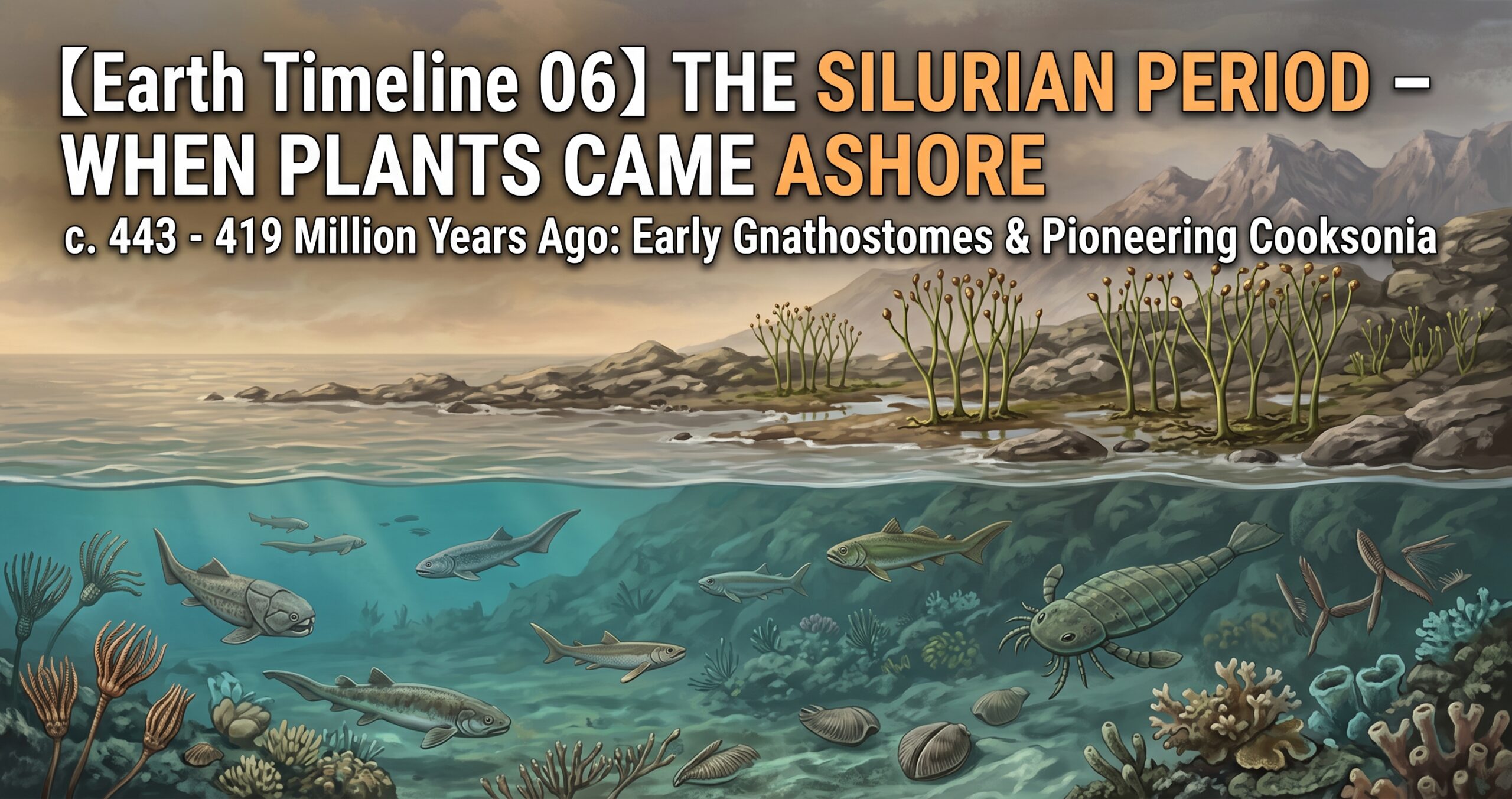
The Silurian ran from about 443 million to about 419 million years ago, lasting some 24 million years. It is the third of the six periods making up the Paleozoic Era, and also the shortest of them.
Its position is clear. The preceding Ordovician closed with a mass extinction at its end. The Silurian begins immediately after and hands on to the Devonian. The name comes from the Silures, an ancient tribe of Wales, applied to the strata of that region by Roderick Murchison in 1835.
The sea after the ice withdrew
Toward the end of the Ordovician, ice sheets grew on Gondwana as it sat near the South Pole, and sea level fell sharply. In the Silurian that ice retreated. Gondwana stayed in the south, so the ice did not vanish entirely, but its scale was far smaller than at the end of the Ordovician.
Melting ice raises sea level. Places where Silurian strata rest unconformably on eroded Ordovician strata — that is, with a gap in time between them — occur worldwide, recording a sea that withdrew, land that was stripped, and a sea that came back. Shallow water pushed into continental interiors, and warm, well-lit seafloor was restored over wide areas.
Near the equator, meanwhile, continents were converging. Laurentia (present-day North America), Baltica (Scandinavia), and Avalonia — which includes the British Isles, New England and part of Atlantic Canada — collided as the Iapetus Ocean between them closed. This series of collisions, the Caledonian orogeny, raised the mountains that became the Scottish Highlands, the Scandinavian ranges and the northern Appalachians. Similar geology occurring on both sides of the Atlantic today is because it was once a single continuous mountain chain.
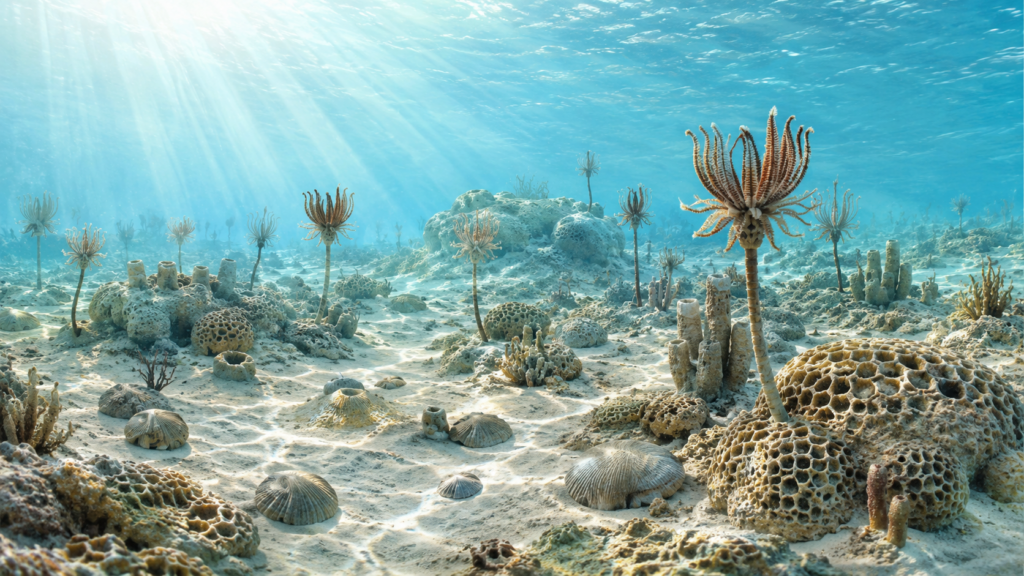
In the sea, recovery from the extinction was under way. Reefs built by stromatoporoids (a sponge group) and tabulate corals spread in many regions, crinoids gathered in stands, and brachiopods covered the seafloor. Graptolites, drifting as plankton, turned over species so rapidly that they now serve as the yardstick for dating Silurian strata.
The arrival of jawed fish
What was new in this sea was the jaw.
Vertebrate history began with jawless fish. The mouth was for sucking or scraping, not for biting. Adding a frame that opens and closes produced the gnathostomes, the lineage containing today’s fish, the amphibians, and us.
Estimates from gene comparisons put the origin of gnathostomes in the Late Ordovician, at least 450 million years ago. The fossils, however, did not keep up. The oldest gnathostome fossil preserving the whole body was long a Late Silurian specimen around 425 million years old, leaving tens of millions of years before it as a blank with nothing but scales and tooth fragments.
In 2022, that blank was filled. A team led by Zhu Min of the Institute of Vertebrate Paleontology and Paleoanthropology, Chinese Academy of Sciences, reported a set of gnathostomes dating from about 439 to about 436 million years ago, from two fossil localities in Xiushan County, Chongqing, and in Guizhou Province. The Chongqing site produced Xiushanosteus, a placoderm only about three centimeters long, and Shenacanthus, an early shark relative, both complete from head to tail. Guizhou yielded a gnathostome preserving a tooth row and a shark relative with spines and shoulder plates. Four related papers appeared side by side in the same issue of Nature.
The skull of Xiushanosteus in particular, the papers state, shows an arrangement transitional between placoderm construction and bony fish construction. The layout of the bones on top of our own heads lies downstream of that transition.
Silurian fish, though, all remained small. Most known gnathostomes run from a few centimeters to a few tens of centimeters. The exception is Megamastax, from strata about 423 million years old in Yunnan Province, China, with an estimated length of about one meter — the largest vertebrate before the Devonian. Even so, the largest predator in this sea was not a fish.
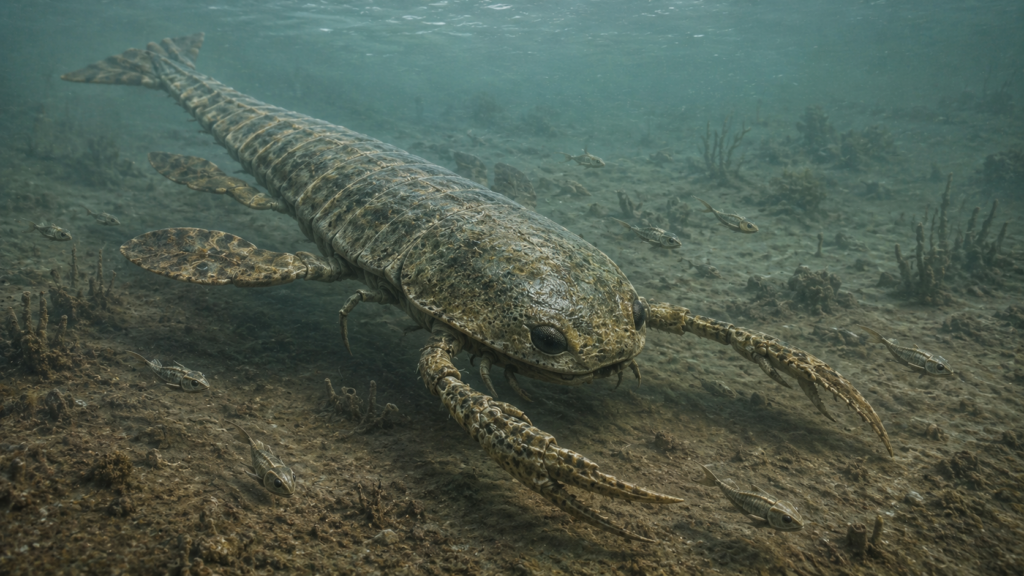
That role belonged to the eurypterids, or sea scorpions: arthropods related to horseshoe crabs and spiders, with species reaching around two meters in the later Silurian. The largest arthropods that have ever lived come from this group. Eurypterids were found alongside the fish in the Chongqing beds — a three-centimeter fish and an arthropod tens of times its size in the same place.
Repeated oceanic events
Short, and sandwiched between two mass extinctions. That makes the Silurian easy to picture as a quiet recovery interval. It was not.
Within these 24 million years, the ocean environment swung sharply at least three times: the Ireviken, Mulde and Lau events, all named after places on the Swedish island of Gotland. Silurian limestone is preserved there in good condition, making the island the reference locality for reading these events.
In the best-studied, the Ireviken event, about 80 percent of conodont species — the tooth-like microfossils left by an extinct group of elongate vertebrates — and about 50 percent of trilobite species disappeared. Its duration is estimated at roughly 200,000 years. The Mulde event drove graptolites nearly to extinction, and the Lau event again cut conodonts sharply. In all three, the carbon isotope ratio of the deposited carbonates swings strongly positive. The carbon cycle itself was being reorganized each time.
The cause is still under discussion. Explanations invoking changes in the deep ocean spreading onto shallow shelves, or temperature and sea-level swings tied to the waxing and waning of the remaining southern ice, all lack a clincher. What does not hold is the view of 24 million years of stable warm seas. The events on land described next were unfolding alongside this unsettled ocean.
The first stems standing on land
Plants did not first come ashore in the Silurian. This point is easy to get wrong.
Spores produced by land plants — often fossilized as groups of four stuck together, and called cryptospores — have already been found in Middle Ordovician strata in Argentina, about 470 million years old. Estimates from gene comparisons are older still, placing the origin of land plants themselves somewhere between the Middle Cambrian and the Early Ordovician. Vascular plants are likewise estimated within a range from the Late Ordovician into the Silurian.
Yet spores turn up and bodies do not. For tens of millions of years, the record of land plants consisted of microscopic fragments. So to put it precisely, what happened in the Silurian was not that plants came ashore, but that the bodies of plants that had come ashore began to be preserved as fossils.
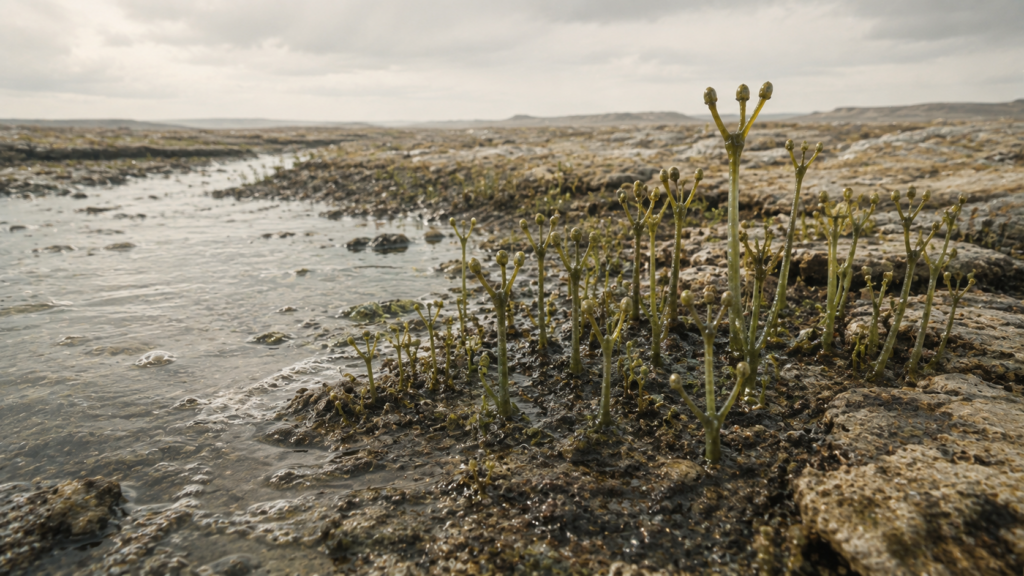
The lead here is Cooksonia, which appears in Silurian strata across Europe, North America and South America. Its form is simplicity itself, a few centimeters tall. No leaves, no roots: a slender axis forking in two, with a single spore capsule at each tip. William Lang named it in 1937 after the Australian paleobotanist Isabel Cookson.
Simple as it looks, it is a bundle of new machinery. Conducting tissue for water runs through the center of the axis, the surface is covered by a drought-resistant cuticle (a waxy membrane), and stomata open through it. The full toolkit for standing upright and living away from water is there. The great lineage of vascular plants — ferns through trees and the crops we eat — spread out from this form. It should be noted, though, that “Cooksonia” is close to a grab bag of similar-looking forms, and vascular tissue has actually been confirmed in only some specimens.
The oldest Cooksonia is held to be Cooksonia barrandei, found in the Barrandian area near Prague, Czech Republic. The graptolite species from the same strata put it at about 432 million years old. When it was described as a new species in 2018, it was positioned as the world’s oldest body fossil of a land plant.
The other half that left no fossils
Here something needs adding about how plants are built.
A plant runs its life through two generations: one that makes spores (the sporophyte) and one that makes sperm and eggs (the gametophyte). The chromosome numbers differ; a spore from the sporophyte becomes a gametophyte, fertilization occurs on the gametophyte, and the next sporophyte forms. This back and forth is called alternation of generations.
Which one looks like the main body flips between groups. Picture a moss. The green carpet covering the ground is the gametophyte. If a slender stalk rises from it with a capsule at the tip, that stalk and capsule are the sporophyte, living on top of the carpet and drawing nourishment from it. In ferns and seed plants the arrangement is reversed: the green body we see as “the plant” is entirely sporophyte. The gametophyte becomes a thin plate a few millimeters across, or is sealed inside pollen and ovules, and is barely visible.
So which is the Cooksonia fossil? With spore capsules at the tips, all of it is sporophyte. No gametophyte has ever been found.
Then in 2008, C. Kevin Boyce, then at the University of Chicago, raised an awkward point about that sporophyte: the axis is too thin.
Cooksonia has no leaves and no roots, with no division into organs. That means supporting the body, conducting water, resisting drought and photosynthesizing all have to be handled by that single axis. Boyce measured the axis thickness in the fossils and allocated cross-sectional area according to the cell types and sizes each job requires. In slender Cooksonia, the outer cuticle, the conducting tissue and the supporting tissue fill the cross-section, leaving no room for photosynthetic tissue — green tissue with air spaces running through it.
In other words, small Cooksonia most likely could not feed itself. It makes more sense that, like a moss sporophyte, it drew nourishment from a gametophyte pressed against the ground. The job of that axis was not photosynthesis but holding the spore capsule as high as possible and continuing to release spores even as the body dried out. That was Boyce’s reading.
The story does not end there, however. The fossils gathered under “Cooksonia” vary in axis thickness by more than tenfold. The thick ones pass Boyce’s threshold, leaving open the possibility that they were self-supporting. The Cooksonia barrandei mentioned above is exceptionally thick for an early land plant, and the Czech team that described it stated it would have reached a size able to hold both air spaces and photosynthetic tissue. If so, the sporophyte was independent from the start, and the starting point for land plants was a form in which the two generations each lived on their own. It is unresolved.
What is clear is that the textbook picture of “the first land plant” is not the whole of that plant. That few-centimeter stalk is only one generation of its life, and the half more likely to fossilize at that. The other half, presumably a soft body clinging to the ground, has left almost no record.
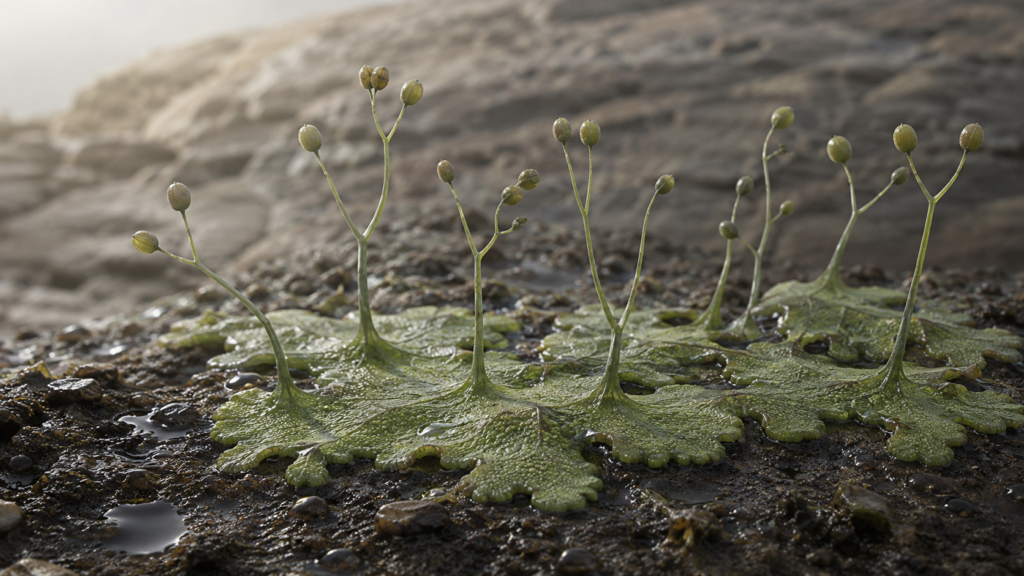
There is one clue. Somewhat later, in the Early Devonian, the Rhynie chert in Scotland preserves plants down to the cellular level, and gametophytes are among them. They have upright axes, stomata and conducting tissue, built no less thoroughly than the sporophytes. They are, however, much smaller than the sporophytes, and researchers differ on whether this counts as alternation between similar generations. Silurian gametophytes may have been close to these, but no fossil allows that to be stated outright.
The first land animals, and wobbling dates
Where green stands up, animals that eat it follow, and animals that eat those animals after them.
The oldest case where body fossils clearly show life on land comes from strata at Ludford Lane in Shropshire, western England. They belong to the Pridoli Epoch at the very end of the Silurian, about 420 million years ago. The site produced the legs of a centipede relative and trigonotarbids, an extinct arachnid group. The point when this was reported in Science in 1990 was that the cast were predators. If predators were there, animals to be eaten were below them, and below those a layer of plants and decaying organic matter. By this point, a food chain existed on land.
There is another famous fossil: Pneumodesmus newmani, a millipede found near Stonehaven in Scotland. Spiracles — openings for taking in air — are preserved on its surface, and it has been known as the oldest land animal confirmed to have breathed air. But its age is not settled. It was originally dated to about 428 million years; in 2017 a study using uranium–lead dating of zircons reported about 414 million years, placing it in the Early Devonian. In 2024 a British team produced results supporting the Late Silurian from spore analysis and additional zircon data, and in 2025 another review supported the younger age on the basis of differences in depositional setting and sediment source.
Among old strata, those formed on land are particularly hard to date. Marine strata offer index fossils such as graptolites and conodonts; terrestrial strata have none, leaving minerals in volcanic ash and the assemblages of spores mixed in. For this reason, the question of when animals came ashore still carries a range of tens of millions of years.
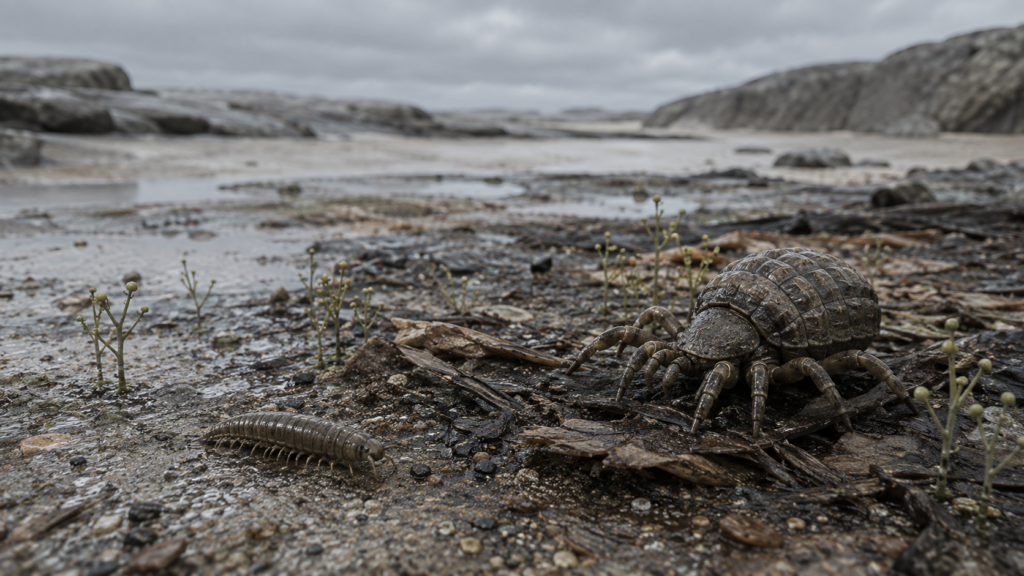
For early terrestrial ecosystems, plants and animals alike, the reality is that everything is assembled from what happened to survive. Soft bodies do not last. Strata formed on land have wobbling dates. The first tens of millions of years as green spread lie on the far side of that double gap. Even so, the fact that a few-centimeter stem stood on dry ground does not move. What follows from there is forests, roots breaking rock into soil, and changes reaching as far as the composition of the atmosphere.
Sources
Early Silurian land plant sporophytes: Libertín et al., “Sporophytes of polysporangiate land plants from the early Silurian period may have been photosynthetically autonomous” (Nature Plants, 2018)
Size and physiological constraints in Cooksonia: Boyce, “How green was Cooksonia? The importance of size in understanding the early evolution of physiology in the vascular plant lineage” (Paleobiology, 2008)
Complete early Silurian gnathostomes: Zhu et al., “The oldest complete jawed vertebrates from the early Silurian of China” (Nature, 2022)
The largest Silurian vertebrate: Choo et al., “The largest Silurian vertebrate and its palaeoecological implications” (Scientific Reports, 2014)
Estimated timing of land plant origins: Morris et al., “The timescale of early land plant evolution” (PNAS, 2018)
Middle Ordovician land plant spores: Rubinstein et al., “Early Middle Ordovician evidence for land plants in Argentina (eastern Gondwana)” (New Phytologist, 2010)
Silurian terrestrial arthropods: Jeram, Selden & Edwards, “Land animals in the Silurian: arachnids and myriapods from Shropshire, England” (Science, 1990)
Age of the Stonehaven Group (supporting the Late Silurian): Wellman et al., “Age of the basal ‘Lower Old Red Sandstone’ Stonehaven Group of Scotland” (Journal of the Geological Society, 2024)
The same strata (supporting the Early Devonian): Suarez et al., “A U-Pb zircon age constraint on the oldest-recorded air-breathing land animal” (PLOS ONE, 2017)
The Ireviken event: Munnecke, Samtleben & Bickert, “The Ireviken Event in the lower Silurian of Gotland, Sweden” (Palaeogeography, Palaeoclimatology, Palaeoecology, 2003)
Alternation of generations in early land plants: Gerrienne & Gonez, “Early evolution of life cycles in embryophytes” (Journal of Systematics and Evolution, 2011)
コメント