This article contains affiliate links. As an Amazon Associate I earn from qualifying purchases.
| Name | Diplocaulus, Greek for “double stalk.” The best-known species is Diplocaulus magnicornis (“large horn”) |
| Classification | Amphibian, lepospondyl (nectridean) |
| Age | Early Permian |
| Found in | United States (Illinois, and the red beds of Texas and Oklahoma) and elsewhere |
| Length | About 1 m in large individuals, by common estimates |
| Head width | About 35 cm from horn tip to horn tip (the life-size model used in wind tunnel tests) |
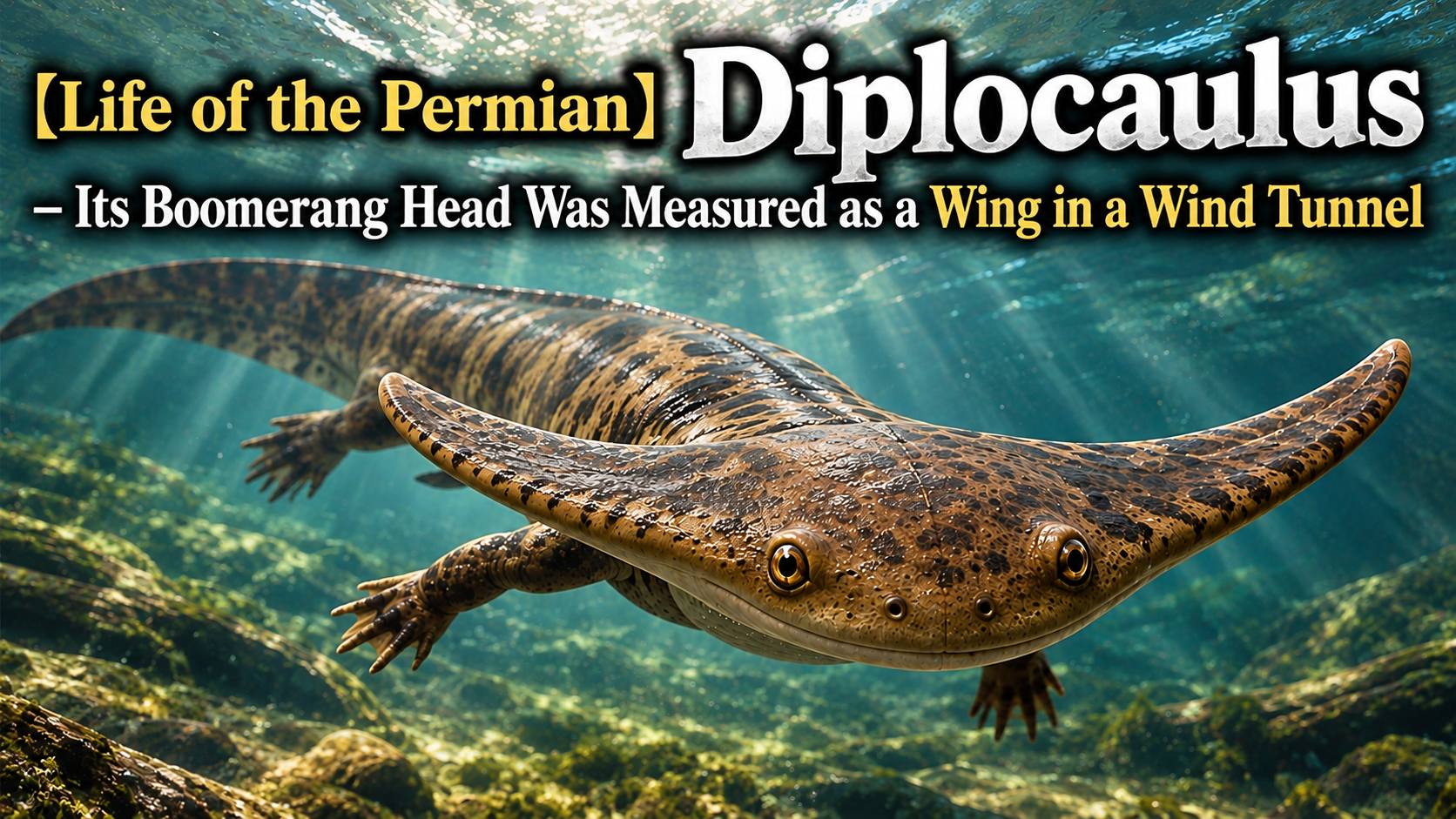
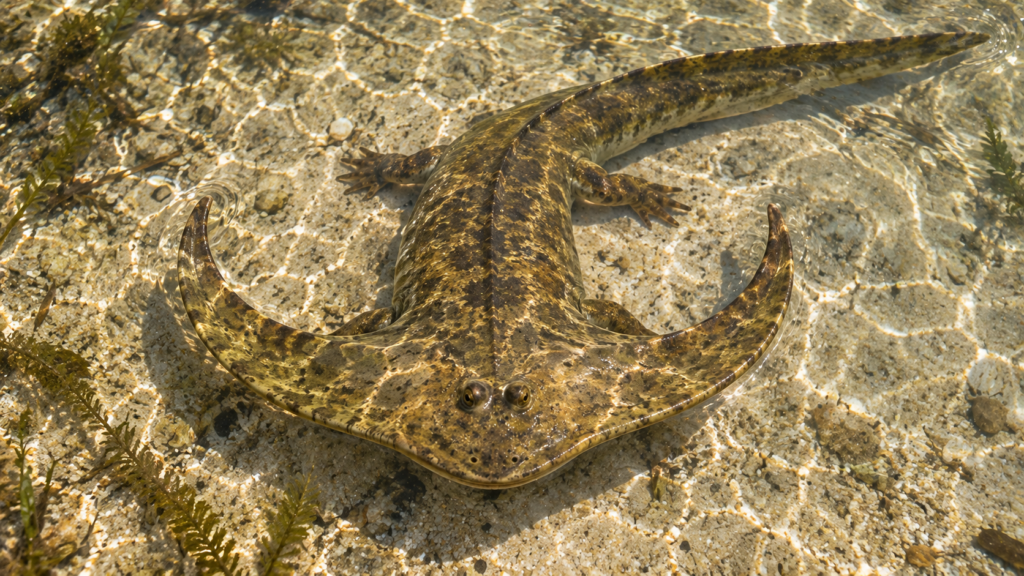
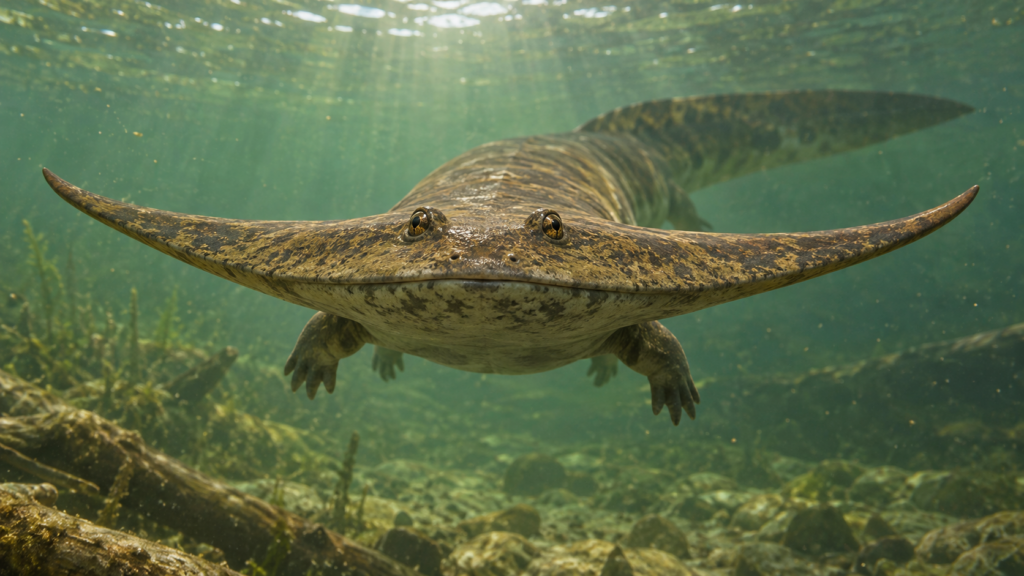
Diplocaulus was an amphibian that lived in the rivers and swamps of North America in the early Permian. The back corners of its skull flared out to the sides like horns, giving the head a boomerang shape when seen from above. What this head was for has been debated since the early 20th century, and in 1980 a fluid dynamics researcher put a life-size model of it in a wind tunnel.
Appearance and Way of Life
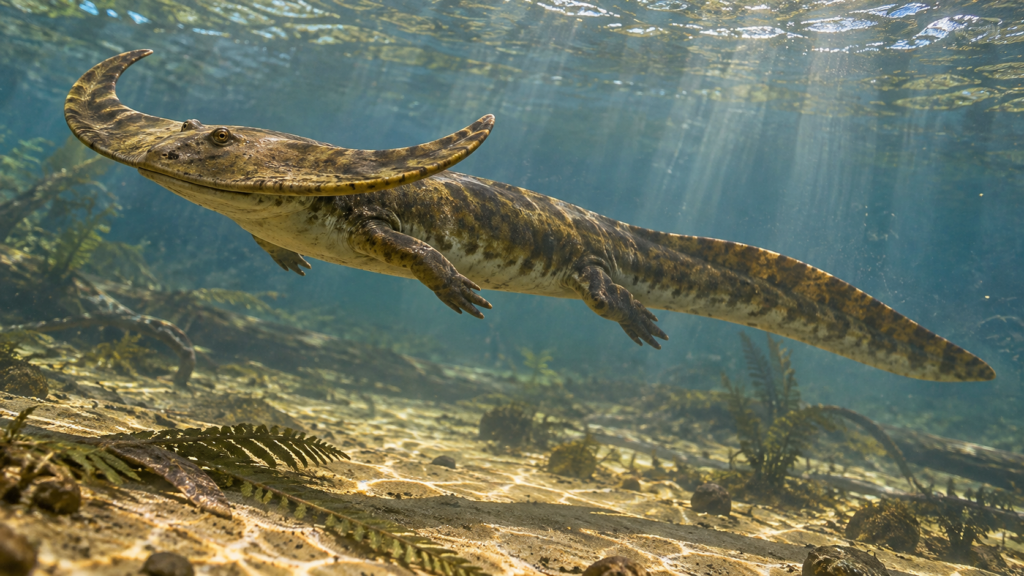
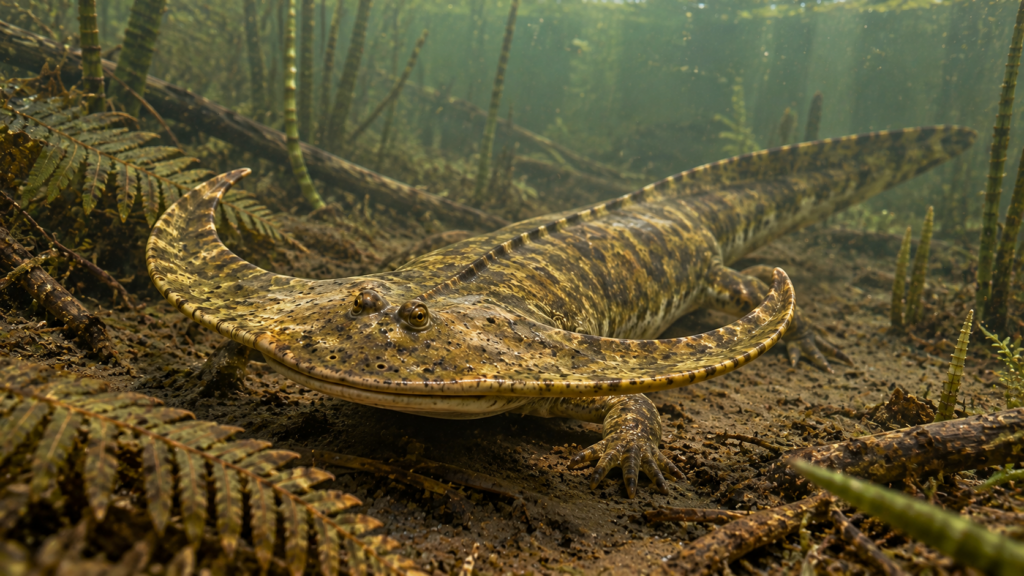
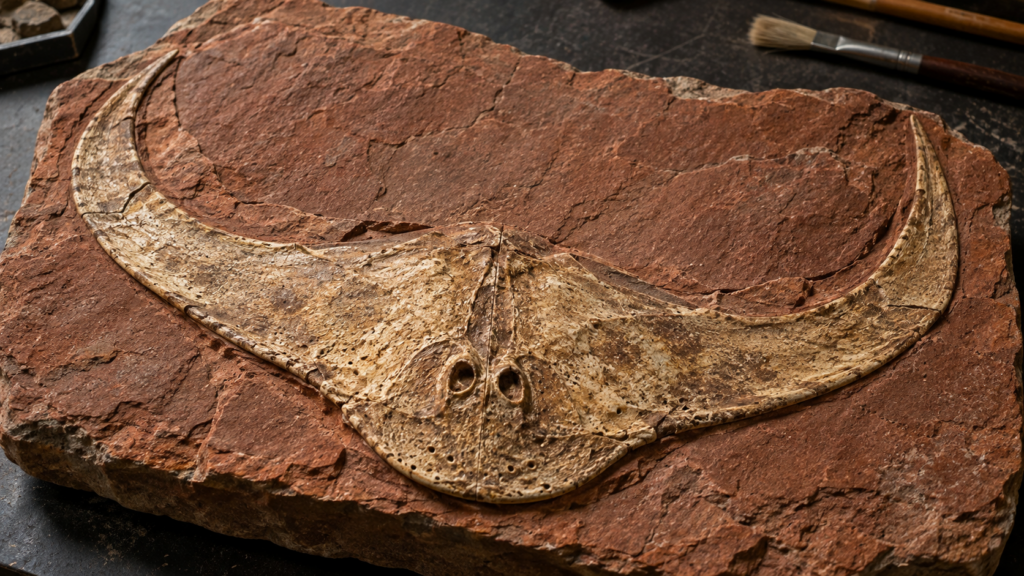
Diplocaulus had a flat body, a long trunk and tail, and short, small legs. Its eyes sat on the top of the head toward the front, facing upward. The tail was flattened from side to side and is thought to have driven it through the water. The flaring sides of the boomerang-shaped head are the tabular bones at the back corners of the skull, greatly extended outward and backward.
The genus Diplocaulus was named in 1877 by the American paleontologist Edward Drinker Cope from fossils found in Illinois. The best-known species, Diplocaulus magnicornis, was named by Cope in 1882 from fossils found in Texas. The early Permian red beds of north-central Texas, such as the Clear Fork Group, have produced many nearly complete skeletons. The early Permian rocks of Texas have also yielded the sail-backed synapsid Dimetrodon.
Studies that arranged many skulls by size show that the shape of the head changed greatly as Diplocaulus grew. In young individuals the side projections are small, and the boomerang shape becomes distinct only later in growth.
The Boomerang Head Was Measured as a Wing in a Wind Tunnel
Many ideas have been put forward for the role of the Diplocaulus head: protecting exposed external gills (Williston, 1917), counterbalancing the weight of the head (Douthitt, 1917), locomotion and protection (Olson, 1951), and ballast for stability or an aid to breathing (Beerbower, 1963). Its flat body and upward-facing eyes also led to the view that it lay still on the bottoms of rivers and swamps.
In 1980, Beric Skews, a fluid dynamics researcher at the University of the Witwatersrand in South Africa, worked with the paleontologist Arthur Cruickshank to test whether the head worked as a wing in water. Based on fossil casts provided by the Field Museum of Natural History in Chicago, they built a life-size model of the head, 11.8 cm from the snout to the neck joint and 35 cm from horn tip to horn tip, and measured in a wind tunnel the lift, the drag and the force tending to rotate the head up or down around the neck joint (the pitching moment). Assuming it swam at 0 to 3 meters per second in water, they ran the tunnel at about 50 meters per second to account for the difference between water and air.
At a slight nose-down angle, both the lift and the turning force on the head fell to zero, putting almost no strain on the neck muscles. The point at which the lift acted also stayed in the same position relative to the neck joint, so the tension in the neck muscles was directly proportional to the lift. The two concluded that these properties fit an animal feeding in midwater better than one living on the bottom. The head, shaped much like the swept wings of a jet airliner, made sense as a hydrofoil.
In 2016, Skews added a model of the body and measured the forces as both the head and the body changed angle. The animal proved to be “unstable”: a small change in angle tends to grow larger, a trait of highly maneuverable shapes. When estimates of weight and buoyancy were added, lift balanced the animal’s weight with the head tilted about 5 degrees upward, close to the point of least drag. Holding its place in a current with its tail, it could have risen or sunk quickly simply by changing the angle of its head. Skews noted that the distribution of density in the body, and whether a flap of skin lined the edges of the trunk, cannot be read from the fossils, and that firmer conclusions await better data.
Related products
You can find books and products related to this article on Amazon.
If you buy through the links above, this blog may earn a commission.
About the images
The images in this article are illustrations created with AI (ChatGPT), and you are welcome to use them. If you do, we would appreciate a link back to this article as the source.
Sources
Cruickshank, A. R. I. & Skews, B. W. (1980). The functional significance of nectridean tabular horns (Amphibia: Lepospondyli). Proceedings of the Royal Society of London. Series B 209, 513–537. https://doi.org/10.1098/rspb.1980.0110
Skews, B. W. (2016). Hydrodynamics of an Extinct Amphibian. Journal of Applied Fluid Mechanics 9(6), 2899–2903. https://doi.org/10.29252/jafm.09.06.25634
Rinehart, L. F. & Lucas, S. G. (2001). A statistical analysis of a growth series of the Permian nectridean Diplocaulus magnicornis showing two-stage ontogeny. Journal of Vertebrate Paleontology 21(4), 803–806. https://doi.org/10.1671/0272-4634(2001)021[0803:ASAOAG]2.0.CO;2


コメント