This article contains affiliate links. As an Amazon Associate I earn from qualifying purchases.
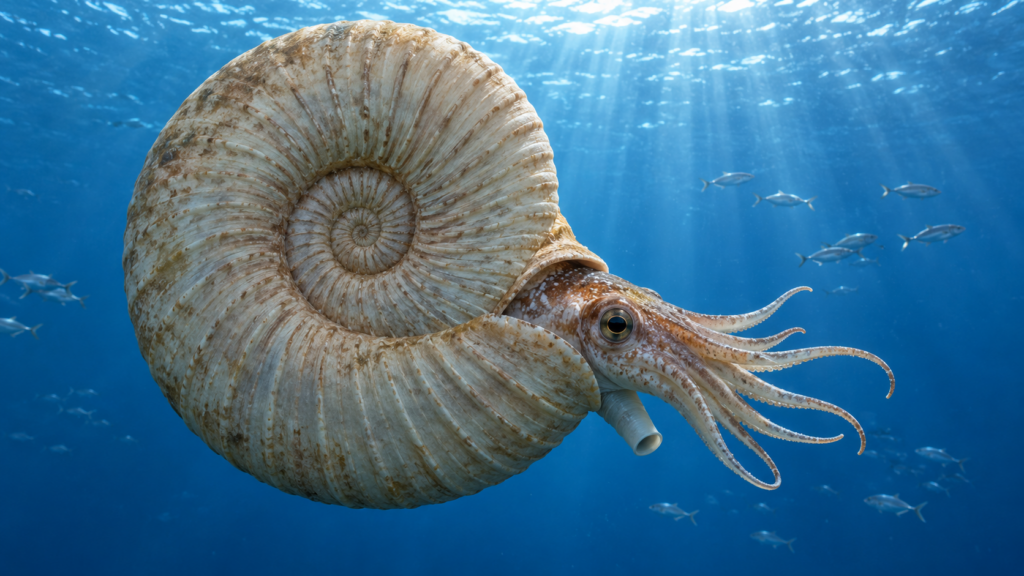
| Name | Ammonites (Ammonoidea). The name goes back to Pliny the Elder, who called them “horns of Ammon” after the Egyptian god shown with ram’s horns |
| Classification | Mollusca, Cephalopoda, Ammonoidea |
| Age | Early Devonian (about 410 million years ago) to the end of the Cretaceous (about 66 million years ago). This article places them in the Cretaceous, the home of the giant species |
| Found in | Marine rocks worldwide. In Japan, the Cretaceous rocks of Hokkaido are well known |
| Size | Shell diameter from about 1 cm up to about 1.8 m in the largest species, Parapuzosia seppenradensis |
| Weight | No reliable estimate, because the size of the body inside the shell is unknown |
Ammonites are cephalopods with coiled shells. They appeared in the Early Devonian, flourished in the world’s seas for more than 340 million years, and vanished at the end of the Cretaceous. Their shells turn up in huge numbers worldwide, but the body inside is almost never preserved, and even the number of arms has not been confirmed.
Appearance and Way of Life
The inside of the shell is divided into many chambers by walls called septa. The body occupied the last chamber, nearest the opening. A thin tube ran through the chambers behind it, and water was drawn out of them to adjust buoyancy. The line where each septum meets the shell wall is called a suture, and sutures grew more intricate over time.
Because species came and went quickly and spread over wide areas, ammonites have long been used as index fossils to date rocks. The same species in distant places marks rocks of the same age.
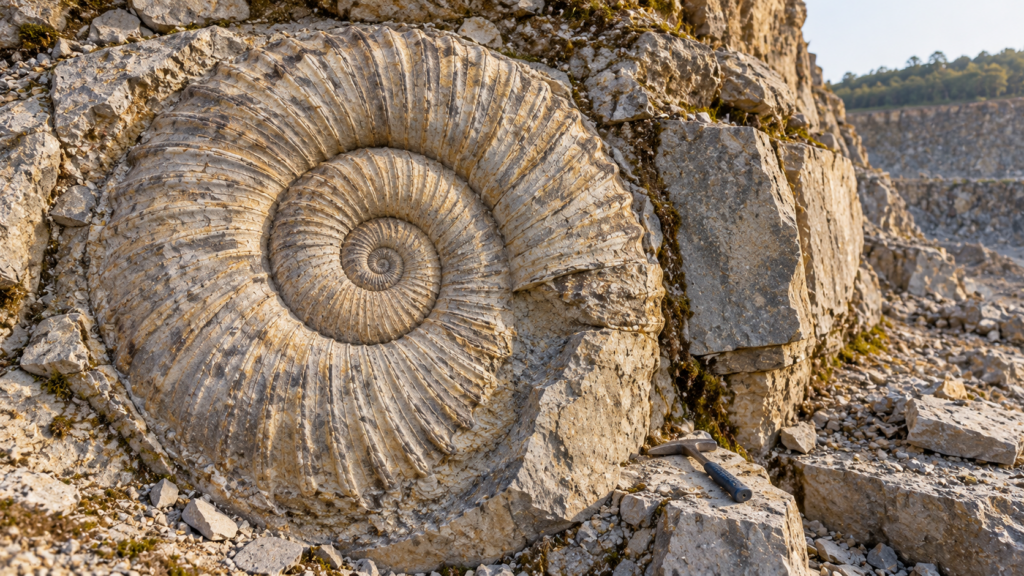
Their size varied enormously. Adults of some species had shells only about 10 mm across, while the Cretaceous Parapuzosia seppenradensis reached 1.74 m in a specimen reported in 1895 from Seppenrade, Germany. A 2021 study says the species typically grew to about 1.5 m, with the largest reaching about 1.8 m.
The shell resembles that of the nautilus, but in evolutionary terms ammonites are thought to be closer to squid and octopuses. The mass extinction at the end of the Cretaceous wiped out the ammonites, while the nautiluses survived.
Countless Shells, and Still No Clear Picture of the Body
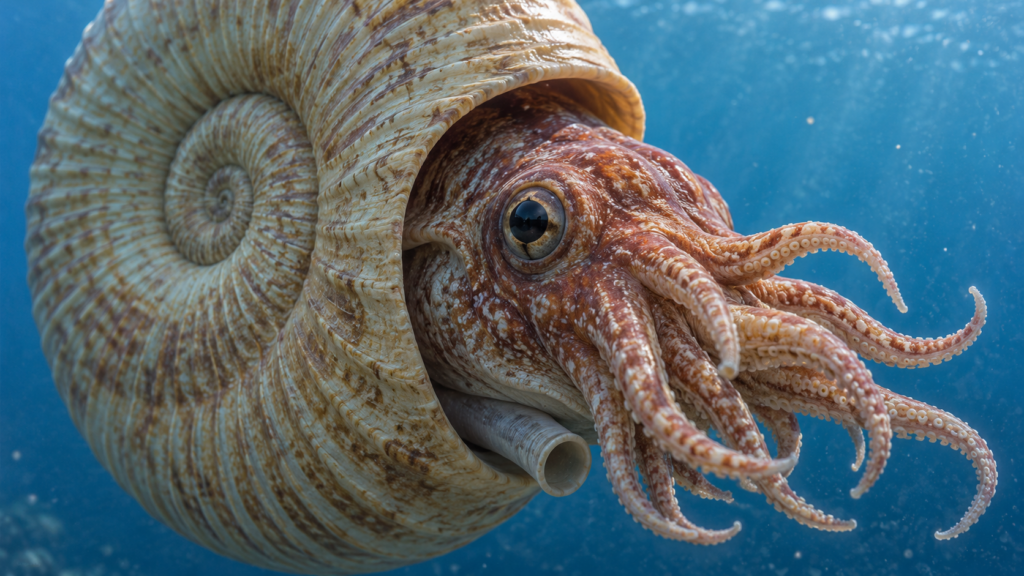
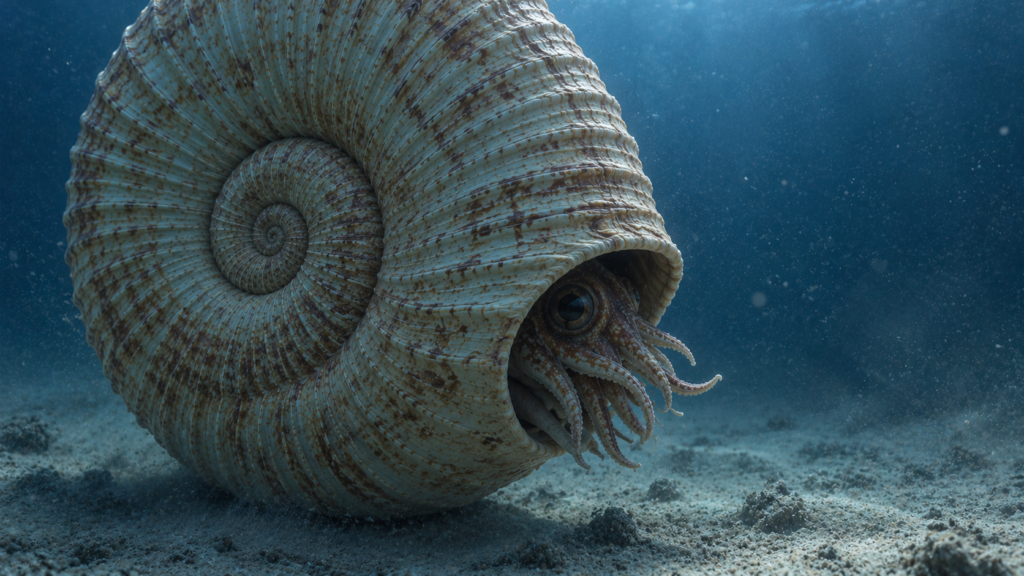
Most ammonite fossils are shells and nothing more. Muscles and organs are preserved only very rarely, and for a long time the living nautilus served as the model for reconstructing the body. Arms have been drawn in large numbers, as in a nautilus, or at around ten, as in a squid. Fossils have not settled the count.
One of the few clues from inside the shell is a structure called the aptychus: a pair of calcite plates sometimes found near the shell opening. They were first described as the shells of bivalves. Later the idea spread that they were a lid that closed the opening.
In 1972, the German paleontologist Ulrich Lehmann used specimens found with other mouthparts to argue that the aptychus was the lower jaw itself. In 1981, Nigel Morton published a paper calling the lid idea a “myth.” Others have suggested that a jaw might also have served as a lid when the body pulled back into the shell. Lehmann and Kulicki argued for this double function in 1990, and in 1993 Adolf Seilacher asked how a jaw could be transformed into a lid. The lower jaw view is now widely accepted, and the debate continues over whether it doubled as a lid.
In 2011, the inside of the mouth itself came into view. Isabelle Kruta and colleagues used synchrotron X-rays to reconstruct in three dimensions the mouthparts of Baculites, an ammonite with a straight shell. Along with the shape of the jaws and the radula, the rows of teeth, they found food remains in the mouth and concluded that this ammonite fed on plankton. They suggested the same diet may have extended to all aptychus-bearing ammonites with the same mouth shape.
Muscles were first seen in three dimensions in 2021. Lesley Cherns of Cardiff University and colleagues studied Sigaloceras enodatum, an ammonite about 5 cm across and about 165 million years old, found in 1998 at a pit in Gloucestershire, England. X-rays alone could not resolve the soft tissue, but adding neutron imaging produced a 3D model that revealed a pair of muscles for pulling the body deep into the shell. These muscles are not present in the nautilus. The team concluded that ammonites swam by jetting water from a funnel and protected themselves by withdrawing into the shell.
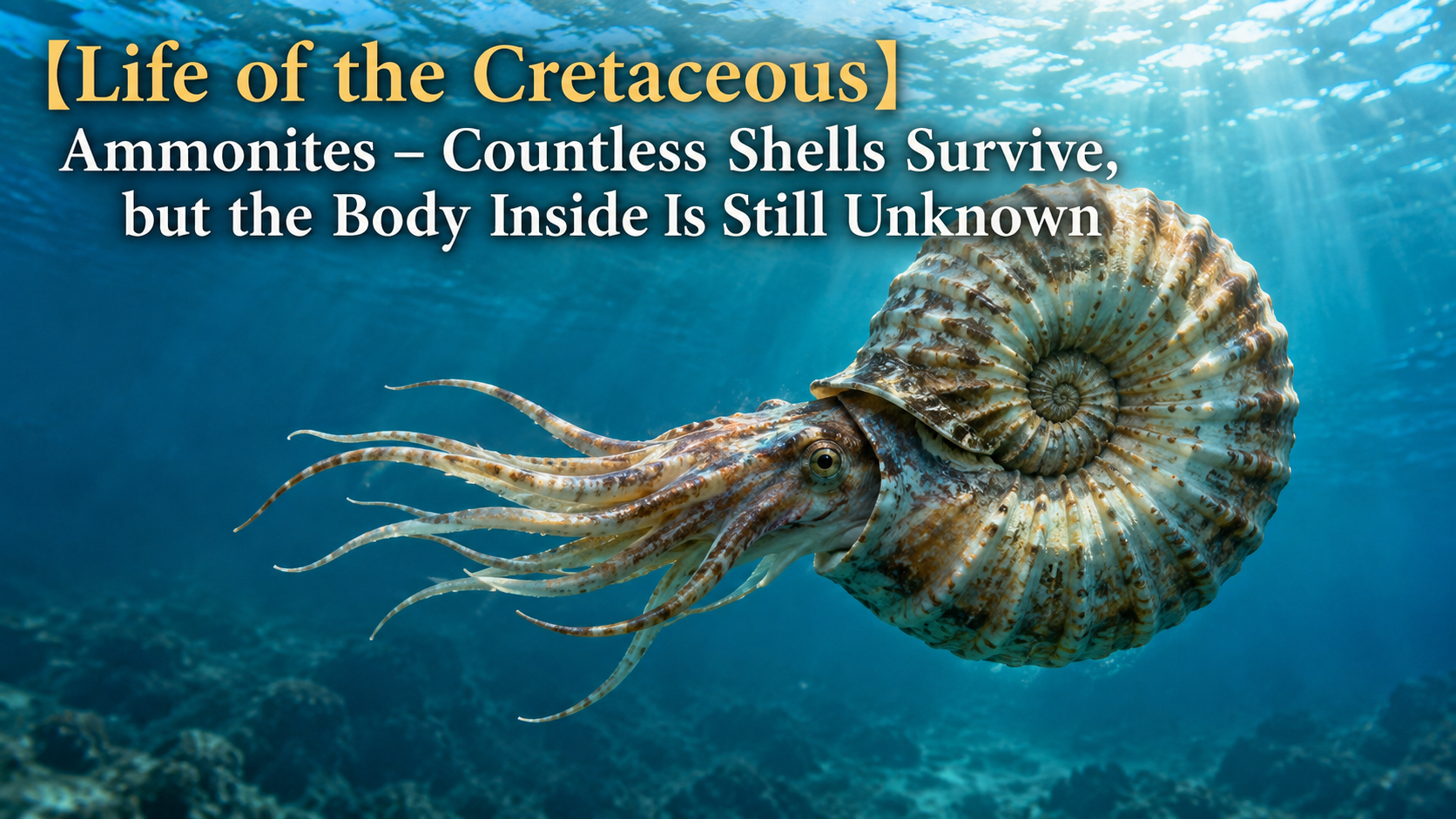
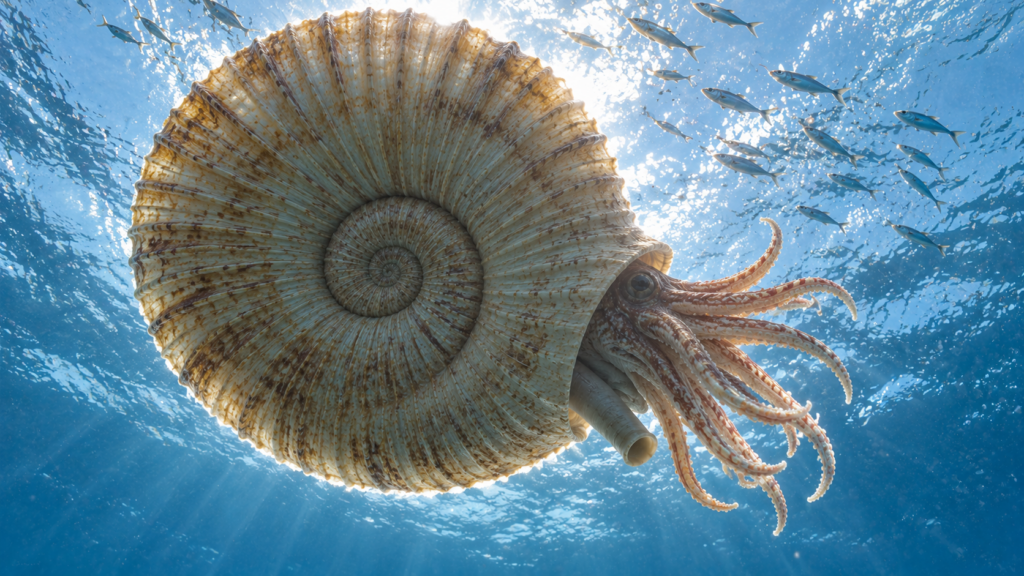
This result showed that reconstructions based on the nautilus cannot simply be carried over. Very few specimens have had their soft tissue studied in 3D, and the number of arms and the shape of the head remain unknown. The bodies in the images in this article are one possible reconstruction and include guesswork.
Related products
You can find books and products related to this article on Amazon.
If you buy through the links above, this blog may earn a commission.
About the images
The images in this article are illustrations created with AI (ChatGPT), and you are welcome to use them. If you do, we would appreciate a link back to this article as the source.
Sources
Cherns, L. et al. (2022). Correlative tomography of an exceptionally preserved Jurassic ammonite implies hyponome-propelled swimming. Geology 50, 397–401. https://doi.org/10.1130/G49551.1
ISIS Neutron and Muon Source (2021). Neutron imaging reveals never-before-seen 3D muscle structure in rare Jurassic ammonite fossil. https://www.isis.stfc.ac.uk/?p=5311
Kruta, I. et al. (2011). The role of ammonites in the Mesozoic marine food web revealed by jaw preservation. Science 331, 70–72. https://doi.org/10.1126/science.1198793
Lehmann, U. (1972). Aptychen als Kieferelemente der Ammoniten. Paläontologische Zeitschrift 46, 34–48. https://doi.org/10.1007/BF02989550
Morton, N. (1981). Aptychi: the myth of the ammonite operculum. Lethaia 14, 57–61. https://doi.org/10.1111/j.1502-3931.1981.tb01074.x
Lehmann, U. & Kulicki, C. (1990). Double function of aptychi (Ammonoidea) as jaw elements and opercula. Lethaia 23, 325–331. https://doi.org/10.1111/j.1502-3931.1990.tb01365.x
Seilacher, A. (1993). Ammonite aptychi; how to transform a jaw into an operculum? American Journal of Science 293-A, 20–32. https://doi.org/10.2475/ajs.293.a.20
Ifrim, C. et al. (2021). Ontogeny, evolution and palaeogeographic distribution of the world’s largest ammonite Parapuzosia (P.) seppenradensis (Landois, 1895). PLOS ONE 16, e0258510. https://doi.org/10.1371/journal.pone.0258510
Wikipedia: Ammonoidea (origin of the name, time range, treatment of arm number). https://en.wikipedia.org/wiki/Ammonoidea
Wikipedia: Aptychus (early description as bivalves). https://en.wikipedia.org/wiki/Aptychus

コメント