This article contains affiliate links. As an Amazon Associate I earn from qualifying purchases.
| Name | Gorgonops (Gorgonops; type species Gorgonops torvus) |
| Classification | Synapsida, Therapsida, Gorgonopsia |
| Period | End of the Middle Permian to the Late Permian (about 264 to 254 million years ago) |
| Found in | Karoo Basin, South Africa (also recorded from Zambia) |
| Skull length | About 30 cm (estimate from a skeleton reported in 2023) |
| Weight | Estimated at about 73 to 146 kg, about 98 kg on average (possibly an underestimate) |
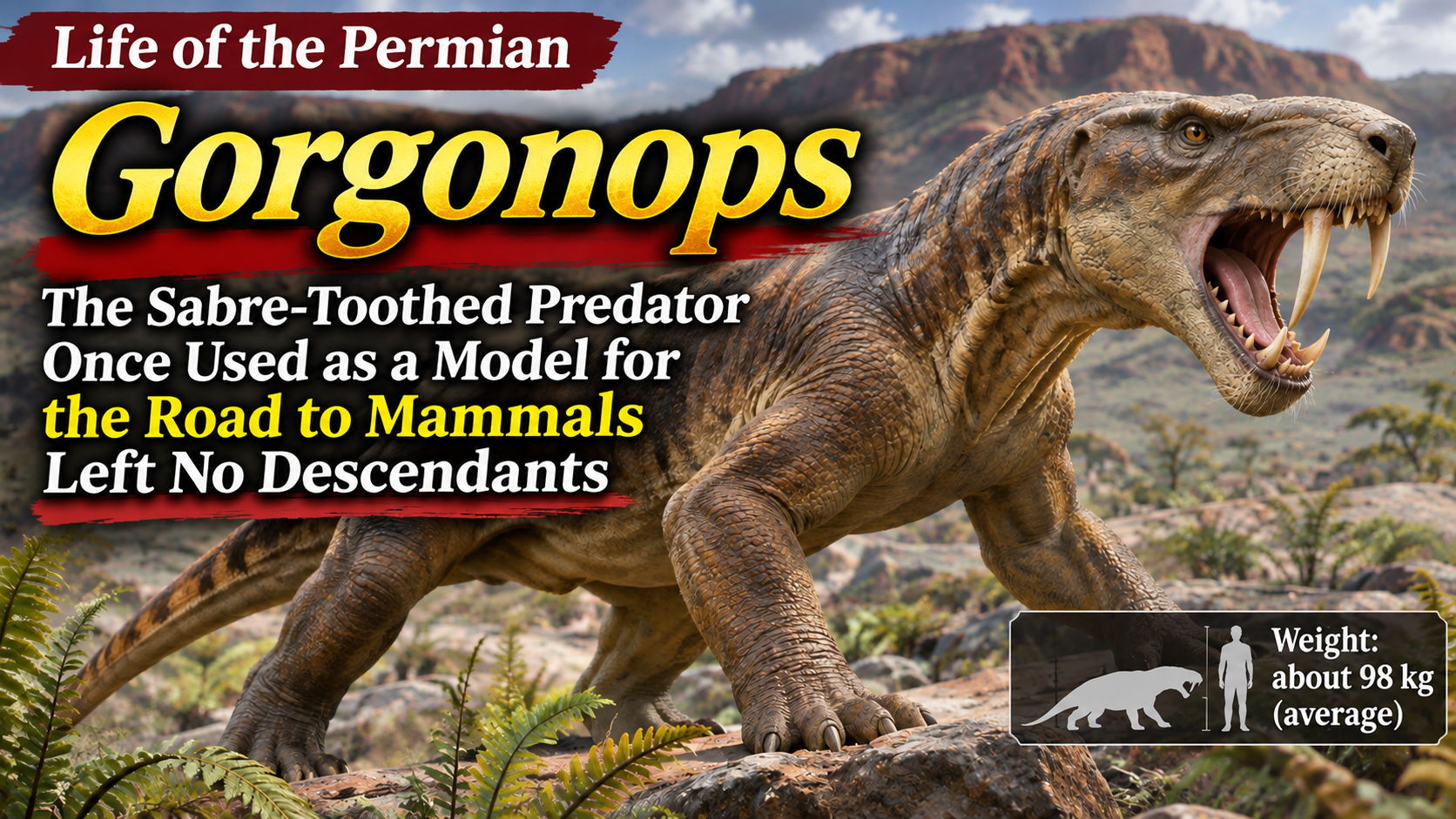
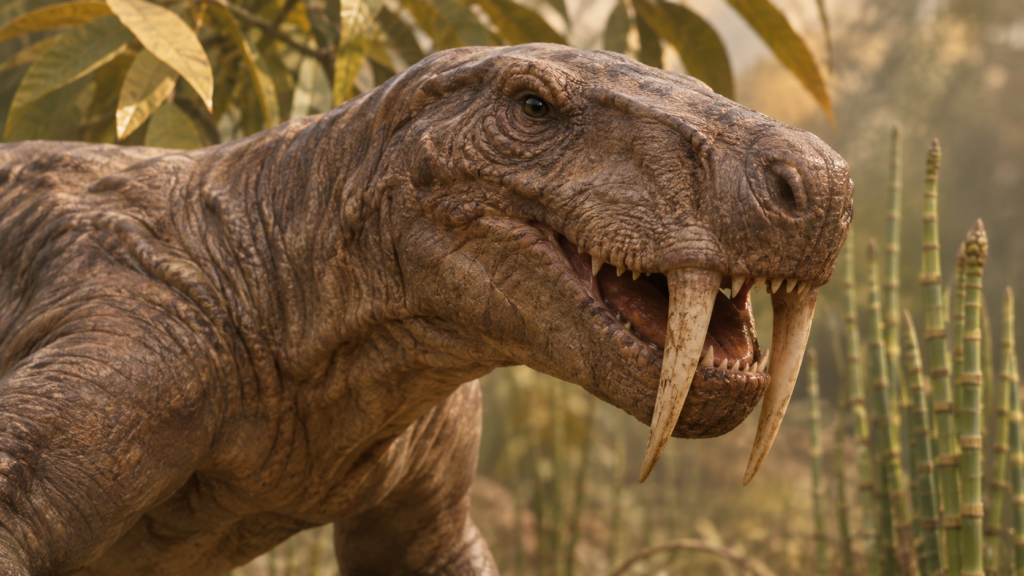
Gorgonops was a synapsid from the lineage that leads to mammals, a meat eater with long, sabre-like canine teeth. In the Permian of South Africa it stood near the top of the food chain on land. In the early 20th century it served as a model for working out how the body changed on the way from reptile-like animals to mammals, yet the gorgonopsians died out in the mass extinction at the end of the Permian without leaving any descendants.
Appearance and life
Gorgonops was named in 1876 by the British anatomist Richard Owen, based on a skull found in the Karoo Basin of South Africa. The skull, now in the Natural History Museum in London, is incomplete and flattened from top to bottom. The name of the whole group, the gorgonopsians, comes from this genus. The genus name also appears in the “Tropidostoma–Gorgonops Subzone,” one of the fossil-based divisions of the Karoo rocks.
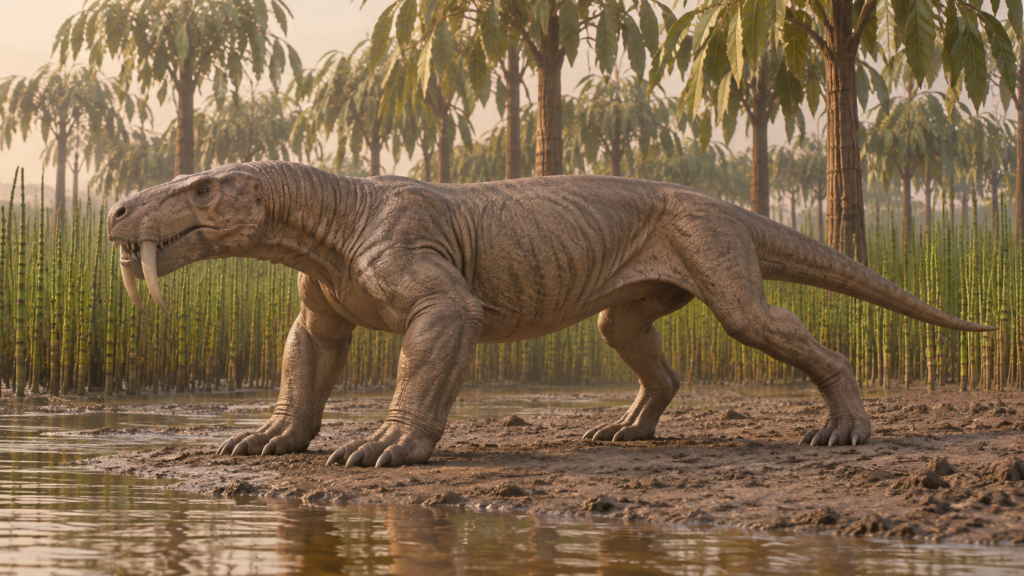
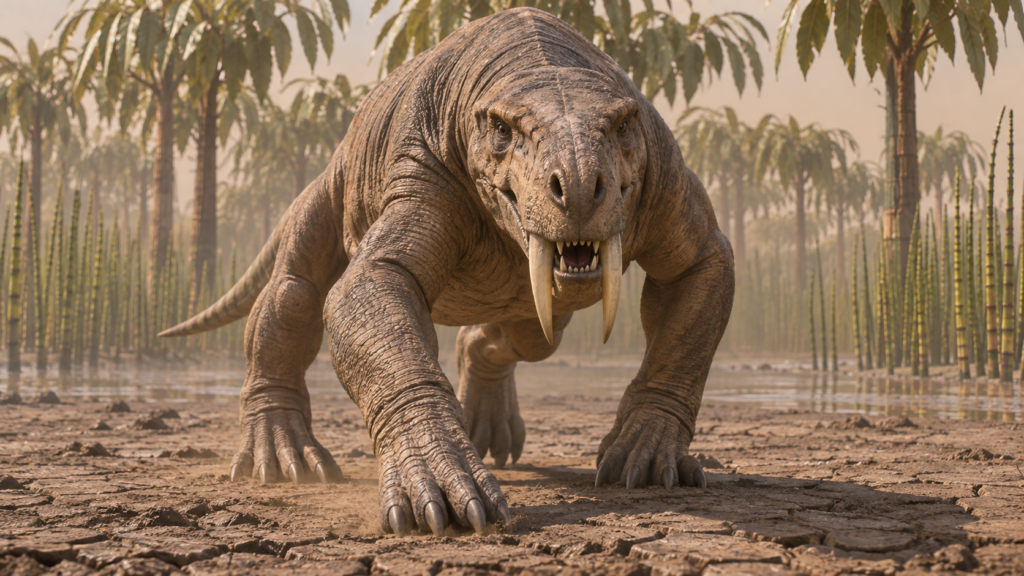
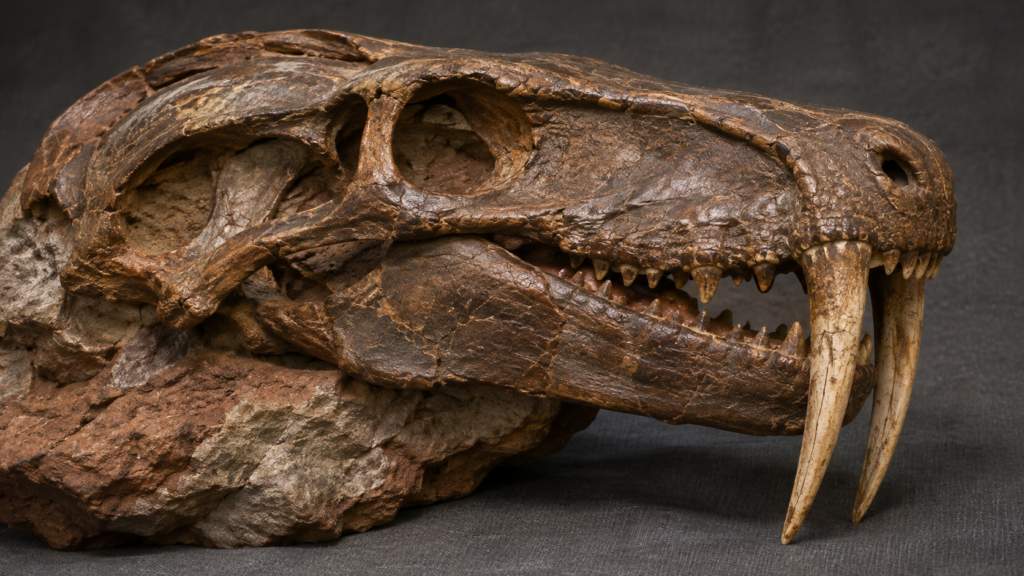
Its body is known in detail from a nearly complete skeleton found in 2007 in South Africa’s Northern Cape province. In 2023, Eva-Maria Bendel of Humboldt University of Berlin and colleagues described it. The complete skull would have been about 30 cm long, and the canine teeth at the front of the jaw were far larger than any of the other teeth. The forelimbs were thick and sturdy, and the hind limbs longer and slimmer. The legs were neither sprawled straight out to the sides nor tucked directly beneath the body, but held in between in a semi-erect posture, and the animal probably walked with its heels slightly raised. Three methods put its weight at about 73 to 146 kg, about 98 kg on average, close to that of a modern lioness.
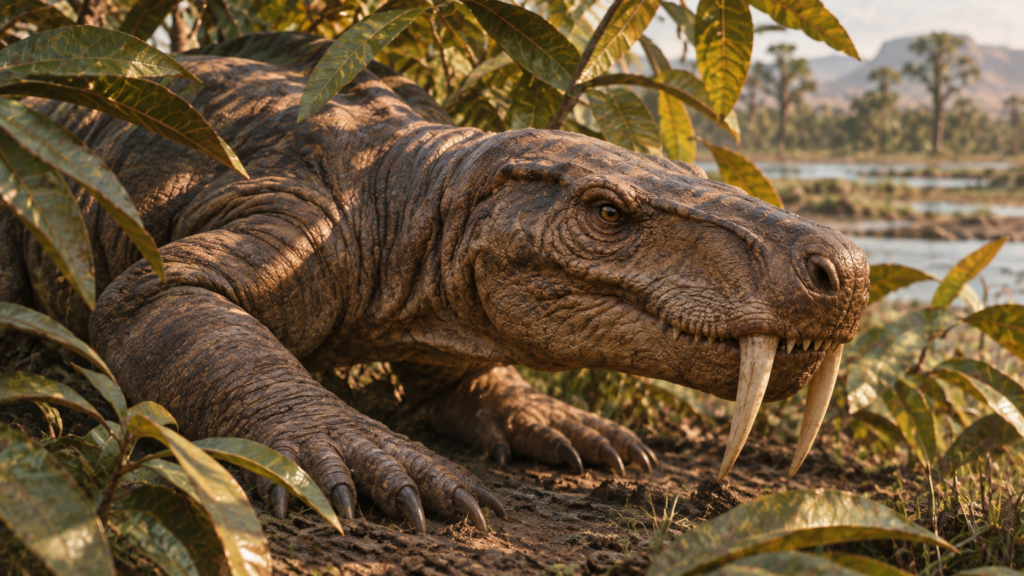
From this build, Bendel and colleagues infer that it did not chase prey over long distances. Instead it probably waited in cover, made a short dash, pinned its prey with its forelimbs and then used its canines. Large gorgonopsians such as Gorgonops were very likely the top predators on land at the time.
The same rocks yield many dicynodonts, plant-eating synapsids. Endothiodon and Tropidostoma, which give their names to the fossil zones, are both dicynodonts and likely prey for Gorgonops. The same zone is also where fossils of cynodonts, the group on the mammal-ancestor side, first appear in the Karoo Basin.
A model for the road to mammals that left no descendants
Gorgonopsian skulls share many features with mammals. Their teeth are divided by position into front cutting teeth, long canines and cheek teeth. In the 1910s, the South African paleontologist Robert Broom and the British paleontologist D. M. S. Watson used gorgonopsians as models for reconstructing how the body plan shifted from reptile-like animals to mammals.
Later research clarified where gorgonopsians sit within the mammal lineage. In a 2018 analysis by Christian Kammerer of the North Carolina Museum of Natural Sciences and a colleague, the group next to the gorgonopsians is the one that unites therocephalians and cynodonts. Mammals arose from the cynodonts within that group. Gorgonopsians were not the ancestors of mammals themselves, but a separate lineage that branched off close to that ancestry.
And the gorgonopsians left nothing at the end of their branch. In 2023, Kammerer and colleagues reported fossils of Inostrancevia, a giant gorgonopsian previously known from Russia, from South Africa, and traced how top predators replaced one another in South Africa at the end of the Permian. The largest native gorgonopsians of South Africa had already declined before the mass extinction. Inostrancevia, arriving from the northern hemisphere, filled the vacant role, but only briefly. By the Permian–Triassic boundary all gorgonopsians were gone, and therocephalians became the largest synapsid predators.
The line that made it through the mass extinction and on to the mammals was the cynodonts, which lived alongside the gorgonopsians at smaller body sizes.
Related products
You can find books and products related to this article on Amazon.
If you buy through the links above, this blog may earn a commission.
About the images
The images in this article are illustrations created with AI (ChatGPT), and you are welcome to use them. If you do, we would appreciate a link back to this article as the source.
Sources
Bendel, E.-M., Kammerer, C. F., Smith, R. M. H. & Fröbisch, J. (2023). The postcranial anatomy of Gorgonops torvus (Synapsida, Gorgonopsia) from the late Permian of South Africa. PeerJ 11, e15378. https://doi.org/10.7717/peerj.15378
Kammerer, C. F., Viglietti, P. A., Butler, E. & Botha, J. (2023). Rapid turnover of top predators in African terrestrial faunas around the Permian-Triassic mass extinction. Current Biology 33, 2283–2290. https://doi.org/10.1016/j.cub.2023.04.007
Kammerer, C. F. & Masyutin, V. (2018). Gorgonopsian therapsids (Nochnitsa gen. nov. and Viatkogorgon) from the Permian Kotelnich locality of Russia. PeerJ 6, e4954. https://doi.org/10.7717/peerj.4954
Day, M. O. & Smith, R. M. H. (2020). Biostratigraphy of the Endothiodon Assemblage Zone (Beaufort Group, Karoo Supergroup), South Africa. South African Journal of Geology 123, 165–180. https://doi.org/10.25131/sajg.123.0011
Field Museum (2023). Fossils of a saber-toothed top predator reveal a scramble for dominance. https://www.fieldmuseum.org/about/press/fossils-of-a-saber-toothed-top-predator-reveal-a-scramble-for-dominance
The Paleobiology Database. Gorgonops Owen 1876. https://paleobiodb.org/classic/basicTaxonInfo?taxon_no=39118

コメント