This article contains affiliate links. As an Amazon Associate I earn from qualifying purchases.
| Name | Plesiosaurus (Plesiosaurus dolichodeirus; the genus name means “near to reptile”) |
| Classification | Reptilia, Sauropterygia, Plesiosauria, Plesiosauridae |
| Period | Early Jurassic (the first complete skeleton comes from rocks about 199.5 to 192.9 million years old) |
| Found in | Lyme Regis, Dorset, southwest England, UK |
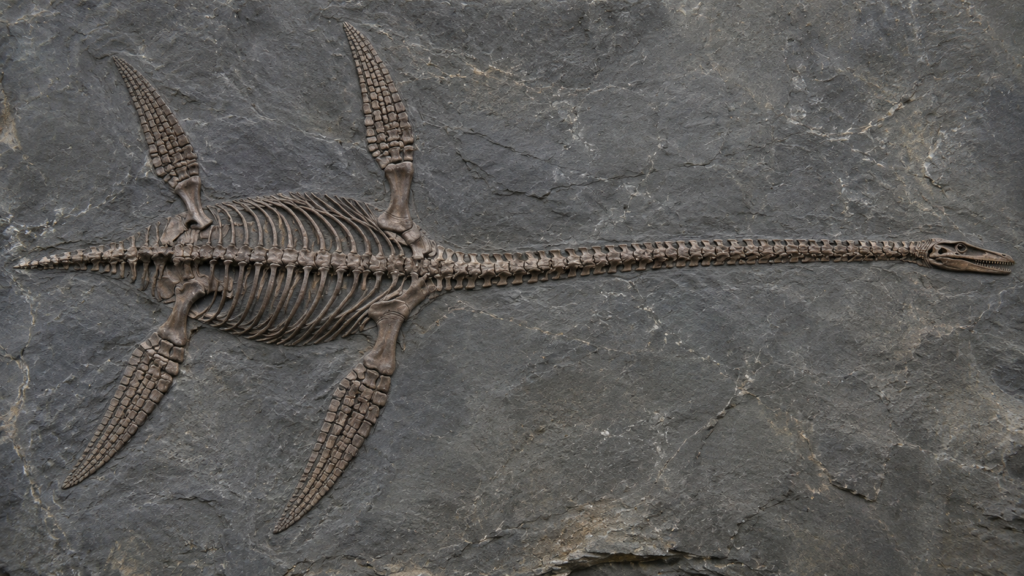
| Specimen size | The first complete skeleton sits in a rock slab about 3 m long and 2 m wide |
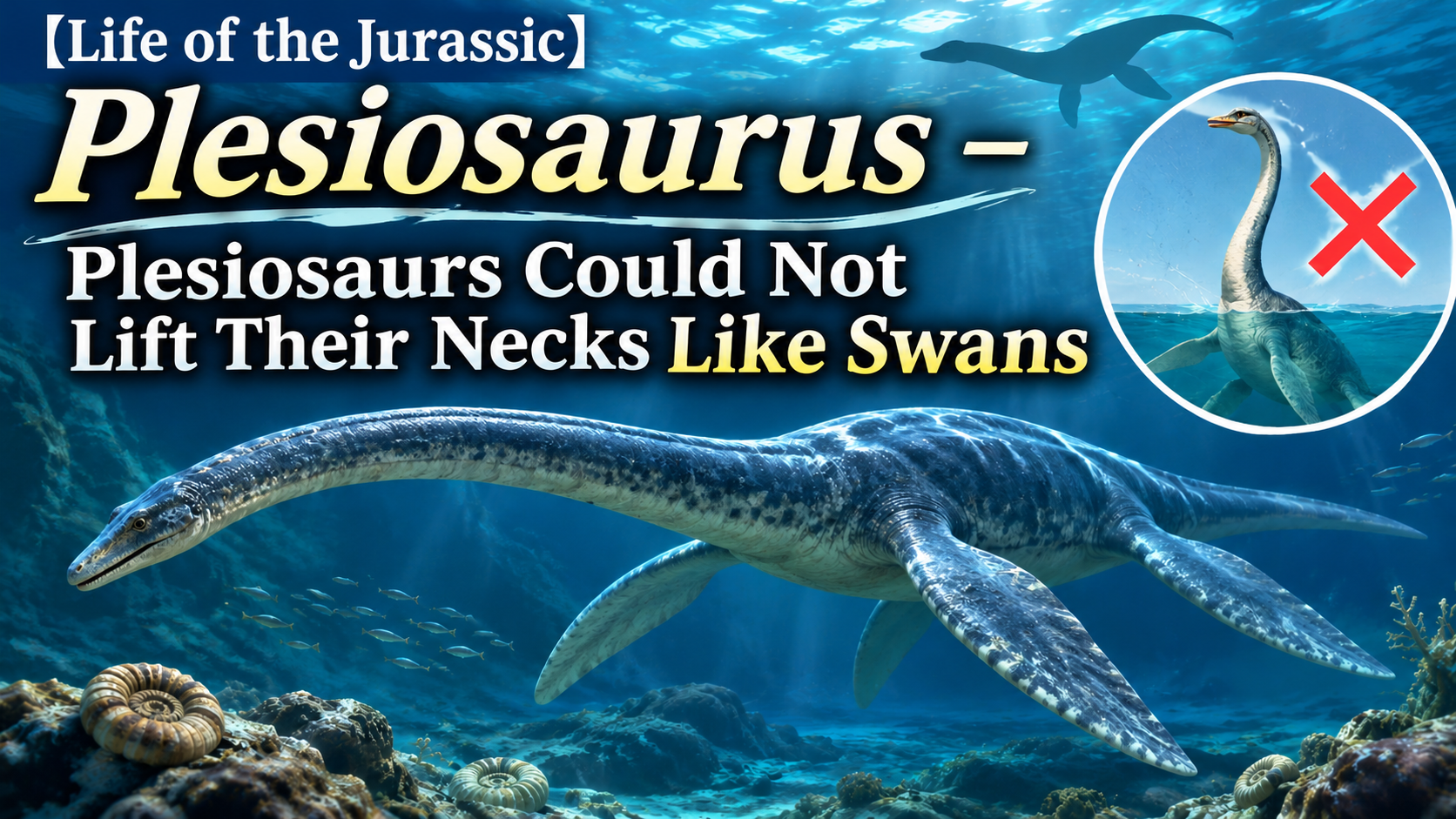
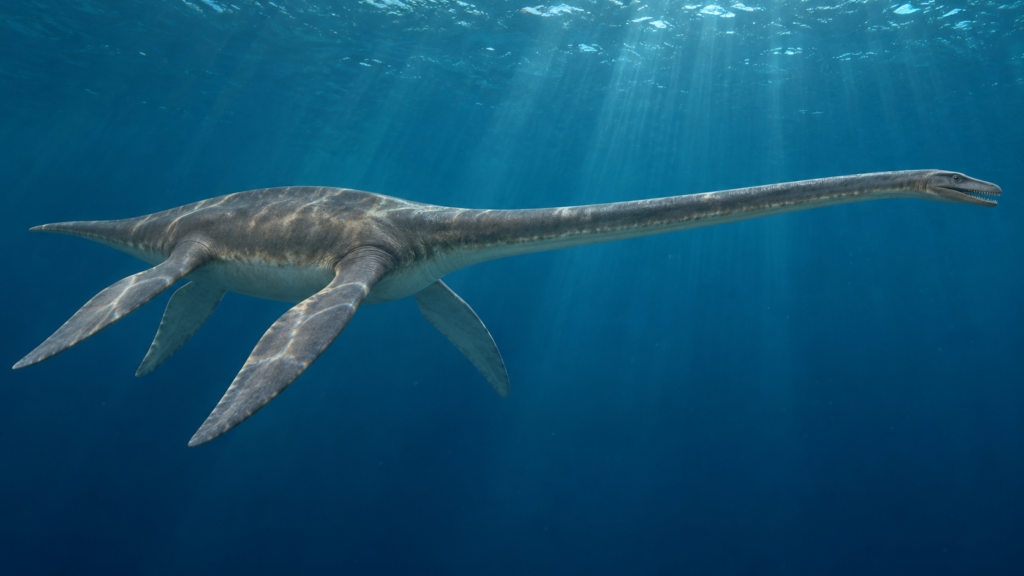
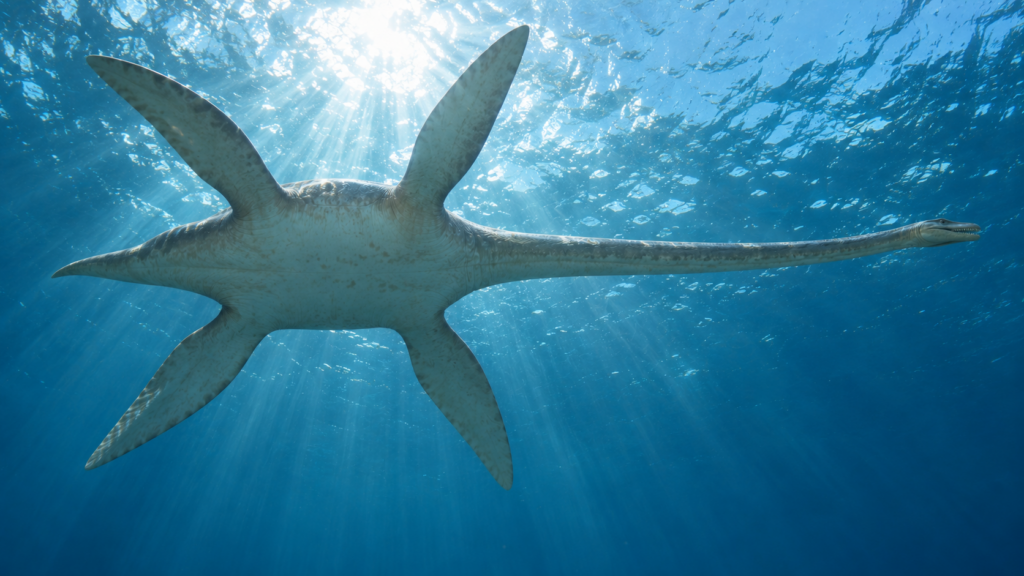
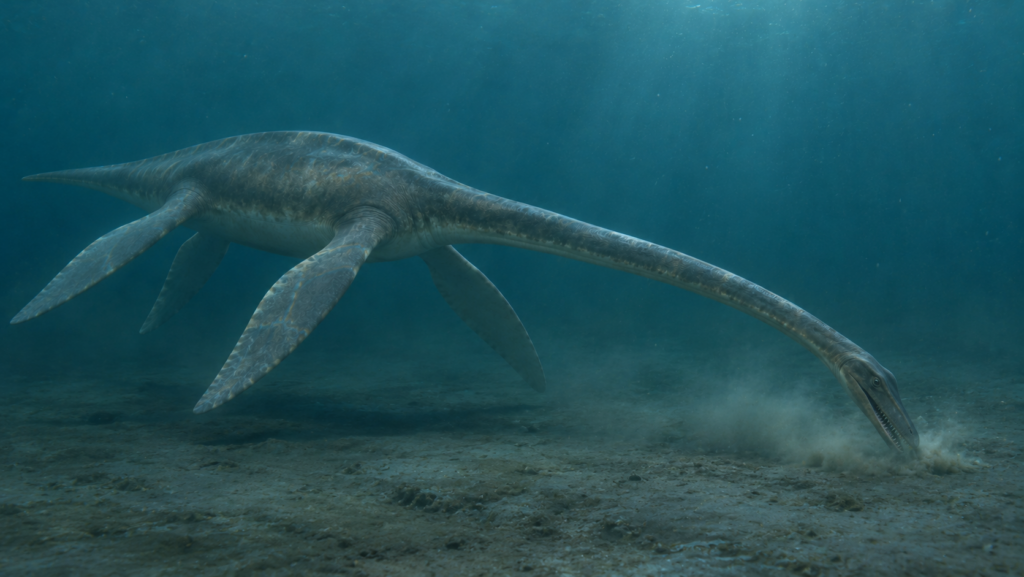
Plesiosaurus was a plesiosaur, a marine reptile with a small head, a long neck and four flippers. It was the first plesiosaur ever named, and the scientific name of the whole group, Plesiosauria, comes from this genus. Pictures of the Loch Ness monster often show a plesiosaur holding its neck high out of the water like a swan, but studies of plesiosaur neck bones conclude that they could not hold such a posture.
Appearance and life
The name Plesiosaurus was coined in 1821 by the British geologists Henry De la Beche and William Conybeare, based on scattered bones. At that point the body as a whole was unknown, and the arrangement of the front flipper bones was pieced together by guesswork that included misidentified bones.
The full body became known on 10 December 1823, when the fossil collector Mary Anning found a skeleton with its bones still joined together at Lyme Regis. The following year, 1824, Conybeare named the species dolichodeirus based on this skeleton. Its neck was extremely long, and when it was shown at a meeting of the Geological Society in London on 20 February 1824, the French anatomist Georges Cuvier suspected it was a fake assembled from the bones of different animals. Convinced it was genuine after explanations by Conybeare and William Buckland, Cuvier later had another plesiosaur skeleton bought from Anning for the museum in Paris. The first complete skeleton is now on display at the Natural History Museum in London.
In the 19th century many plesiosaur fossils found in various places were placed in the genus Plesiosaurus, but most of them have since been moved to other genera. Today P. dolichodeirus is the only species recognized in the genus.
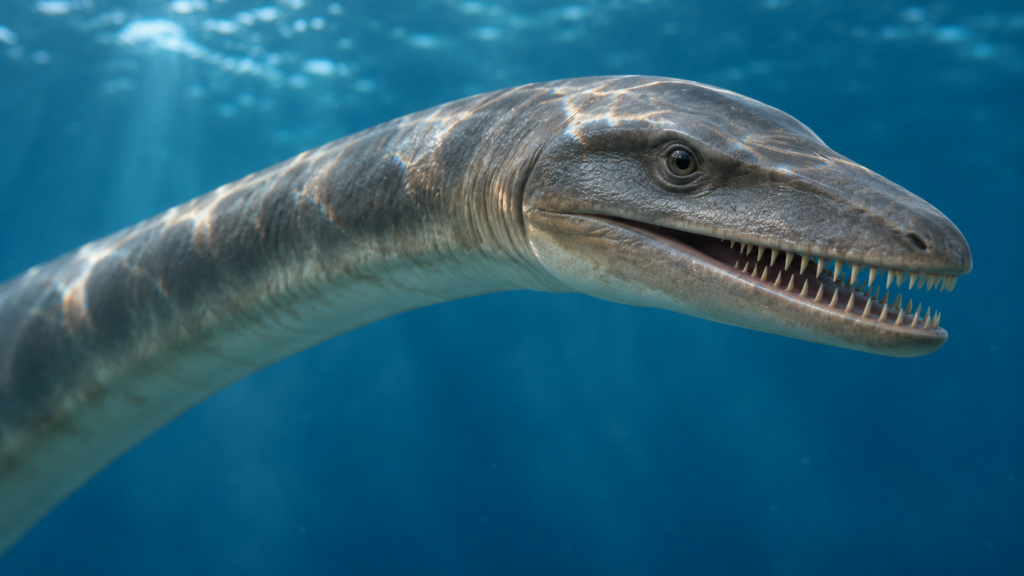
Plesiosaurus is thought to have swum by moving its four flippers up and down, much like a bird’s wings. In 2017 a team led by the University of Southampton tested flipper models based on fossils in a water tank. When the hind flippers moved in step with the front ones, they produced up to 60% more thrust and up to 40% higher efficiency than when moving alone. No stomach contents are known for Plesiosaurus, but the shape of its teeth suggests it ate small, soft prey such as fish and squid-like cephalopods.
Plesiosaurs gave birth to live young rather than laying eggs, as shown by a fossil of a different, Cretaceous plesiosaur reported in 2011. A single large fetus was preserved inside the mother’s body.
It could not lift its neck like a swan
For a long time plesiosaurs were drawn with their necks bent in an S-shape, holding their heads high like swans. Pictures of the Loch Ness monster with its neck sticking up out of the water are based on this pose.
In 2008, Maria Zammit and colleagues examined the neck bones of Aphrosaurus, a long-necked plesiosaur from the Cretaceous, and measured how far each joint between the bones could bend. They estimated that the neck as a whole could bend 75 to 177 degrees downward, 87 to 155 degrees upward and 94 to 176 degrees sideways. Because a swan-like S-shaped posture would need more than 360 degrees of bending in the up-and-down direction, they concluded that it was impossible. The neck is thought to have been held straight out ahead while swimming and moved sideways or downward when catching food.
In 2017, Leslie Noè and colleagues reviewed plesiosaur neck bones, joints, muscles and swimming together. They found that the neck was mainly suited to bending downward, while lifting it up, moving it sideways and twisting it were limited. Noè and colleagues see the plesiosaur neck as a stiff “feeding tube” carried on a body that the flippers moved around. In their view, plesiosaurs fed in the water just above the seafloor or in soft mud, sieving or raking through water and sediment. In 2019 a team at the University of Bonn in Germany modeled the neck bones of the Middle Jurassic plesiosaur Cryptoclidus on a computer and found that its neck had limited movement in every direction.
These studies looked at the necks of other plesiosaurs, not of the genus Plesiosaurus itself. The range of motion of Plesiosaurus’s own neck has not yet been studied with the same methods.
Related products
You can find books and products related to this article on Amazon.
If you buy through the links above, this blog may earn a commission.
About the images
The images in this article are illustrations created with AI (ChatGPT), and you are welcome to use them. If you do, we would appreciate a link back to this article as the source.
Sources
De la Beche, H. T. & Conybeare, W. D. (1821). Notice of the discovery of a new fossil animal, forming a link between the Ichthyosaurus and crocodile. Transactions of the Geological Society of London 5, 559–594. https://doi.org/10.1144/transgsla.5.559
Conybeare, W. D. (1824). On the discovery of an almost perfect skeleton of the Plesiosaurus. Transactions of the Geological Society of London, series 2, 1, 381–389. https://doi.org/10.1144/transgslb.1.2.381
Zammit, M., Daniels, C. B. & Kear, B. P. (2008). Elasmosaur (Reptilia: Sauropterygia) neck flexibility: implications for feeding strategies. Comparative Biochemistry and Physiology Part A 150, 124–130. https://doi.org/10.1016/j.cbpa.2007.09.004
Noè, L. F., Taylor, M. A. & Gómez-Pérez, M. (2017). An integrated approach to understanding the role of the long neck in plesiosaurs. Acta Palaeontologica Polonica 62, 137–162. https://doi.org/10.4202/app.00334.2016
Wintrich, T. et al. (2019). Neck mobility in the Jurassic plesiosaur Cryptoclidus eurymerus: finite element analysis as a new approach to understanding the cervical skeleton in fossil vertebrates. PeerJ 7, e7658. https://doi.org/10.7717/peerj.7658
Muscutt, L. E. et al. (2017). The four-flipper swimming method of plesiosaurs enabled efficient and effective locomotion. Proceedings of the Royal Society B 284, 20170951. https://doi.org/10.1098/rspb.2017.0951
O’Keefe, F. R. & Chiappe, L. M. (2011). Viviparity and K-selected life history in a Mesozoic marine plesiosaur (Reptilia, Sauropterygia). Science 333, 870–873. https://doi.org/10.1126/science.1205689
Geological Society of London. Mary Anning and the Geological Society: Plesiosaurus dolichodeirus. https://www.geolsoc.org.uk/the-library/online-exhibitions/Mary-Anning-and-the-Geological-Society/reconstruction-of-life/plesiosaurus-dolichodeirus
Natural History Museum, London. Mary Anning: the unsung hero of fossil discovery. https://www.nhm.ac.uk/discover/mary-anning-unsung-hero.html
Smith, A. S. The Plesiosaur Directory: Plesiosaurus. https://plesiosauria.com/plesiosaurus/


コメント