| Name | Yunnanozoon lividum, “the animal of Yunnan.” The species name lividum means “lead-colored,” after the color of the fossils |
| Classification | Bilaterian. Its phylogenetic position is undetermined (proposals include the vertebrate stem lineage and the chordate stem lineage) |
| Age | Early Cambrian (about 518 million years ago) |
| Found in | Chengjiang, Yunnan Province, China |
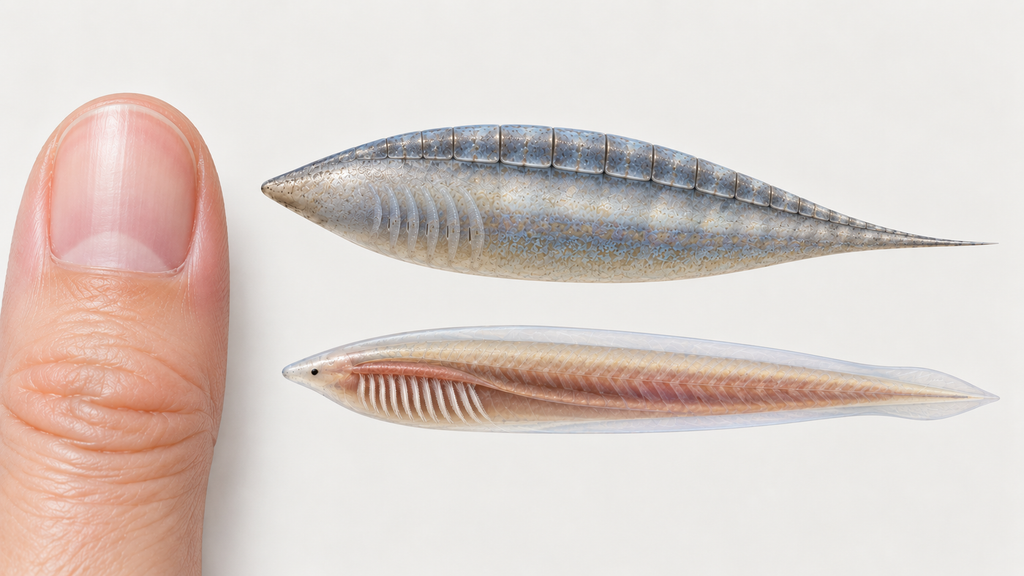
| Length | 2 to 6 cm |
| Weight | Around 1 g (approximated from fish-shaped animals of the same size) |
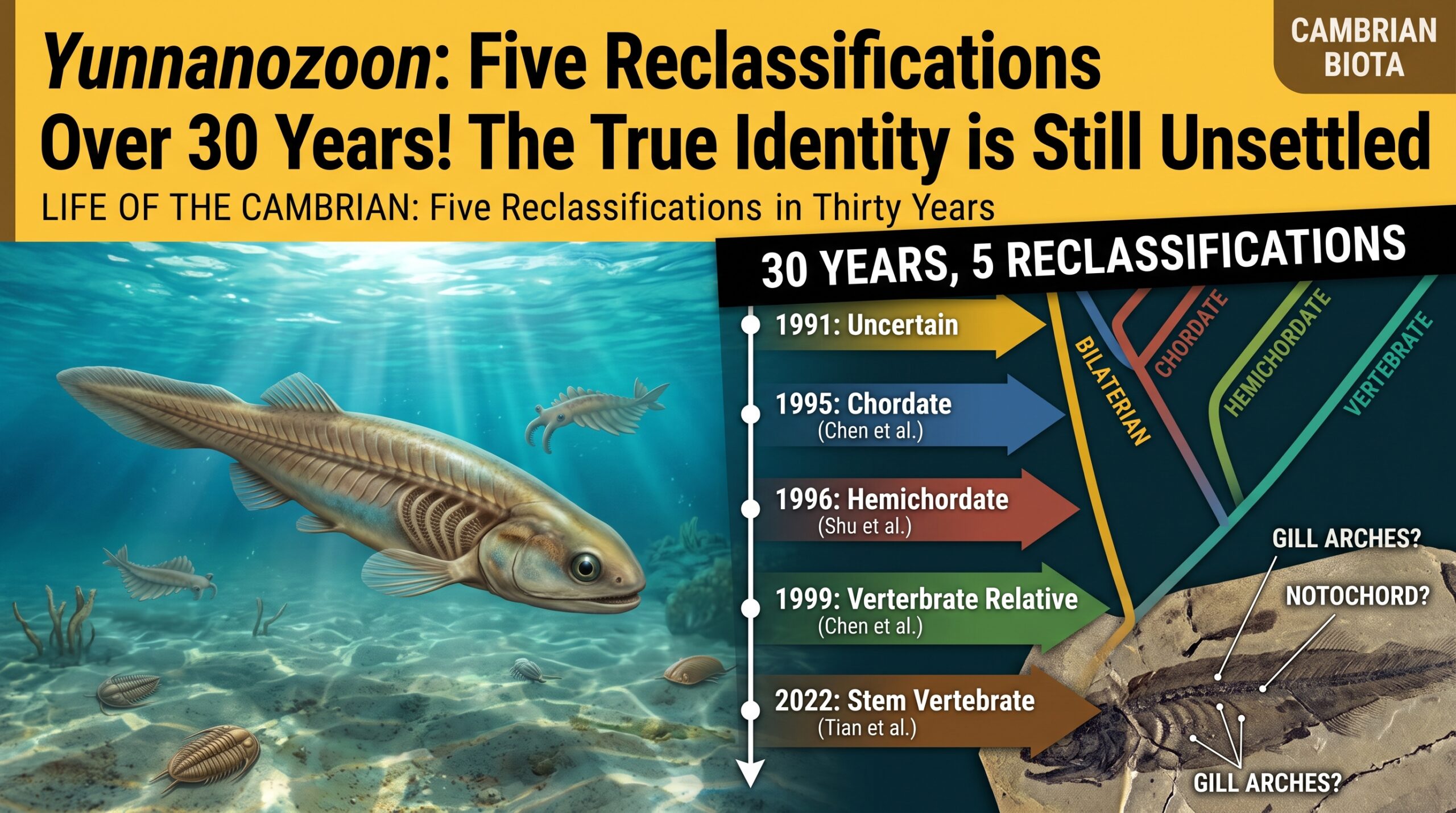
Yunnanozoon was a fish-shaped animal a few centimeters long that lived in the Early Cambrian sea. Since its description from the Chengjiang strata in China in 1991, its classification has shifted with each researcher who took it up — chordate, hemichordate, vertebrate stem lineage, an older lineage still. In 2022 a paper appeared calling it the oldest relative of the vertebrates; rebuttals followed the next year, and its identity remains undecided.
Form and way of life
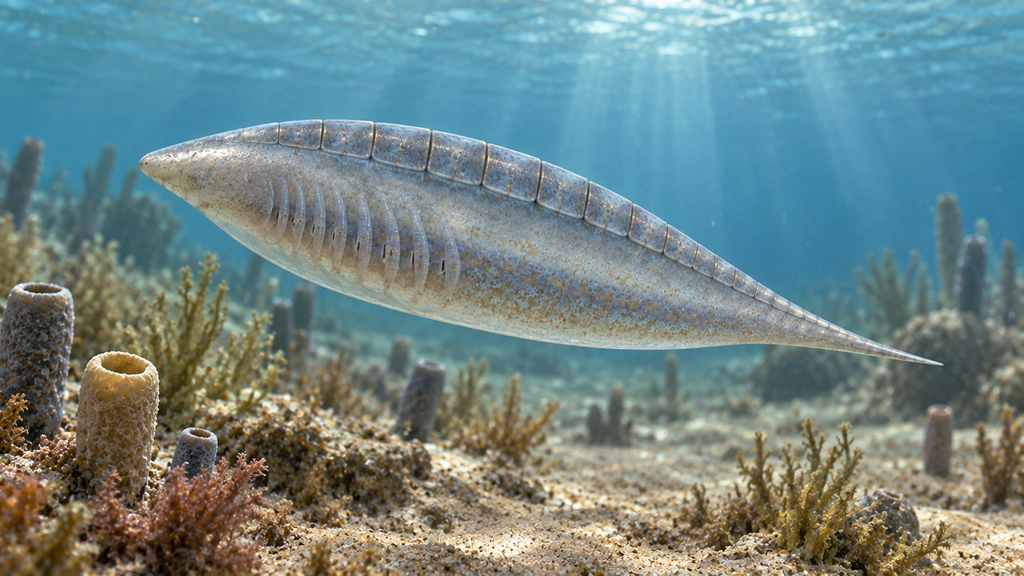
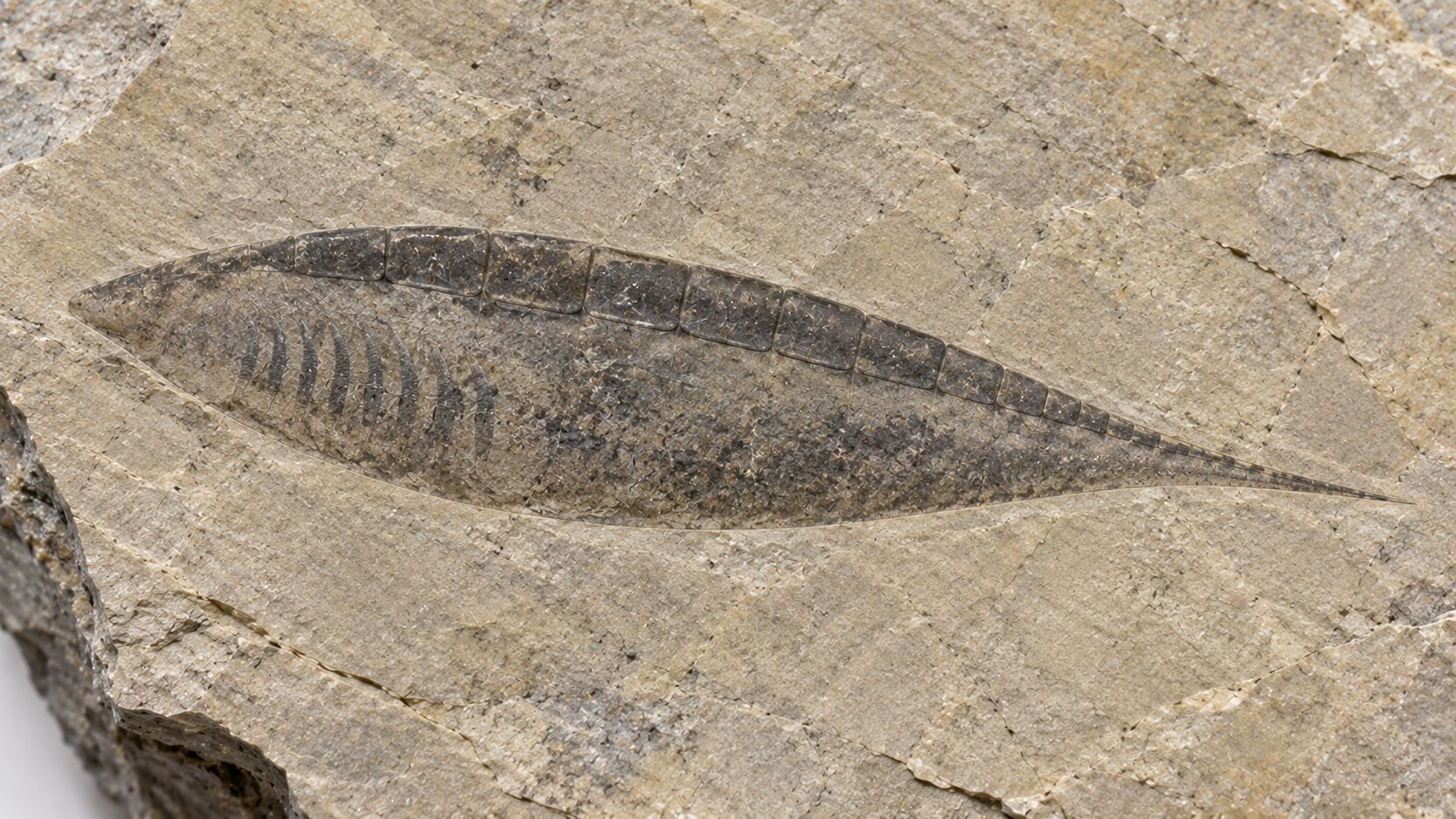
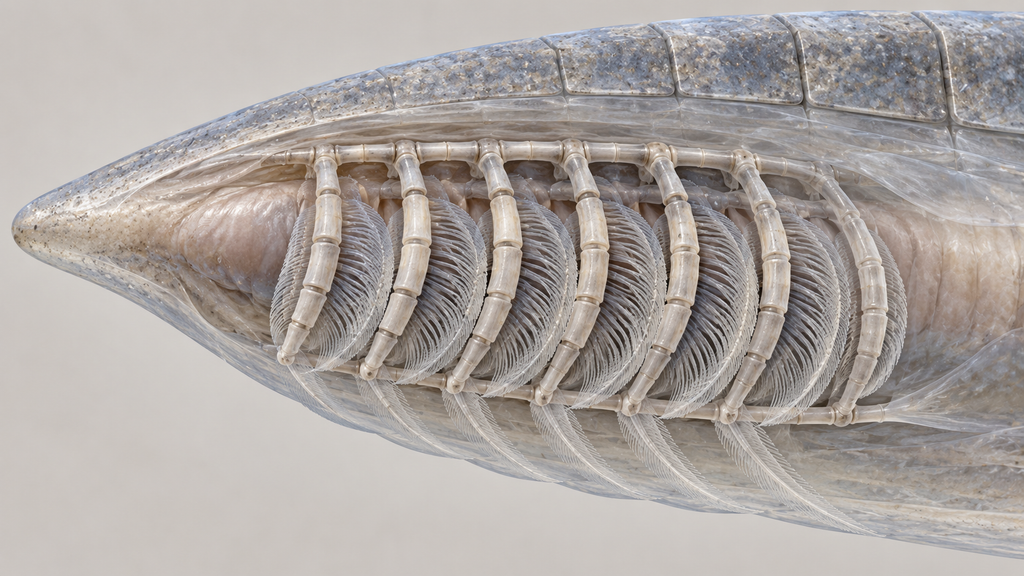
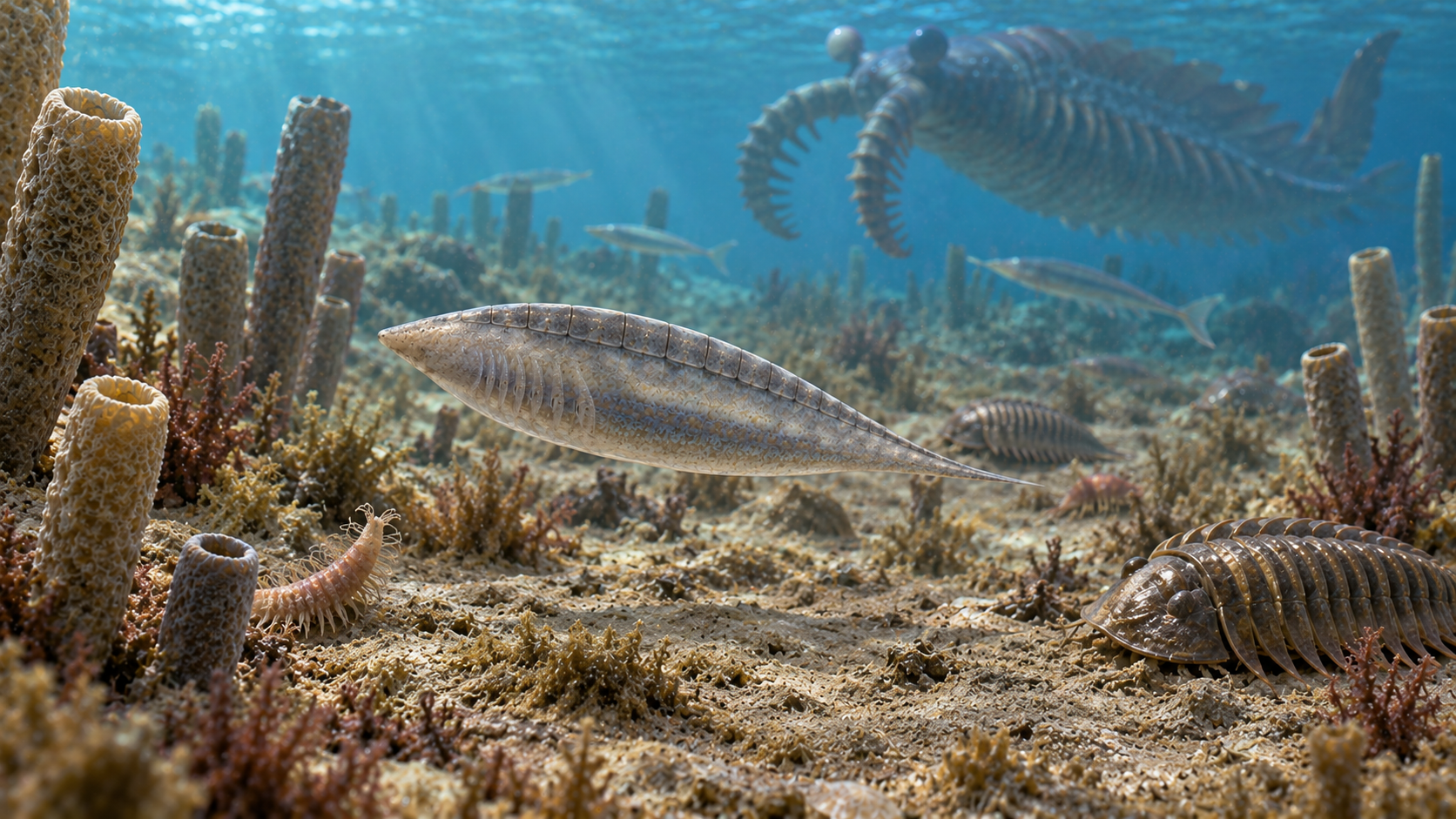
The body is spindle-shaped and thin, as if compressed from the sides, taller than it is wide. Along the dorsal side runs a band of square segments arranged front to back, the foremost of which alone is triangular. In the front half of the body, seven pairs of filamentous arches line the sides of the head. This is the structure that would become the focus of a major argument. The arches are covered above by pouch-like structures, with openings between the pouches leading outside. A tubular structure runs through the rear half of the body, and four pairs of rounded structures sit around the middle. The tube is thought to be the gut and the rounded structures the gonads, though neither is confirmed.
Its way of life is most often taken to be filter feeding with the seven pairs of arches. Water was drawn in through the mouth, fine particles collected on the arches, and the water expelled through the openings along the sides of the body — a mode of feeding close to that of living lancelets and lamprey larvae. The eyes are not clearly defined, and it is not thought to have been a fast-swimming predator.
The Chengjiang strata where Yunnanozoon is found are mud deposited on the seafloor about 518 million years ago. The same strata yield Anomalocaris, the apex predator of the time, Myllokunmingia and Haikouichthys, regarded as among the oldest fish, and numerous trilobites and arthropods. Chengjiang is known for preserving even soft tissue in fossils, and Yunnanozoon too leaves traces of muscle and internal organs as thin films of carbon on the rock. The reason the classification argument has run so long is that these films can be read differently from specimen to specimen and from researcher to researcher.
Five classifications in thirty years
The 1991 description registered Yunnanozoon as an animal of uncertain affinity. The turning point came in 1993, when the Polish paleontologist Jerzy Dzik examined new specimens in Nanjing and identified a notochord, gill arches and gonads arranged segment by segment. On the basis of these observations, Chen Jun-Yuan and colleagues published the animal in Nature in 1995 as a possible Early Cambrian chordate. It was placed among the cephalochordates, close to the lancelets, and was the oldest chordate fossil then known.
The following year, 1996, Shu Degan and colleagues published a rebuttal in the same journal, arguing that Yunnanozoon was not a chordate but a hemichordate close to the acorn worms. They reread the structure called a notochord as part of the gut, and the structures called gill arches as something else. Two papers placing the same fossil in entirely different phyla appeared in the same journal within a year of each other.
In 1999, Chen Jun-Yuan and colleagues collected 305 specimens from Haikou, near Chengjiang, and described a new genus, Haikouella, in Nature. Reporting a heart, dorsal and ventral aortae, a nerve cord with a brain and even structures that appeared to be eyes, they positioned it as an animal close to the craniate vertebrates. The argument was that it closely resembles Yunnanozoon but is a separate species, and one with more vertebrate features.
In 2003, Shu Degan and colleagues described a second species of Haikouella in Science, stating that no chordate-like structures were found in any specimen, and placed Yunnanozoon and Haikouella together on an older lineage that branched before the chordates (the deuterostome stem). That makes four positions proposed to this point: cephalochordate, hemichordate, an animal close to vertebrates, and the deuterostome stem.
In 2015, Cong Pei-Yun and colleagues reviewed the yunnanozoan specimens comprehensively and found that the two species of Haikouella, treated as a separate genus, match Yunnanozoon in both the number of gill arches and the number of rounded structures, and that the structures called pharyngeal teeth were the remains of something else. They merged them all into the single species Yunnanozoon lividum, concluding that nothing more specific than “bilaterian” could be determined about its taxonomic position.
Then in 2022, Tian Qingyi and colleagues published a study in Science combining X-ray microtomography, scanning and transmission electron microscopy, Raman spectroscopy and elemental mapping on 127 newly collected specimens. The central claim is that the seven pairs of arches contain cellular cartilage, with the space around those cells filled by fine fibers spaced 12 nanometers apart. The combination of cellular cartilage and a fibrous extracellular matrix had until then been thought unique to vertebrates. Their phylogenetic analysis concluded that Yunnanozoon is the oldest stem vertebrate, branching before all living vertebrates. They also noted that the arches are linked by dorsal and ventral bars into a basket-like arrangement, a feature shared with the pharyngeal skeletons of living lampreys and hagfish.
The paper was reported worldwide as the oldest known relative of the vertebrates. In July 2023, however, two rebuttals appeared together in Science. One, from a group led by He Kaiyue that included Shu Degan, the author of the 1996 hemichordate argument, denied the very existence of the cellular cartilage and the fibers on the basis of an examination of more than 8,000 specimens. The other, by Zhang Xi-guang and Brian R. Pratt, argued that the fibers seen under the electron microscope are not 500-million-year-old tissue but most likely contamination by modern organic matter. Tian and colleagues rejected the rebuttals in the same issue with additional evidence, but the two sides remain at an impasse.
In 2024, a study reinterpreting Pikaia from the Burgess Shale also presented a tree placing Yunnanozoon not among the vertebrates but on the stem short of the chordates. At present there is no basis for stating outright that Yunnanozoon is the oldest relative of the vertebrates, and opinion wavers within the range of “something close to a chordate.” In the thirty-odd years since 1991, five answers have been offered for the same fossils from the same locality — cephalochordate, hemichordate, an animal close to vertebrates, the deuterostome stem, stem vertebrate — and none has become the settled view.
Sources
Hou, Ramsköld & Bergström (1991) Composition and preservation of the Chengjiang fauna. Zoologica Scripta. https://doi.org/10.1111/j.1463-6409.1991.tb00303.x
Chen et al. (1995) A possible Early Cambrian chordate. Nature. https://doi.org/10.1038/377720a0
Chen, Huang & Li (1999) An early Cambrian craniate-like chordate. Nature. https://www.nature.com/articles/990080
Shu et al. (2003) A new species of yunnanozoan with implications for deuterostome evolution. Science. https://doi.org/10.1126/science.1079846
Cong et al. (2015) New data on the palaeobiology of the enigmatic yunnanozoans from the Chengjiang Biota. Palaeontology. https://doi.org/10.1111/pala.12117
Tian et al. (2022) Ultrastructure reveals ancestral vertebrate pharyngeal skeleton in yunnanozoans. Science. https://doi.org/10.1126/science.abm2708
He et al. (2023) Comment on “Ultrastructure reveals ancestral vertebrate pharyngeal skeleton in yunnanozoans”. Science. https://doi.org/10.1126/science.ade9707
Zhang & Pratt (2023) Comment on “Ultrastructure reveals ancestral vertebrate pharyngeal skeleton in yunnanozoans”. Science. https://doi.org/10.1126/science.adf1472
Tian et al. (2023) Response to Comments. Science. https://doi.org/10.1126/science.adf3363
Mussini et al. (2024) A new interpretation of Pikaia reveals the origins of the chordate body plan. Current Biology. https://doi.org/10.1016/j.cub.2024.05.026
Nanjing Institute of Geology and Palaeontology, Chinese Academy of Sciences, press release (July 2022) https://english.nigpas.cas.cn/rh/rp/202207/t20220704_307593.html
コメント