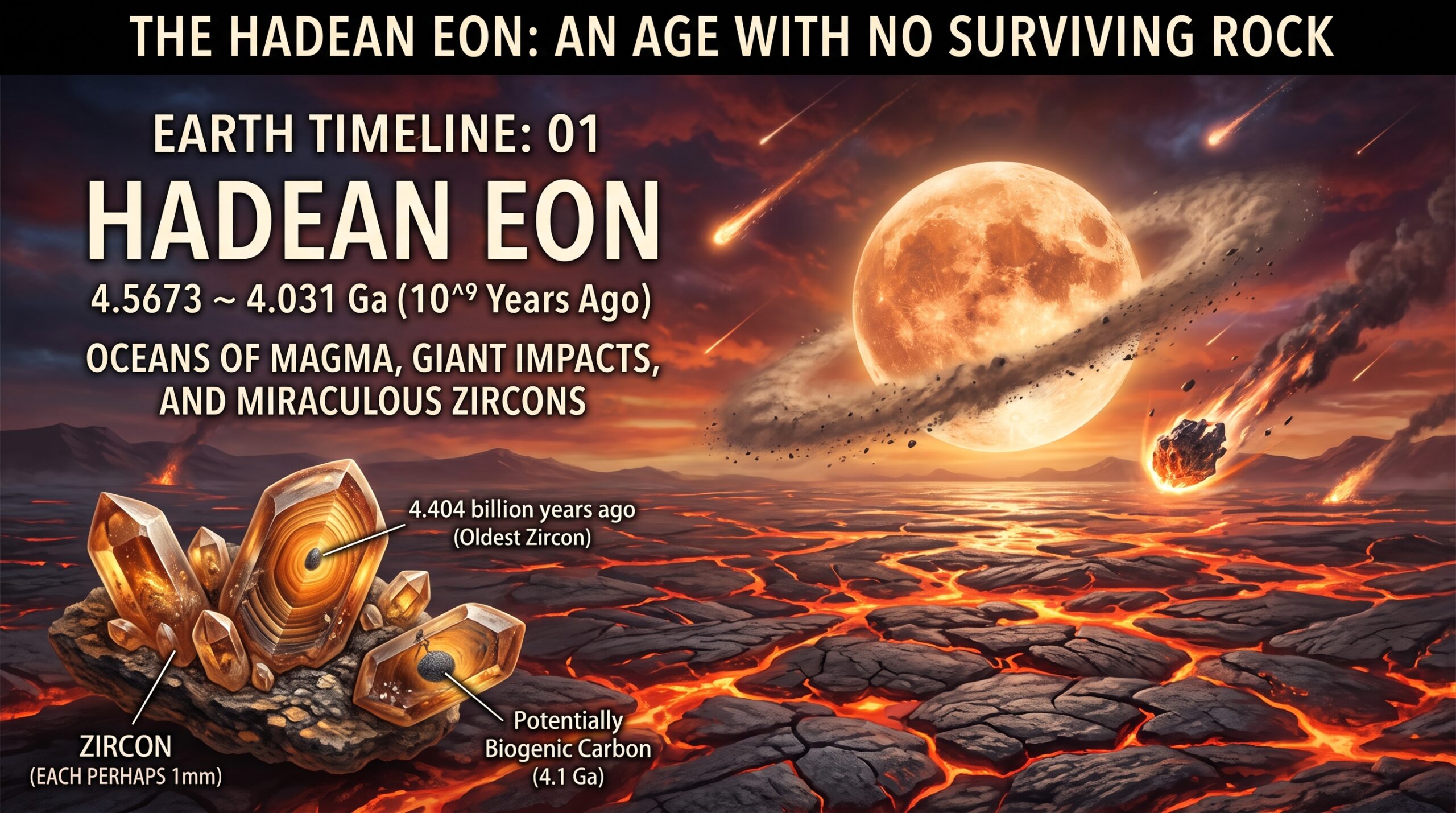
The Hadean is the very first division of Earth’s history, running from about 4.5673 billion to about 4.031 billion years ago — roughly 540 million years. The first half-billion years after the Earth formed fall entirely within it.
The name comes from Hades, god of the underworld in Greek mythology. When the American geologist Preston Cloud proposed the division in 1972, the newborn Earth was thought to be covered in molten rock and bombarded ceaselessly by meteorites — an age fit to be named for hell.
Yet the physical evidence we hold for this eon amounts to a handful of crystals the size of sand grains. And what those crystals say sits slightly askew of what the name suggests.
A surface covered in magma
The Earth grew through repeated collisions of small rocky bodies (planetesimals) within the disk of gas and dust orbiting the sun. Each impact converted kinetic energy into heat, so the more mass it gained the hotter it became. By the time growth was complete, temperatures had reached the point where rock melts.
This state is called a magma ocean. The entire surface was covered in molten rock; heavy iron sank through it and gathered at the center, forming Earth’s core. Lighter rocky components remained above and became the mantle. Earth’s layered structure originates in that separation.
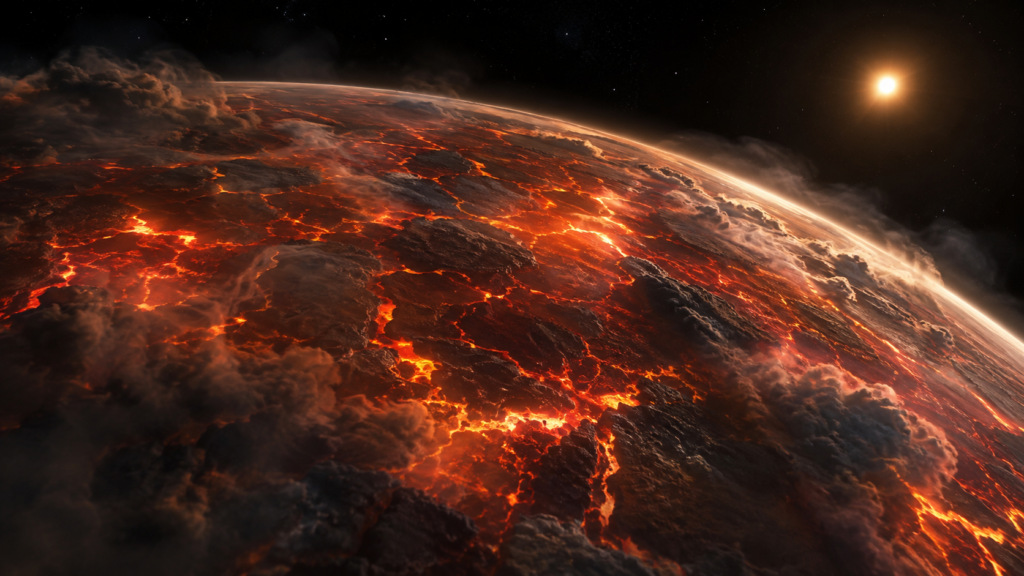
The atmosphere of the time bore no resemblance to today’s either. There was almost no oxygen; a thick layer of mainly water vapor and carbon dioxide is thought to have covered the surface. That atmosphere had a strong greenhouse effect, keeping the surface from cooling quickly.
The impact that made the Moon
Early in the Hadean, the Earth experienced one more great collision. A body about the size of Mars struck the proto-Earth. It was named Theia, after the mother of Selene, the moon goddess of Greek myth.
Debris thrown out by the impact spread into a disk around the Earth and eventually gathered into the Moon. This is the giant impact hypothesis, the most widely accepted account of the Moon’s origin. That Earth and Moon have nearly identical oxygen isotope compositions is a major support for it.
When the impact occurred, though, still carries a range. Estimates run from 30 million years after the solar system formed to 100 million years, putting the date somewhere between about 4.52 and 4.35 billion years ago. The answer changes with the combination of elements used (hafnium and tungsten, tungsten isotopes, and so on).
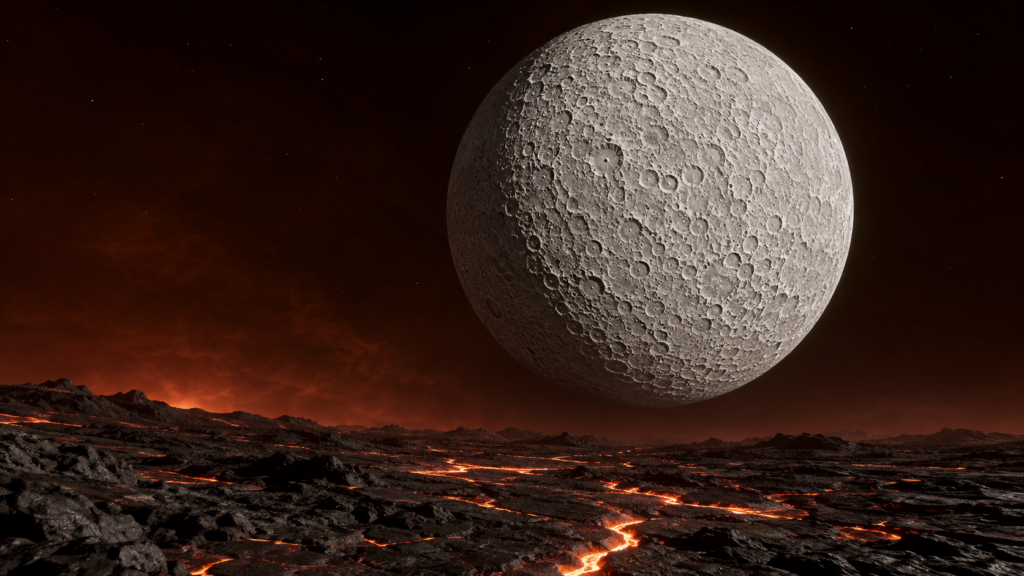
The newly formed Moon was far closer to Earth than it is now. The present distance is about 380,000 km; at formation it is calculated to have been around a seventeenth of that, in the tens of thousands of kilometers. The Moon hanging in the sky would have looked several times larger than today.
Earth’s rotation was also far faster. The impact set the planet spinning violently, and several models put the length of a day at only a few hours. Through tidal exchange with the Moon, Earth’s rotation then slowed and the Moon gradually receded. Measurements using the retroreflectors placed on the lunar surface by the Apollo missions show the Moon still moving away at about 2.5 cm a year.
An age with no surviving rock
Here the story gets complicated. Not a single Hadean rock survives on Earth.
The oldest rock body currently confirmed is the Acasta Gneiss, exposed near the Acasta River in the Slave craton of northwestern Canada. It sits on an island about 300 km north of Yellowknife and was described in 1989. Originally igneous, it has been dated to about 4.031 billion years. A value of about 4.28 billion years has also been reported from the Nuvvuagittuq greenstone belt on the eastern shore of Hudson Bay in Quebec, but debate continues over the interpretation of the dating method.
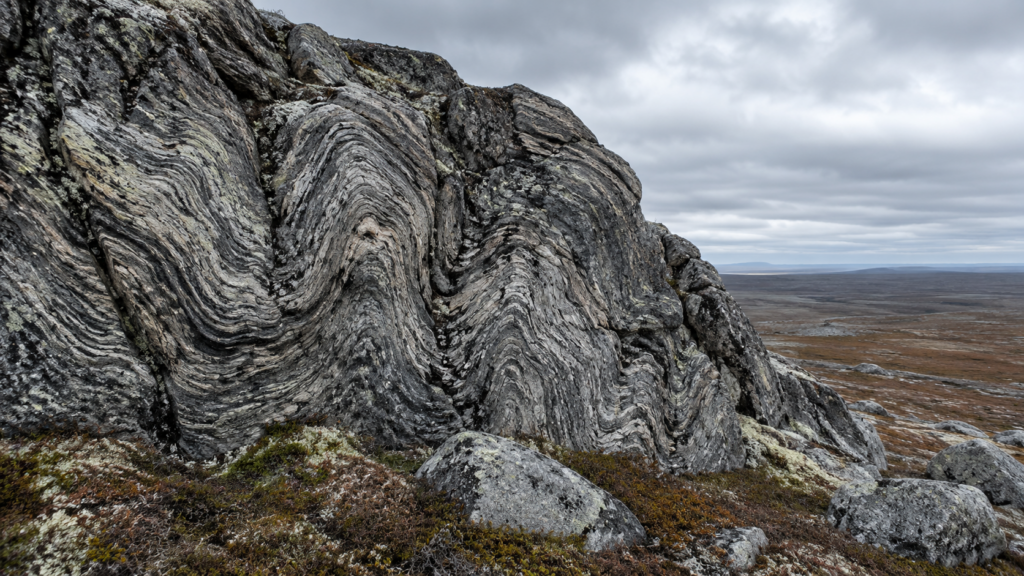
Several reasons for the absence of rock overlap. The Earth then held many times its present internal heat, and volcanism was intense. Subduction dragged crust into the mantle to be melted again and again. Impacts were frequent, remelting the surface each time. The interval of intense bombardment said to have concentrated around 4 billion years ago (the Late Heavy Bombardment) is itself being reassessed in recent years, but either way it was a harsh environment for early crust to survive.
What is interesting is that this absence of rock is used directly in the definition of the division. In 2023, the International Commission on Stratigraphy (ICS) set the end of the Hadean — that is, the start of the Archean — at the age of zircon in the Acasta Gneiss, 4.031 billion years. The Hadean is the age older than the oldest rock on Earth. By definition, Hadean rock cannot exist.
Only sand grains survived
Things that are not rock, however, do survive: mineral grains.
In a range of hills in Western Australia called the Jack Hills, there are sedimentary rocks containing fine grains of the mineral zircon. Zircon is a zirconium silicate, extremely hard and chemically stable. Even when the parent rock weathers and breaks apart, zircon crystals survive as sand grains, wash down rivers and are incorporated into new strata elsewhere. That is how they crossed the ages.
Jack Hills zircons span ages from 4.0 to 4.4 billion years. The oldest single grain has been dated to 4.404 billion years, and is the oldest material known to have formed on Earth. Crust already existed 160 million years after the solar system came into being.
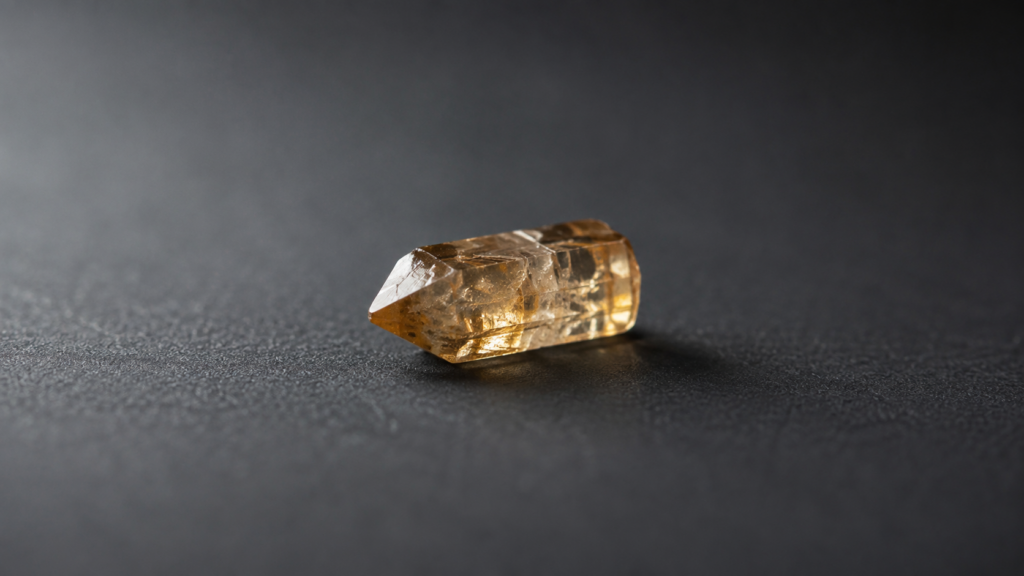
Zircon has another convenient property. It incorporates trace uranium into the crystal, which converts to lead over time, so measuring the uranium-to-lead ratio gives the age at which the crystal formed. And once solidified, the interior of the crystal exchanges almost no material with the outside, so the chemical information present at its birth stays sealed within. For studying the Hadean, these grains are effectively the only handle available.
What the zircons say about a watery surface
What was read from those zircons changed the picture of the Hadean.
A team led by John Valley of the University of Wisconsin–Madison confirmed the age of the oldest Jack Hills zircon at 4.4 billion years, combining atom probe tomography — which maps the distribution of lead atom by atom — with secondary ion mass spectrometry. The study was published in Nature Geoscience in 2014.
At the same time they measured oxygen isotope ratios. Oxygen comes in forms of differing mass (isotopes), and their ratio shifts according to what a rock has been through. Rock that has reacted with water at the surface shows an oxygen isotope ratio different from rock derived from the mantle.
And the ratio the oldest zircon showed was not that of magma coming directly from the mantle. The natural reading is that rock which had once reached the surface and reacted with low-temperature water was remelted, and the zircon crystallized from that magma.
Which means that 4.4 billion years ago, the Earth already had liquid water. And the surface was cool enough for water to stay liquid — not hot enough to keep rock molten. Valley described the result as strengthening the case that Earth had a hydrosphere before 4.3 billion years ago. This line of thinking is known as the cool early Earth.
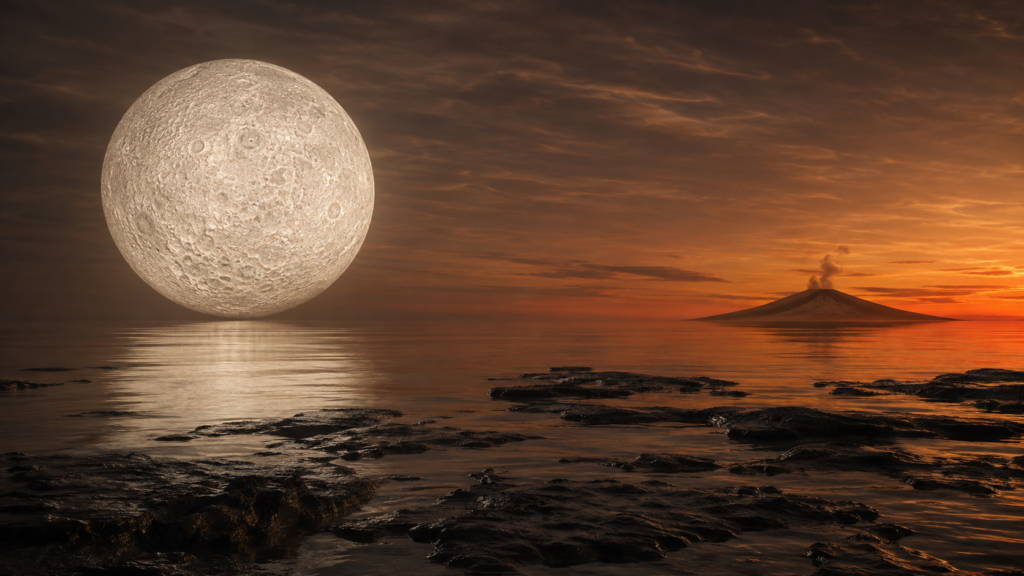
The existence of a magma ocean phase is not denied. What changed is the estimate of how long that state lasted. The Earth cooled its surface at a fairly early stage and became a planet holding water. Of the Hadean’s 540 million years, only the first portion may deserve to be called hell.
This is, however, an inference from sand grains. A single zircon records only the place and time at which that crystal formed, and the whole planet need not have been like that. How large the ocean was, and how long it remained stable, is still unknown.
Was there life?
If there was water at the surface, what about life? That question has no answer yet.
The difficulty is the same as before. With no Hadean rock, there can be no fossils. In fact, microfossils accepted with confidence reach back only about 3.5 billion years, and chemical traces to about 3.7 to 3.8 billion years. A large gap still separates these from the end of the Hadean (4.031 billion years).
There are, even so, two indirect clues.
One is zircon. A team led by Elizabeth Bell of the University of California, Los Angeles, examined more than 10,000 Jack Hills zircons and found one grain, 4.1 billion years old, with graphite sealed inside. Measuring the carbon isotope ratio gave a value within the range seen in organic matter produced by organisms. The study was published in the Proceedings of the National Academy of Sciences (PNAS) in 2015.
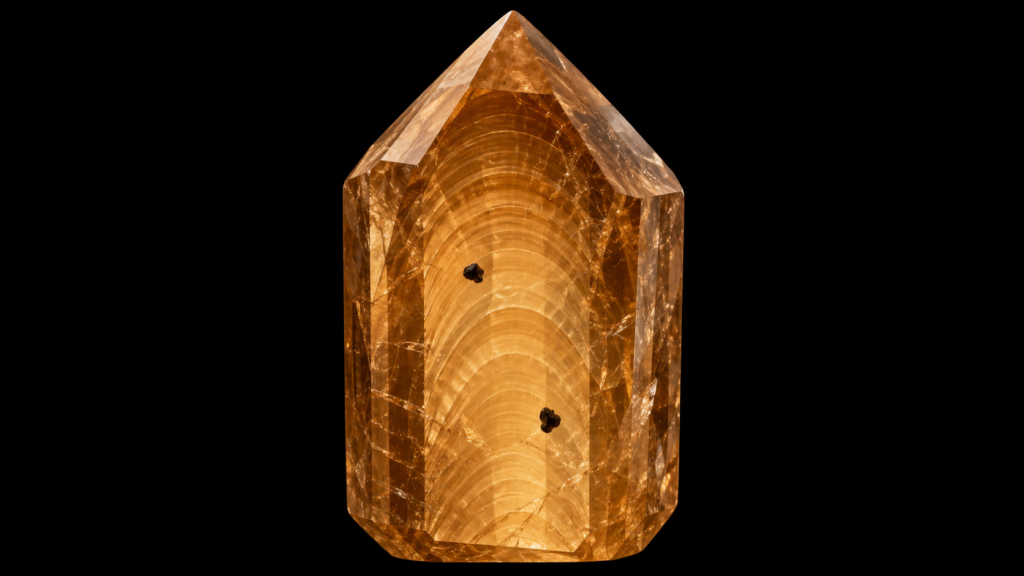
The paper’s title, though, uses the cautious phrase “potentially biogenic carbon.” Similar isotope ratios can arise from chemical reactions that involve no organism, so this alone does not constitute evidence of life.
The other approach works backward from the genes of living organisms rather than from fossils. In 2024, a team led by Edmund Moody of the University of Bristol compared the genomes of organisms alive today, worked back through the accumulation of mutations, and estimated that the last universal common ancestor of all cellular life (LUCA) existed about 4.2 billion years ago. The study appeared in Nature Ecology & Evolution.
What is interesting about the estimate is less the date than the substance. By the team’s reconstruction, LUCA already had genes for about 2,600 proteins, a complexity comparable to modern bacteria. And it did not live alone; it is inferred to have been part of an ecosystem exchanging materials with other lineages. If that is right, the origin of life lies further back still — partway through the Hadean.
Molecular clock dating carries a range, however (4.09 to 4.33 billion years in this study), and the gap with the fossil record remains unclosed. Whether there was life in the Hadean stands, at present, at “not ruled out.”
An eon with both ends defined off the Earth
The Hadean has one more peculiarity: how its start is defined.
In 2022 the ICS set the beginning of the Hadean at 4.56730 billion years ago. This is not the day the Earth was born. The basis for the date is the age of the oldest solid material in the solar system, the calcium–aluminium-rich inclusions found inside meteorites. The Earth itself took shape somewhat later, over time.
The result is an eon bounded at its start by a meteorite and at its end by the oldest rock on Earth. Both boundaries were set because almost no record survives on Earth itself. The first chapter of Earth’s history is a chapter holding almost no material of its own.
Even so, a few dozen crystals the size of sand grains are enough to suggest water at the surface 4.4 billion years ago. Hadean research keeps moving precisely in the space between how few the clues are and how much, unexpectedly, can be drawn from them.
Sources
Divisions and boundary dates follow the International Chronostratigraphic Chart of the International Commission on Stratigraphy (ICS): International Chronostratigraphic Chart (ICS)
On the Jack Hills zircons and the cool early Earth (University of Wisconsin–Madison): Oldest bit of crust firms up idea of a cool early Earth
On the Acasta Gneiss (Geological Survey of Canada): Acasta Gneiss (Geological Survey of Canada)
On the formation of the Earth and Moon (University of Chicago): How the Earth and moon formed, explained
On carbon in a 4.1-billion-year-old zircon (PNAS): Potentially biogenic carbon preserved in a 4.1 billion-year-old zircon
On dating the last universal common ancestor (Nature Ecology & Evolution): The nature of the last universal common ancestor and its impact on the early Earth system

コメント