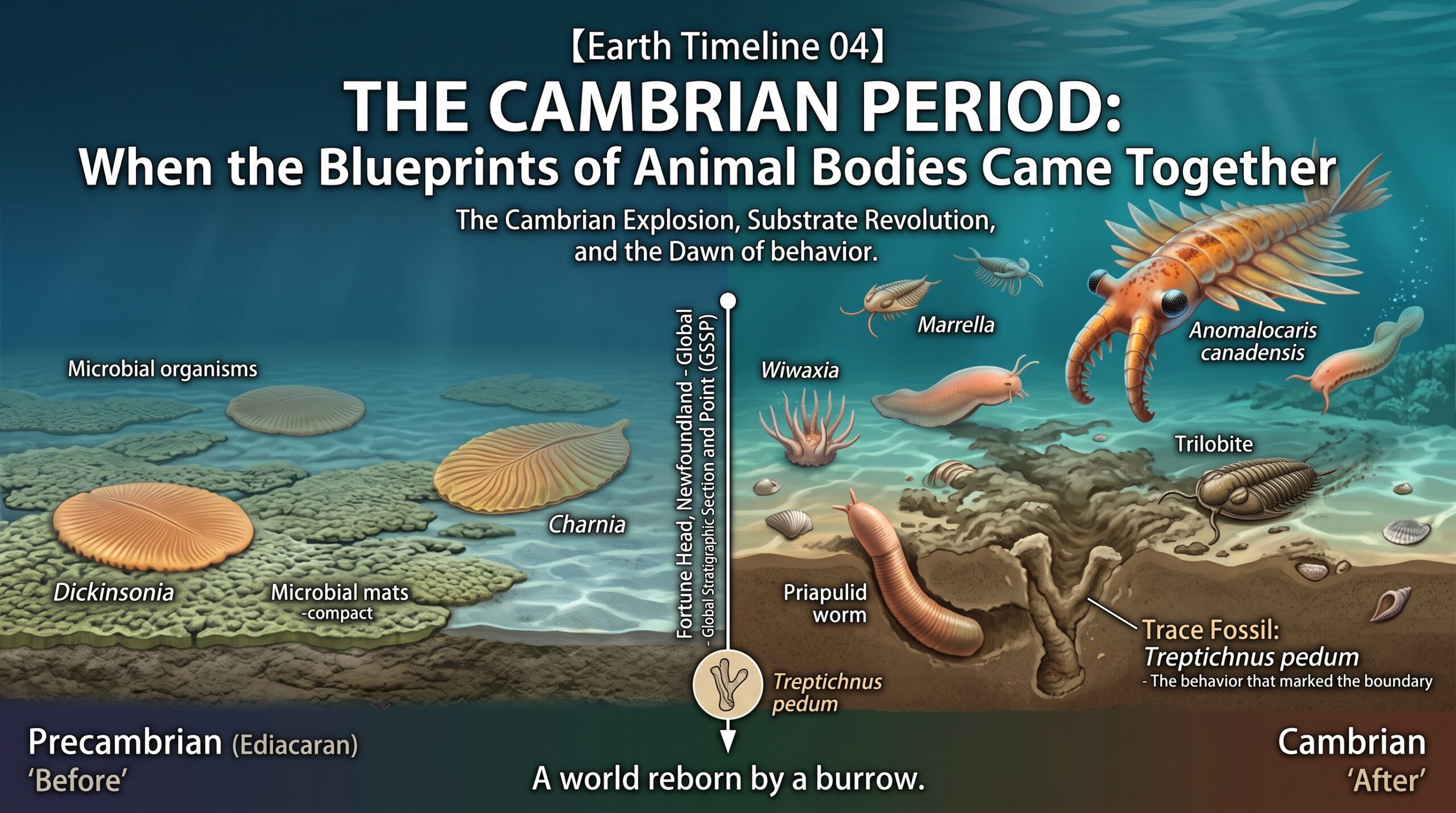
The Cambrian began about 539 million years ago and ran to about 487 million years ago, spanning some 52 million years. It is the first period of the Paleozoic Era and also the doorway into the Phanerozoic — the great division of Earth history in which the forms of living things become clearly visible as fossils. Before it comes the Ediacaran (the end of the Proterozoic); after it, the Ordovician.
The period is known alongside the phrase “Cambrian explosion.” Animals with eyes, with shells, that swam and caught prey, appear in the fossil record one after another over what is, by geological standards, a short interval. The basic body patterns of animals alive today are essentially all in place by the end of this period.
Where in the strata that beginning is drawn, however, is not something you can see by looking at a timescale chart.
A sea equipped with shells and eyes
Work up through Cambrian strata from the bottom and the first thing to increase is surprisingly unglamorous. Tubes, plates, spines and cones under a few millimeters across — hard fragments of uncertain identity, collectively called small shelly fossils — turn up in quantity. For many of them it is still unknown which animal they came from, or which part of it.
The familiar trilobites appear considerably later. The oldest trilobite fossils are about 521 million years old — some 18 million years after the Cambrian began.
From there, the sea becomes crowded quickly. The Chengjiang biota of Yunnan Province, China, dates to about 518 million years ago, and Canada’s famous Burgess Shale to about 508 million years ago; both are exceptional localities preserving even soft-bodied animals whole. Arthropods, sponges, brachiopods, chordates — including the lineage leading to us vertebrates — nearly all of the roughly 40 animal phyla (the major divisions of body construction) recognized today are present.
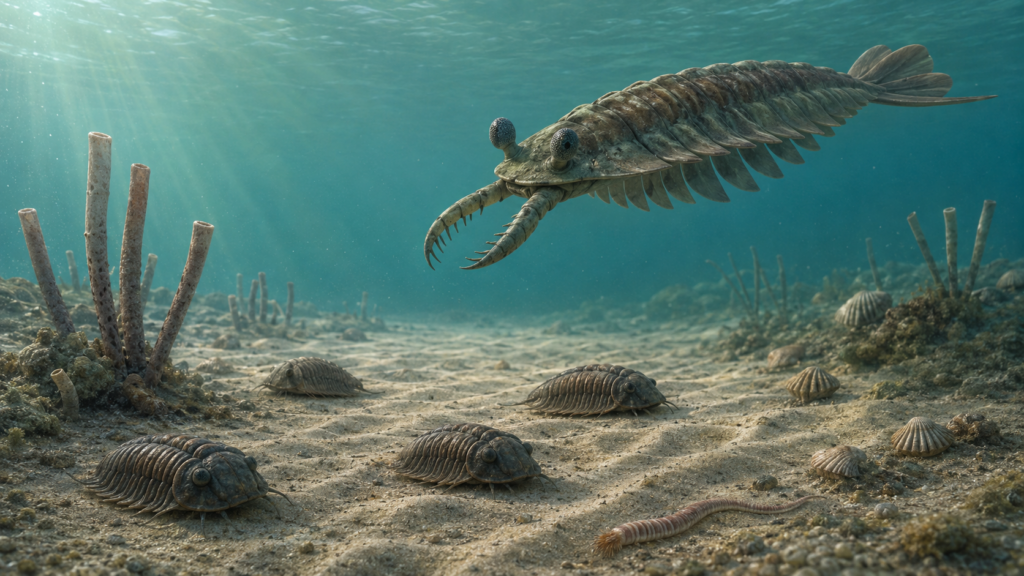
The animal most often drawn as the lead of this sea is Anomalocaris: a swimmer about 60 centimeters long, with a pair of spiny appendages extending from the front of the head and mouth plates arranged in a ring. What stands out is the eyes. Fossil eyes of a relative found in southern Australia pack at least 16,000 lenses onto a surface about three centimeters across. A living dragonfly has about 28,000, so for an animal 500 million years ago that is a startlingly high resolution.
The image of a predator crunching through trilobites, though, has been revised in recent years. A 2023 study reconstructing the appendages and mouth in three dimensions and calculating the forces involved found they could not generate enough force to crack hard shells. The current view is that it makes more sense as a pursuit hunter, swimming fast and taking soft prey.
A prehistory that left no record
“Explosion” is a somewhat too strong word. Animals did not suddenly well up in an empty sea.
Molecular clock studies, which estimate when lineages diverged from rates of genetic change, had long indicated that the major animal lineages split before the Cambrian. Without accompanying fossils, though, that remains a matter of calculation. For a long time, almost no bodies of such animals had been found in Precambrian strata.
That changed in 2026. The April 2 issue of Science carried a report on the Jiangchuan biota, found in Yunnan Province, China. In a joint study by Yunnan University, the University of Oxford and others, more than 700 fossils were recovered from an outcrop of about 50 square meters. The age is about 554 to 539 million years — just before the Cambrian begins, at the end of the Ediacaran.
What made the difference here was the mode of preservation. Ediacaran fossils are normally preserved as impressions pressed into sandstone. The Jiangchuan material, however, survives as thin carbon films clinging to the rock surface — the same mode as at famous Cambrian localities like the Burgess Shale and Chengjiang, preservation good enough to show internal structures such as mouths, guts and the organs used for movement.
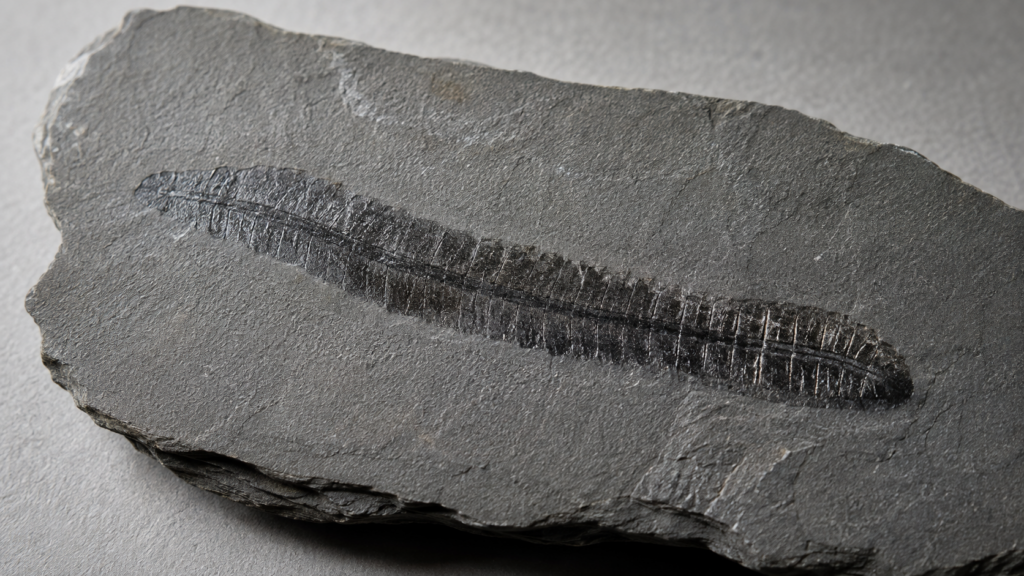
And animal groups previously known only from the Cambrian turned up there, including fossils thought to be the oldest members of the deuterostomes, the group containing humans. Co-author Ross Anderson of the University of Oxford notes that the absence of these animals from other Ediacaran localities may reflect differences in preservation rather than genuine absence.
Here lies the difficulty facing the people who draw lines in strata. Set a boundary at the position where body fossils appear, and that line ends up tracking not when animals originated but where and under what conditions preservation happened. The committee that fixed the Cambrian’s base had to take this problem on directly.
A burrow chosen as the boundary marker
In 1992, the international reference point marking the start of the Cambrian was fixed on the island of Newfoundland, at the eastern edge of Canada: a cliff at Fortune Head, on the tip of the Burin Peninsula. A single point driven into the Chapel Island Formation there is the globally shared marker for the beginning of the Cambrian, of the Paleozoic, and of the Phanerozoic.
What was chosen was not a body fossil. It is Treptichnus pedum, a trace fossil — the mark of a burrow left by an animal in mud.
The burrow has a distinctive form. From a main tunnel running horizontally through the sediment, short branches extend obliquely upward, repeated at regular intervals. It is the record of a systematic search through the mud, changing direction in zigzags. Not merely a crawling trace, nor a straight vertical shaft, but a three-dimensional working of the sediment’s interior.
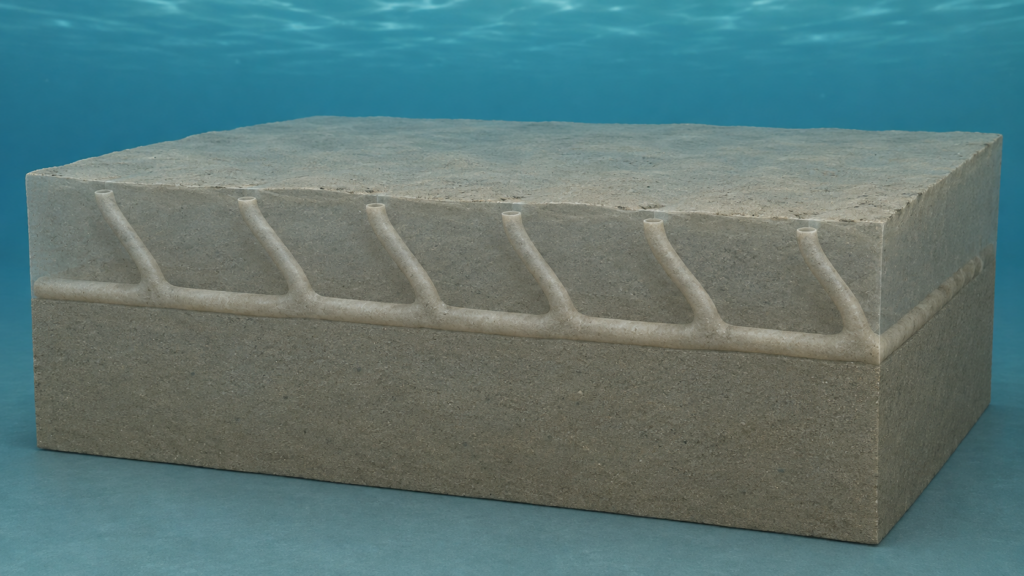
This is the only case where an international stratigraphic boundary has been defined by a trace fossil. It was also the first time a line in the strata was drawn using the record of behavior rather than bodies themselves.
The reason was practical. Small shelly fossils and trilobites both appear in different orders and at different times depending on the region. The order in which trace fossils appear, by contrast, was consistent across strata around the world. Even without knowing who made them, records of behavior can be correlated — that was the judgment.
As for who, the current view points to priapulid worms. Experiments giving living priapulids sediment to burrow in were carried out in 2010 and 2024, and both produced burrows closely resembling Treptichnus pedum. The resemblance extends to behavioral habits: digging into seafloor mud, backing out and probing in another direction.
What was chosen as the signal for the start of the Phanerozoic, in other words, was not a new body but a new behavior.
How burrowing animals remade the seafloor
Why is burrowing into mud treated as carrying so much weight? Because that behavior rebuilt the seafloor itself.
The seafloor before it was nothing like today’s. Microbial mats built by cyanobacteria and others covered wide areas, separating water from mud like a lid. The mud below the mat was compact, holding little water; oxygen barely reached it, and it was a world of sulfide-producing bacteria. The boundary between water and mud is thought to have been as sharp as a knife cut. The flat organisms of the Ediacaran lived lying on top of these stable mats.
Once animals began burrowing vertically, that structure broke down. Mats were torn, mud was stirred, and water and oxygen worked their way down. The upper seafloor became a soft, water-rich layer in constant churn. The sulfide world was pushed downward, and the surface layer became a place where far more organisms could live.
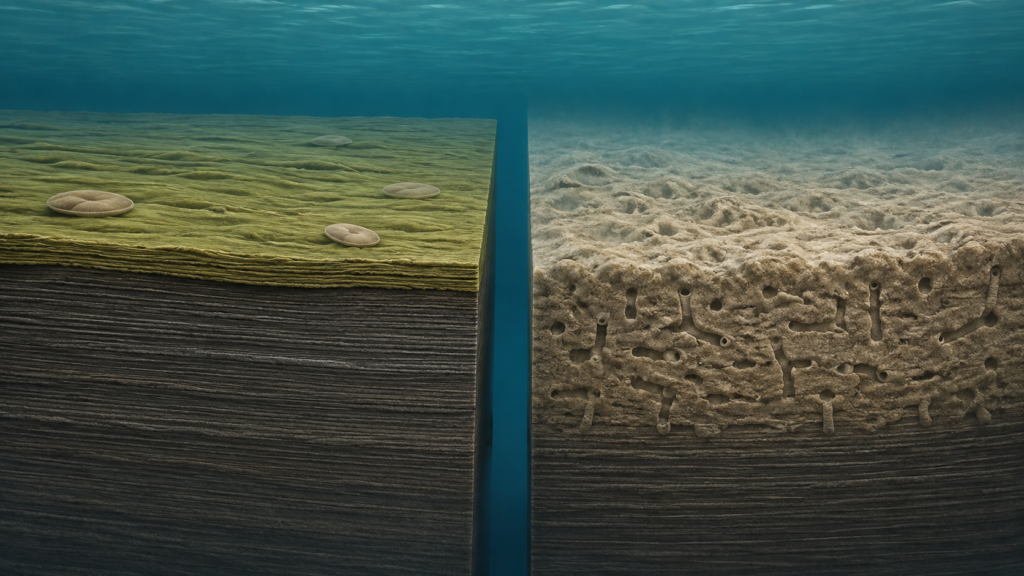
This set of changes is called the Cambrian substrate revolution, or the agronomic revolution. The latter name compares it to tilling a field: softening the soil and letting air and water through. There are two names because separate research groups arrived at the same change from different angles between the 1990s and 2000, and the terms are now used for essentially the same thing.
Material supporting this account keeps appearing. In October 2025, Chen Zhe and Liu Yarong of the Nanjing Institute of Geology and Palaeontology, Chinese Academy of Sciences, reported the oldest known three-dimensional burrow system, from the Shibantan biota in Hubei Province. It dates to about 550 to 543 million years ago — still the Ediacaran. Trace fossils from this interval are almost all shallow trails tracing the seafloor surface, but here a structure penetrating the mud in three dimensions was found. The authors regard the advent of this three-dimensional exploration as having remade seafloor ecology and undermined the stability of microbial mats, and note that it coincides with the interval when the large Ediacaran-type organisms dependent on those mats disappear. They position it as the change that preceded, and enabled, the Cambrian explosion.
Shells, spines and eyes acquire meaning only once relationships exist between pursuer and pursued, between digger and dug. It was not that hard bodies came first and changed the world; the construction of the world changed, and hard bodies then paid off. Behind the phrase “the age when animal body plans were settled,” events ran in that order.
A wobbling line, and new windows
The line driven in at Fortune Head, however, began wobbling within a decade of being fixed.
In 2001, James Gehling and colleagues examined the reference section closely and found Treptichnus pedum — the very fossil defining the boundary — about four meters below it. A fossil that should occur only above the boundary was there below it. This trace is also strongly facies-dependent, appearing only in shallow-marine sand and mud. Correlating with strata formed under different conditions, as in Siberia or South China, remains a problem. A formal reassessment was proposed in 2014, and discussion continues.
As the Shibantan report shows, burrowing behavior itself had begun within the Ediacaran, so this may be less a failure in choosing a marker than a question of whether there was ever a moment at which one could say “from here.”
And the Cambrian we see is viewed through a few dozen exceptional preservation localities worldwide — windows opened in the strata, so to speak. On the mechanism behind this Burgess Shale-type preservation, a 2012 analysis using sulfur isotopes showed the cause was early exhaustion of oxidants within the sediment, halting microbial decay. What made that possible was the nature of Cambrian seawater itself, which is why this kind of preservation is largely confined to the early and middle Cambrian. The time the window stood open was itself limited.
Occasionally, a new window opens. In January 2026, a team led by Zhu Maoyan of the Chinese Academy of Sciences reported the Huayuan biota, found in Huayuan County, Hunan Province, in Nature. It dates to about 512 million years ago and records a deep sea on the outer shelf. More than 50,000 fossils were collected, and sorting 8,681 of them yielded 153 species across 16 phylum-level groups, 59 percent of them new. Some preserve tissue down to the cellular level.
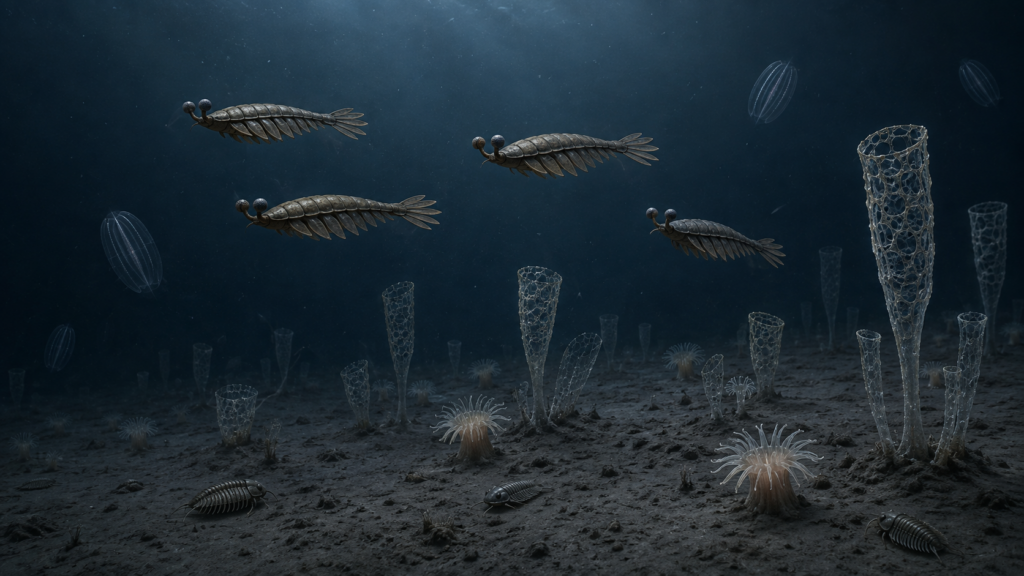
What makes this locality important is its timing. Partway through the Cambrian explosion, about 513.5 million years ago, an extinction known as the Sinsk event occurred. Shallow seas are thought to have gone widely oxygen-deficient, and the archaeocyathids — a group considered sponge relatives — that built reefs were wiped out. It is the first mass extinction of the Phanerozoic, but because the total variety of life was still low at the time, it was long left out of the Big Five.
Checking where the two famous localities mentioned earlier sit: Chengjiang comes before this extinction, the Burgess Shale after. Between two scenes usually imagined as a single continuous Cambrian sea, an extinction was in fact sandwiched. The Huayuan biota captures exactly that interval, the sea immediately after the extinction. Deep-sea organisms survived with their ecosystem structure broadly intact, and the authors suggest the deep sea may have acted as a refuge.
The explosion, then, was not a steady rise. It was cut back sharply partway through and then recovered. How large that cut was, and what survived in the deep sea, gets redrawn each time a new window opens. Where the line at the start of the Cambrian will finally settle is also undecided.
Sources
The late Ediacaran Jiangchuan biota (Science, 2 April 2026): University of Oxford press release / the paper itself: Li et al., “The dawn of the Phanerozoic: A transitional fauna from the late Ediacaran of Southwest China” (Science, 2026)
Ediacaran three-dimensional burrows and the seafloor ecosystem transition: Chen & Liu, “Advent of three-dimensional sediment exploration reveals Ediacaran-Cambrian ecosystem transition” (Science Advances, 2025; full text free to read)
The paper proposing the Cambrian substrate revolution: Bottjer, Hagadorn & Dornbos, “The Cambrian Substrate Revolution” (GSA Today, 2000; PDF)
Experiments identifying priapulids as the burrow makers: Vannier et al., “Priapulid worms: Pioneer horizontal burrowers at the Precambrian-Cambrian boundary” (Geology, 2010) / Turk et al., “Priapulid neoichnology, ecosystem engineering, and the Ediacaran–Cambrian transition” (Palaeontology, 2024)
The report of the index fossil occurring below the reference point: Gehling et al., “Burrowing below the basal Cambrian GSSP, Fortune Head, Newfoundland” (Geological Magazine, 2001; PDF) / the reassessment proposal: Landing et al., “Proposed reassessment of the Cambrian GSSP” (Journal of Asian Earth Sciences, 2014; paywalled)
The mechanism behind Burgess Shale-type preservation: Gaines et al., “Mechanism for Burgess Shale-type preservation” (PNAS, 2012; full text free to read)
Mechanical analysis of the appendages of Anomalocaris: Bicknell et al., “Raptorial appendages of the Cambrian apex predator Anomalocaris canadensis are built for soft prey and speed” (Proceedings of the Royal Society B, 2023)
The Huayuan biota: Zeng et al., “A Cambrian soft-bodied biota after the first Phanerozoic mass extinction” (Nature, 2026) / Chinese Academy of Sciences press release
The status of the Sinsk event: Murphy et al., “Changes in metazoan functional diversity across the Cambrian Radiation and the first Phanerozoic mass extinction: the Cambrian Sinsk Event” (Proceedings of the Royal Society B, 2025)

コメント