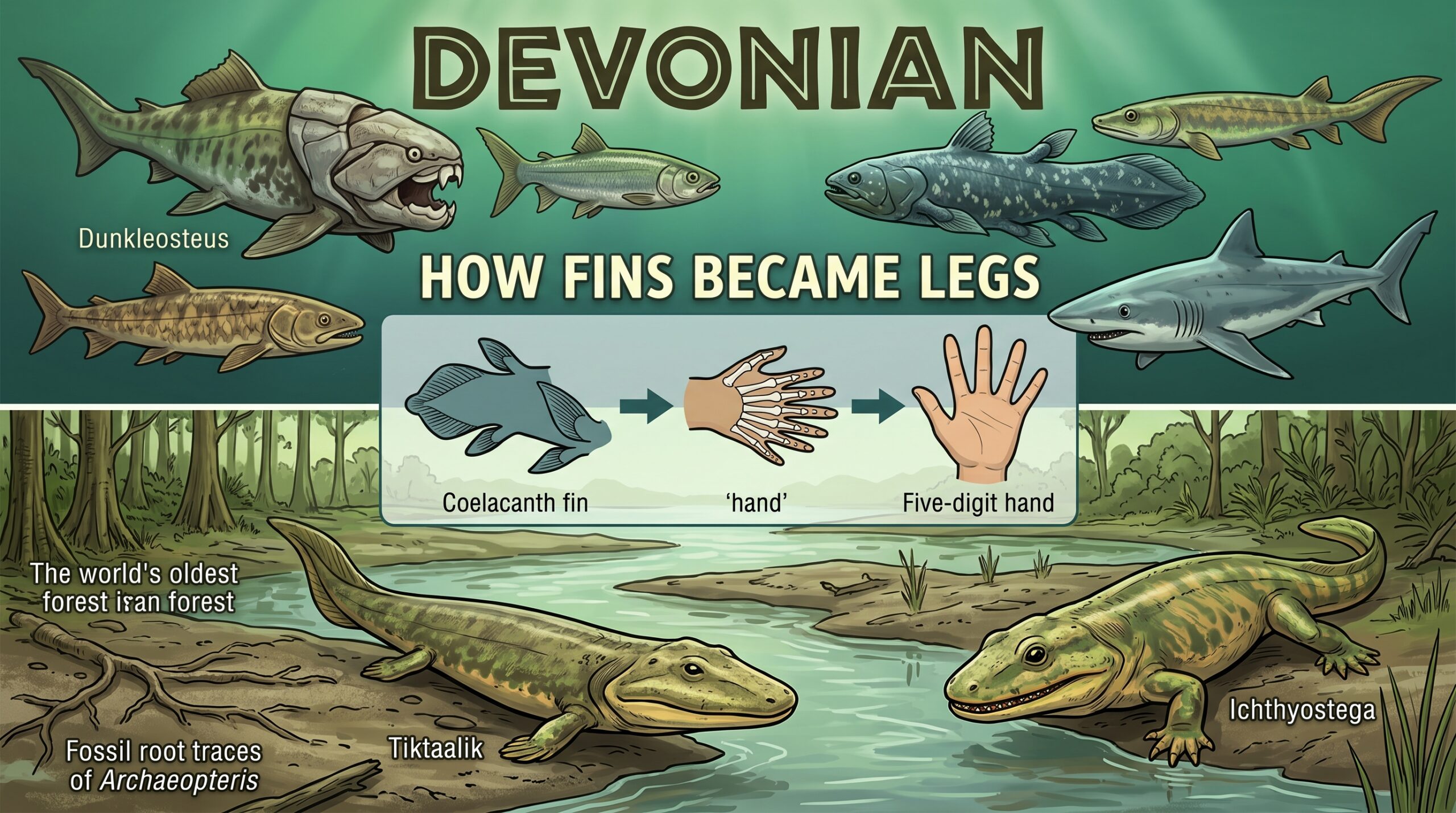
The Devonian ran from about 419 million to about 359 million years ago, lasting some 60 million years. It is the fourth of the six periods making up the Paleozoic Era, taking over from the Silurian and handing on to the Carboniferous.
The name comes from Devon in southwestern England, applied to the strata of that region by Adam Sedgwick and Roderick Murchison in 1839. In English the period is called the Age of Fishes, and it is also commonly described as the time when amphibians appeared.
Why it is called the Age of Fishes
Jawed fish already existed in the Silurian, but it was in the Devonian that they increased sharply in both variety and number. The seas and rivers of this period held prototypes of essentially every fish group alive today.
The most conspicuous were the placoderms, the armored fish whose heads and chests were covered in bony plates. Their emblem is Dunkleosteus, with jaw margins sharpened like blades — among the earliest apex predators in vertebrate history.
Its size has been substantially revised in recent years. Figures of 5 to 10 meters circulated for a long time, but they were not well founded. Only the head and thoracic armor of placoderms fossilizes; the rear half of the body was cartilage and rotted away. In 2023, Russell Engelman re-estimated from head proportions using data on 3,169 living fish and related placoderms, arriving at around 3.4 meters for a typical adult and about 4.1 meters for the largest individuals. Shortened, the animal has been redrawn with a stockier build.

Besides placoderms there were the cartilaginous fish including sharks, the ancestors of the ray-finned fish that dominate today, and the lobe-finned fish. Lobe-fins have a fleshy stalk at the base of the fin with bones inside it. Only coelacanths and lungfish survive now, but in the Devonian they were among the leading animals of rivers and shallow seas. Everything in the second half of this article happens within that group.
Forests begin covering the land
On land, an even larger change was under way. Silurian land plants were stick-like things a few centimeters tall. Over the Devonian, they became trees.
The oldest known forest is a fossil forest found in a quarry at Cairo, New York, reported in Current Biology in 2019 and dated to about 386 million years ago. What was found there was not trunks but the traces of roots left beneath the ground. The quarry floor happened to cut a horizontal section just below the land surface of the time, so the spread of the roots was visible as it was, with no excavation needed.
What surprised researchers was their form. The roots of a tree called Archaeopteris radiated about 11 meters from where the trunk had stood, the thickest reaching 15 centimeters across, with fine roots branching at the tips. One researcher described them as barely different from what you see in your own garden — the same structure as the roots of a modern tree.

Archaeopteris had leaves, a woody trunk and woody roots, yet still reproduced by spores rather than seeds. Seed plants appear only near the end of the Devonian. The form resembling a modern forest, in other words, was completed before the seed was.
Roots reaching deep also means breaking up rock and making soil. Soil formed at the surface, and atmospheric carbon dioxide was drawn down through the weathering of rock. The large decline in atmospheric carbon dioxide across the Devonian is explained in connection with this spread of forests.
Two events that starved the sea of oxygen
That spread of forests, however, may have been a blow to the ocean.
Two major extinctions occurred in the later Devonian. One is the Kellwasser event, about 372 million years ago at the Frasnian–Famennian boundary, counted among the Big Five. Stromatoporoids and rugose corals, which built the reefs of the time, were almost annihilated, and the ecosystems of shallow warm seas collapsed. The other is the Hangenberg event at the very end of the Devonian, about 359 million years ago, which hit vertebrates hard; the placoderms disappear here.
Both horizons share evidence that the seafloor went anoxic: black shale, strata where organic matter accumulated undecayed. This is also why Devonian rocks matter as petroleum source rocks.
So why did the sea lose its oxygen? A leading candidate is the forests newly established on land. Roots make soil, accelerate weathering, and send nutrients such as phosphorus into the sea in quantity via rivers. More nutrients mean more algae; decomposing their remains consumes oxygen, and shallow seas go anoxic first. Earth system model calculations published in Communications Earth & Environment in 2023 found that the increase in phosphorus runoff estimated from Devonian lake records was on its own enough to produce anoxia on a scale capable of causing extinction.
This is not settled, however. Some argue that cooling rather than anoxia was the main driver, and it is known that the anoxia of the time was not globally synchronous — in some places it was mild or absent. Views combining volcanic influence are also under consideration in parallel.
The classic story of coming ashore
Now to the main subject.
The account of coming ashore in twentieth-century textbooks ran roughly like this. Devonian continents alternated between dry and wet seasons, and ponds frequently dried up. Among the fish left stranded, only the lobe-fins with sturdy fins could crawl to the next pool. Repeating that journey strengthened the fins, and eventually they became legs. This is the “drying pond” scenario proposed by Alfred Romer in the 1950s.
To go with it, reconstructions were drawn again and again of the lobe-fin Eusthenopteron crawling across land. The consensus among researchers today is that this fish was fully aquatic.
Fossils supporting the scenario itself were found later. Tiktaalik was discovered on Ellesmere Island in the Canadian Arctic in 2004 and described in 2006. From strata about 375 million years old, it had a flat head, a mobile neck, and a functional wrist joint in the pectoral fin. With the gill-cover bones reduced, the head is disconnected from the shoulder, so it could raise its head without moving its body. Positioned squarely between fish and tetrapod, it was quickly adopted into textbook figures.

A hand completed underwater
The first crack in that scenario came from a set of fossils found in eastern Greenland.
Acanthostega, about 365 million years old, ran 60 centimeters to a meter long. An excavation in 1987 produced more than 200 bones from a single location, and Jenny Clack of the University of Cambridge studied them in detail. It has digits on its limbs and is placed among the earliest tetrapods.
In 1990, Clack and Michael Coates reported something that undid the prevailing assumption: Acanthostega had eight digits on its forelimb. Ichthyostega, also from Greenland, had seven on the hind limb; Tulerpeton from Russia had six. Our count of five, in other words, was not the starting point for tetrapods. The earliest tetrapods varied in digit number, and settling on five came considerably later.
The following year, 1991, the two went further. Examining the throat bones of Acanthostega, they found internal gills of the same kind as in fish — gills for breathing underwater. At the front margin of the shoulder girdle there was also the bony plate that in fish supports the rear wall of the gill chamber. It had lungs for air breathing too, but this animal was breathing in the water.
The rest of the skeleton is not built for land either. There is no wrist joint, and the ribs are short, unable to support the chest out of water. The limbs are not robust enough to bear body weight for long, and the digits are thought to have been webbed.

Limbs with digits, then, were not built for coming ashore. They were already complete while the animals were still in the water. The order was the reverse of the story.
Later fossils reinforced this view. Elpistostege, reported in Nature in 2020, is a 1.57-meter specimen from Quebec, Canada — the first with a complete pectoral fin skeleton. High-energy CT imaging of the interior revealed an arm bone, forearm bones, a row of bones corresponding to the wrist, and finger bones. And yet the outside remained an ordinary-looking fin, covered in scales and fin rays. A hand had formed inside a fin.
A four-limbed animal that could not walk
So how did the earliest limbed animals move on land?
That question was answered by a three-dimensional analysis of Ichthyostega published in Nature in 2012. Stephanie Pierce, Jenny Clack and John Hutchinson scanned the fossils, assembled the joints and quantified the ranges of motion. For comparison they measured five living animals the same way: salamander, crocodile, platypus, seal and otter.
The result: the shoulder and hip had narrower ranges of motion than any living animal measured. In particular, the limbs could not rotate about their long axes — a motion essential to walking in modern land animals. A salamander-style gait, advancing the left and right legs alternately, was impossible.
How did it move, then? The team’s analogy was the mudskipper: bringing both forelimbs forward together and using them like crutches to drag the body. The hind limbs barely reached the ground and, together with the tail, could do little more than support the rear.

Clack stated plainly that the reconstruction common in museum displays and illustrated books — Ichthyostega walking on four sturdy legs like a large salamander — is not correct.
Where the limbs actually helped
If not for walking on land, what were limbs with digits good for?
The leading view is shallow water. Forests existed on land by the later Devonian, and forests mean fallen trunks, dropped branches and roots working their way into the water’s edge. In shallows cluttered with mud and plant debris, limbs that could push, grip and kick off the bottom may have served better than undulating the body to swim.
On this reading, the coincidence in timing between the spread of forests and the origin of limbs takes on a different meaning. The forests were both the suspect in the ocean’s loss of oxygen and the agent that rebuilt the environment of shallow water.
And limbs completed in the water later turned out to be usable on land. Digit counts of eight or seven carried no significance at that point. Settling on five happens only in the Carboniferous.
Questions not yet settled
A fair amount about this period remains unknown.
One concerns the Acanthostega fossils themselves. A study published in Nature in 2016 imaged cross-sections of the humerus using synchrotron radiation and counted the growth lines preserved like tree rings. Even the largest individual, while over six years old, was still growing steadily and had not reached sexual maturity. The fossils long taken for adults were all juveniles. Where the adults were and how they lived is unknown.
Another concerns trace fossils. Footprints from the Zachełmie quarry in Poland, reported in Nature in 2010, are tetrapod tracks preserving even digit impressions, dated to about 390 million years — some 18 million years older than the body fossils. A rebuttal in 2015 argued they were fish burrows or feeding traces rather than tetrapod tracks; in 2018 the depositional setting was reinterpreted as an ephemeral lake rather than a marine environment; and in 2019 a counter-rebuttal appeared. It is unresolved.
Nor, it seems, did the lineages that acquired limbs head straight for land. Qikiqtania, described in 2022, is a close relative of Tiktaalik, found only 1.5 kilometers away. Yet its humerus lacks the muscle attachments and processes needed to push the body up, and is a smooth boomerang shape — a form for swimming. Within lineages that had once acquired supporting limbs, some went back to the water.
The roughly 20 million years after the Devonian ends and the Carboniferous begins is an interval with almost no tetrapod fossils, known as Romer’s Gap. When, and in what order, hands and feet built in the water became usable on land — that crucial stretch falls exactly where the record is missing.
Sources
Uppsala University press release (growth analysis of Acanthostega)
University of Cambridge Department of Zoology press release (limb mobility in Ichthyostega)
Cloutier et al., “Elpistostege and the origin of the vertebrate hand”, Nature (2020)
Daeschler, Shubin & Jenkins, “A Devonian tetrapod-like fish and the evolution of the tetrapod body plan”, Nature (2006) (the description of Tiktaalik)
University of Chicago press release (the description of Qikiqtania)
Cardiff University / Binghamton University press release (the Cairo fossil forest)
Case Western Reserve University press release (revised body-length estimate for Dunkleosteus)
UC Berkeley, Understanding Evolution, “The origin of tetrapods”
コメント