This article contains affiliate links. As an Amazon Associate I earn from qualifying purchases.

| Name | Allosaurus, Greek for “different lizard”, because its vertebrae were built more lightly than those of other reptiles. The best-known species, fragilis, is Latin for “fragile” |
| Classification | Dinosaurs, saurischians, theropods, Allosauridae (species include A. fragilis and A. jimmadseni from North America and A. europaeus from Portugal) |
| Age | Late Jurassic (about 157 to 150 million years ago) |
| Where found | The Morrison Formation of the western United States (Colorado, Utah, Wyoming and elsewhere); also Portugal |
| Length | About 8–10 m (8–9 m for A. jimmadseni; 9.7 m in the Natural History Museum, London’s estimate) |
| Weight | About 1.8–2.7 tonnes |
| Teeth | About 80 dagger-shaped teeth with serrated edges |
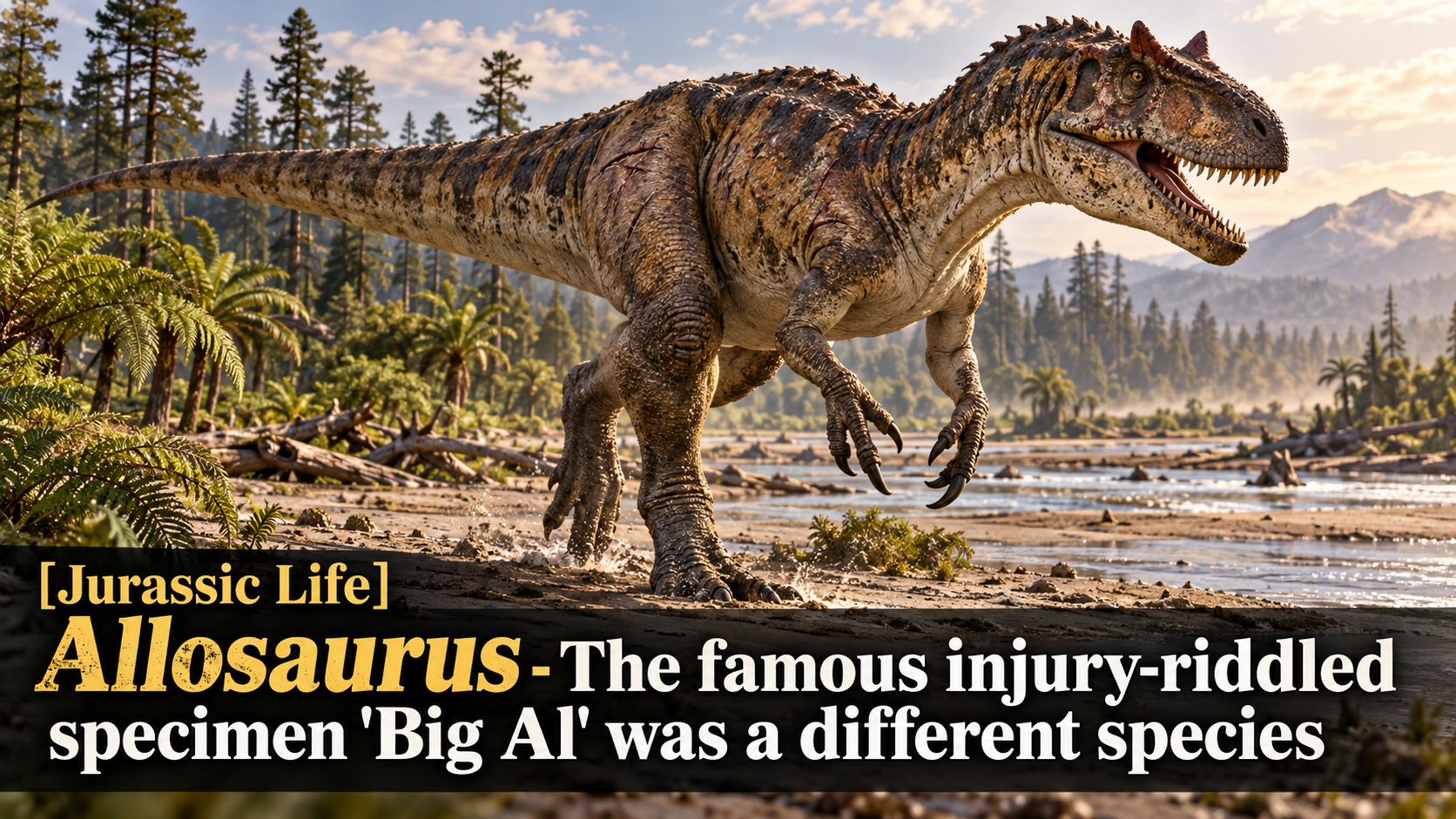
Allosaurus is the most commonly found large meat-eating dinosaur of Late Jurassic North America. The American paleontologist Othniel Marsh named it in 1877 from bones found in Colorado, and it is the state fossil of Utah. Its most famous specimen is a young individual nicknamed “Big Al”, found in Wyoming in 1991, with injuries and signs of disease preserved in 19 of its bones. Big Al was long regarded as Allosaurus fragilis, but in 2020 it was moved to a different species.
Appearance and Way of Life
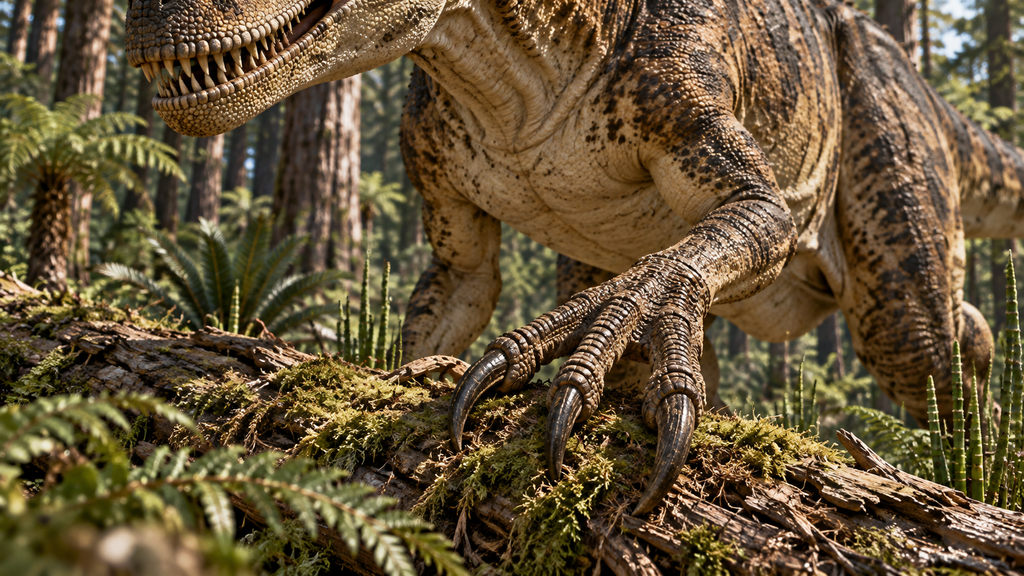
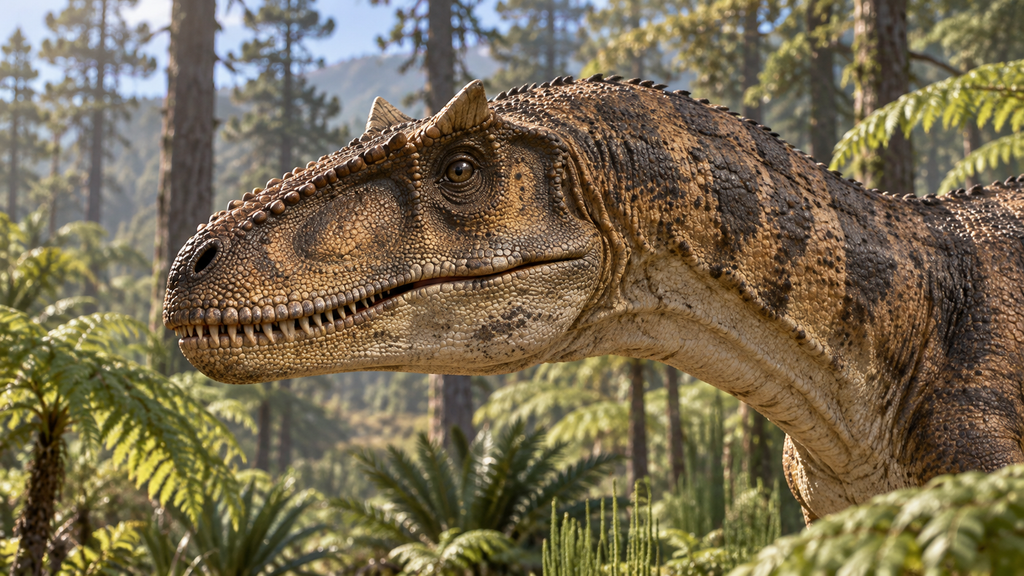
Allosaurus walked on its hind legs and balanced its body with a long tail. Its skull was long and narrow, with a pair of small hornlike bumps just in front of the eyes, from which low ridges ran forward toward the tip of the snout. Its arms were much longer than those of Tyrannosaurus, and each of its three fingers ended in a large, curved claw.
It lived on land crossed by rivers that dried out seasonally and by broad floodplains. The same rocks have produced long-necked sauropods such as Apatosaurus, Diplodocus and Camarasaurus, the plated Stegosaurus, and others. Allosaurus was the most numerous large predator in this landscape.
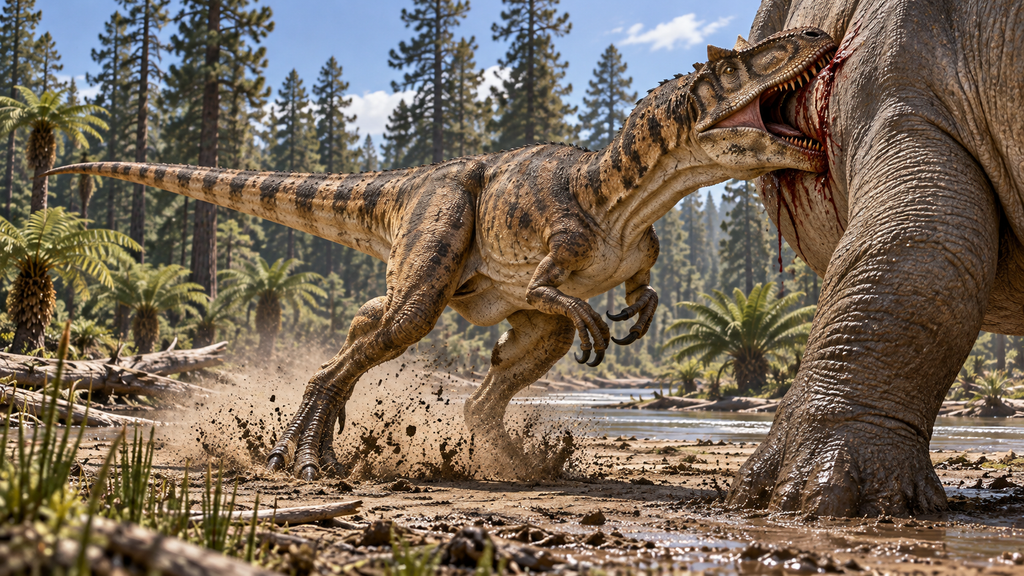
In 2001, a British research team CT-scanned an Allosaurus skull and calculated on a computer how it handled stress. The force of its jaw muscles was weak for an animal of its size, yet the lightly built skull could withstand strong impacts from above. The team proposed that it opened its mouth wide, struck prey with its whole head and then sliced flesh with its teeth. This idea has been challenged, and other studies have estimated a stronger bite.
The largest haul of Allosaurus bones comes from the Cleveland-Lloyd Dinosaur Quarry in Utah. More than 12,000 fossils have been dug out there, from at least 74 animals, and more than 46 of them are Allosaurus. Why so many meat-eaters ended up in one place is still unsettled; drought, predators drawn to prey stuck in mud, and contaminated water have all been proposed. The quarry’s abundant bones have allowed detailed studies of how Allosaurus grew from juvenile to adult.
Injury-Scarred “Big Al” Turned Out to Be a Different Species
In 1991, the Swiss paleontologist Kirby Siber found Allosaurus bones near the town of Shell in northern Wyoming. The site was on land managed by the federal Bureau of Land Management (BLM), and the skeleton was excavated by the Museum of the Rockies at Montana State University, the University of Wyoming Geological Museum and the Royal Tyrrell Museum of Palaeontology in Canada. About 95 percent of the skeleton was present, and it belonged to a young animal that had not finished growing. Its Museum of the Rockies catalogue number is MOR 693; its nickname is “Big Al”.
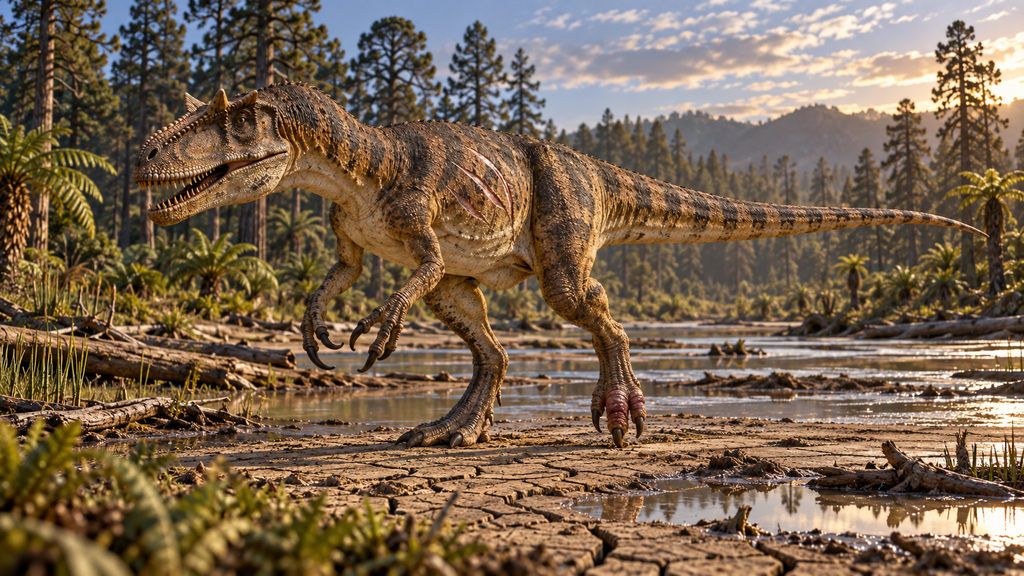
Examination of the bones found abnormalities in 19 of them. Rebecca Hanna’s 2002 report lists several ribs that had broken and healed, an injured finger bone, and abnormalities in vertebrae of the neck, back and tail, among others. A bone of the middle toe of the right foot carried a large swelling caused by infection. A German-Swiss-led team studying another specimen in 2015 concluded that this swelling in Big Al’s foot would have caused chronic pain and made walking difficult.
Big Al became the star of “The Ballad of Big Al”, broadcast by the BBC in 2000. The programme used computer graphics to tell the life of a young Allosaurus that kept accumulating injuries, based on the damage in its bones. The skeleton became one of the Museum of the Rockies’ signature exhibits and was treated as a specimen that showed what Allosaurus fragilis was like.
In 1996, the Sauriermuseum Aathal in Switzerland excavated another Allosaurus from a quarry on the Howe Ranch, also in Big Horn County, Wyoming. This adult, 7.6 m long and a little more than 10 percent larger than Big Al, is known as “Big Al Two”. The 2015 study found more than ten abnormalities in it, including broken ribs, a damaged shoulder blade and an infected toe, and all of them except a fracture in the hip bone showed signs of healing.
In January 2020, Mark Loewen of the Natural History Museum of Utah and Daniel Chure, formerly paleontologist at Dinosaur National Monument, announced a new species, Allosaurus jimmadseni. It was based on a nearly complete skeleton found at Dinosaur National Monument in 1990; the skull was located in 1996 in a survey using a radiation detector. The species name honours James Madsen, the Utah paleontologist who excavated and studied the bones of the Cleveland-Lloyd quarry.
The skull of A. jimmadseni has a low ridge on each side running from the hornlet in front of the eye to the tip of the snout, and the lower edge of the cheekbone below the eye is nearly straight. A. fragilis lacks these ridges, and the lower edge of its cheekbone curves in an S shape. The hornlets in front of the eyes are also taller in A. jimmadseni. It lived in the lower part of the Morrison Formation, about 157 to 152 million years ago, at least 5 million years before A. fragilis, making it the oldest known species of Allosaurus.
The paper also assigned several other specimens to the new species. Among them were Big Al (MOR 693) and Big Al Two (SMA 0005). The two skeletons that had been used to tell the story of “the life of Allosaurus” through their injuries are now regarded as individuals of a separate species older than A. fragilis. The record of injuries read by Hanna and the Swiss-led team is unchanged; the animals that suffered them, however, were not the textbook Allosaurus fragilis.
Related products
You can find books and products related to this article on Amazon.
If you buy through the links above, this blog may earn a commission.
Sources
Chure, D. J. & Loewen, M. A. (2020). Cranial anatomy of Allosaurus jimmadseni, a new species from the lower part of the Morrison Formation (Upper Jurassic) of Western North America. PeerJ 8, e7803. https://doi.org/10.7717/peerj.7803
Hanna, R. R. (2002). Multiple injury and infection in a sub-adult theropod dinosaur Allosaurus fragilis with comparisons to allosaur pathology in the Cleveland-Lloyd Dinosaur Quarry Collection. Journal of Vertebrate Paleontology 22, 76–90. https://doi.org/10.1671/0272-4634(2002)022[0076:MIAIIA]2.0.CO;2
Foth, C., Evers, S. W., Pabst, B. et al. (2015). New insights into the lifestyle of Allosaurus (Dinosauria: Theropoda) based on another specimen with multiple pathologies. PeerJ 3, e940. https://doi.org/10.7717/peerj.940
Rayfield, E. J., Norman, D. B., Horner, C. C. et al. (2001). Cranial design and function in a large theropod dinosaur. Nature 409, 1033–1037. https://doi.org/10.1038/35059070
Natural History Museum of Utah (24 January 2020). New Species of Allosaurus Discovered in Utah. https://nhmu.utah.edu/press/new-species-allosaurus-discovered-utah
Natural History Museum, London. Dino Directory: Allosaurus. https://www.nhm.ac.uk/discover/dino-directory/allosaurus.html
Bureau of Land Management. Jurassic National Monument. https://www.blm.gov/programs/national-conservation-lands/utah/jurassic-national-monument
Cowboy State Daily (8 November 2023). Wyoming’s Famous ‘Big Al’ Dinosaur Getting Another Autopsy. https://cowboystatedaily.com/2023/11/08/wyomings-famous-big-al-dinosaur-gets-sliced-up-for-its-life-story/
Cowboy State Daily (28 June 2026). After 35 Years, 152-Million-Year-Old Dinosaur ‘Big Al’ Returns Home To Wyoming. https://cowboystatedaily.com/2026/06/28/after-152-million-years-big-al-is-returning-to-his-digs-in-shell/
コメント