This article contains affiliate links. As an Amazon Associate I earn from qualifying purchases.
| Name | Deinonychus (Deinonychus antirrhopus; the genus name means “terrible claw” and the species name “counterbalancing”) |
| Classification | Dinosauria, Theropoda, Dromaeosauridae |
| Period | Early Cretaceous (usually given as about 115 to 108 million years ago) |
| Found in | Montana, USA (also found in Wyoming and Oklahoma) |
| Length | About 3.4 m |
| Weight | About 100 kg |
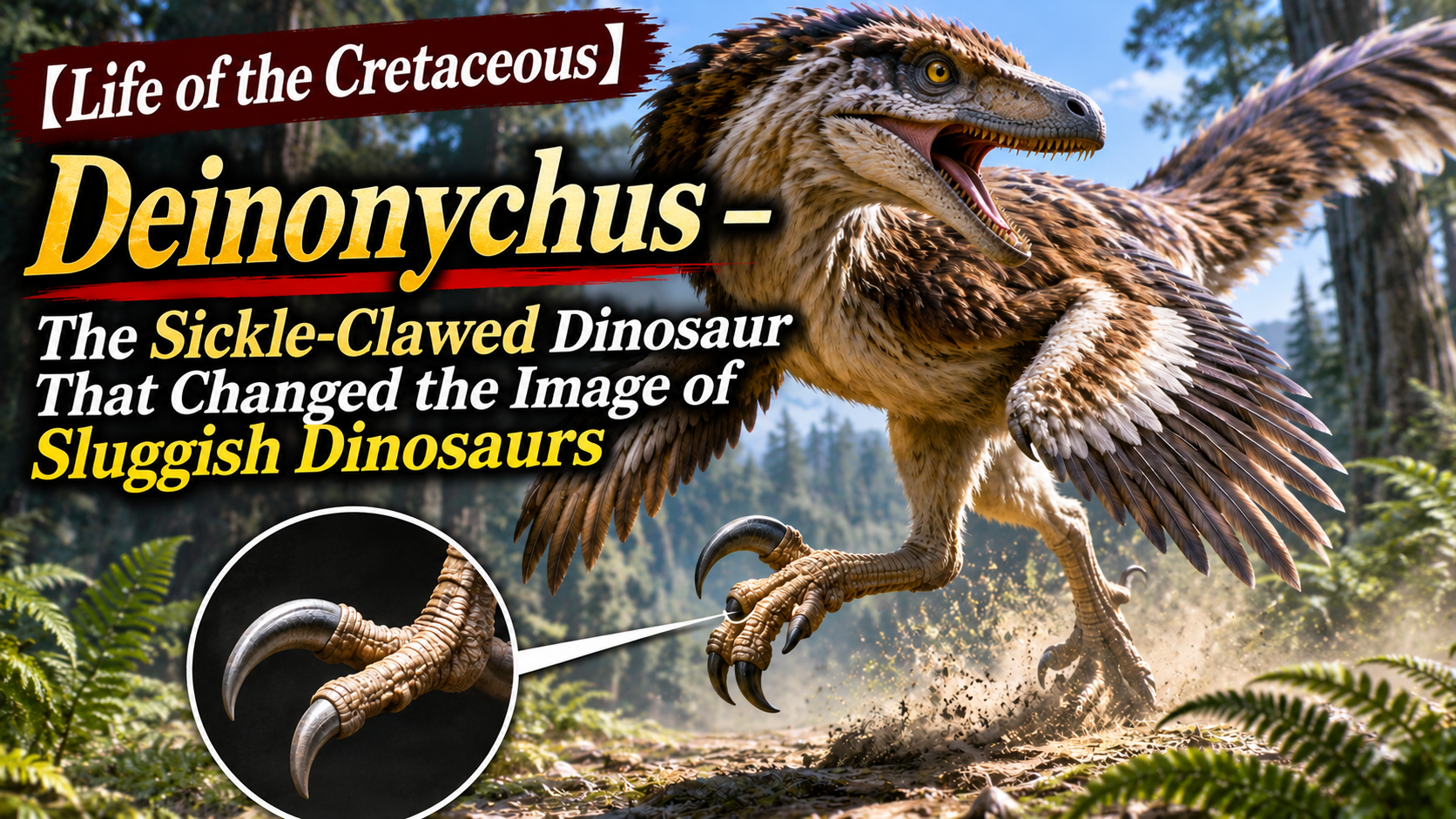
Deinonychus was a dromaeosaurid theropod, a meat-eating dinosaur with a large sickle-like claw on the second toe of each hind foot. It lived in North America in the Early Cretaceous. The 1969 study that described it helped overturn the view of dinosaurs as sluggish, cold-blooded reptiles, and also helped bring back the idea that birds evolved from dinosaurs.
Appearance and life
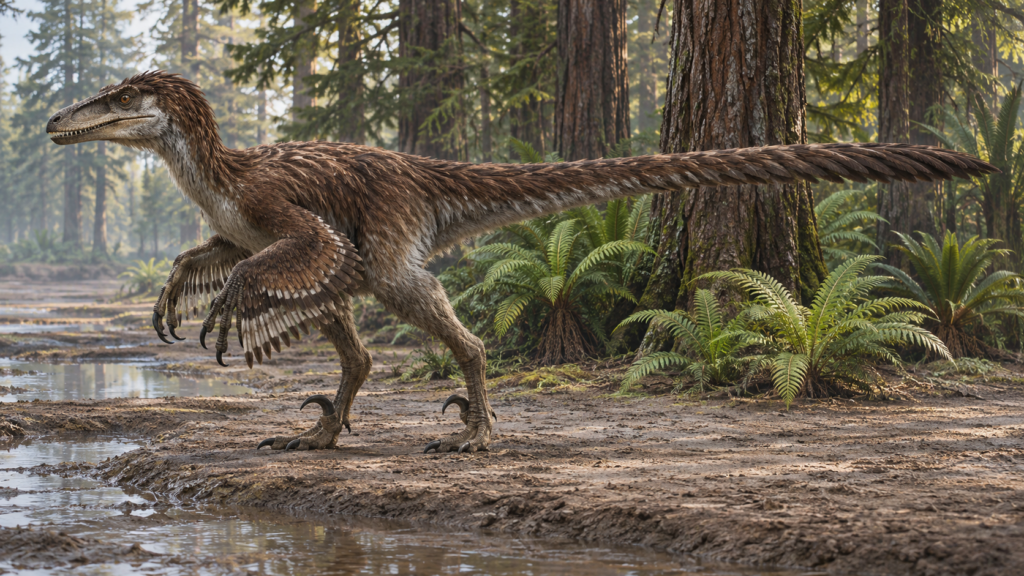
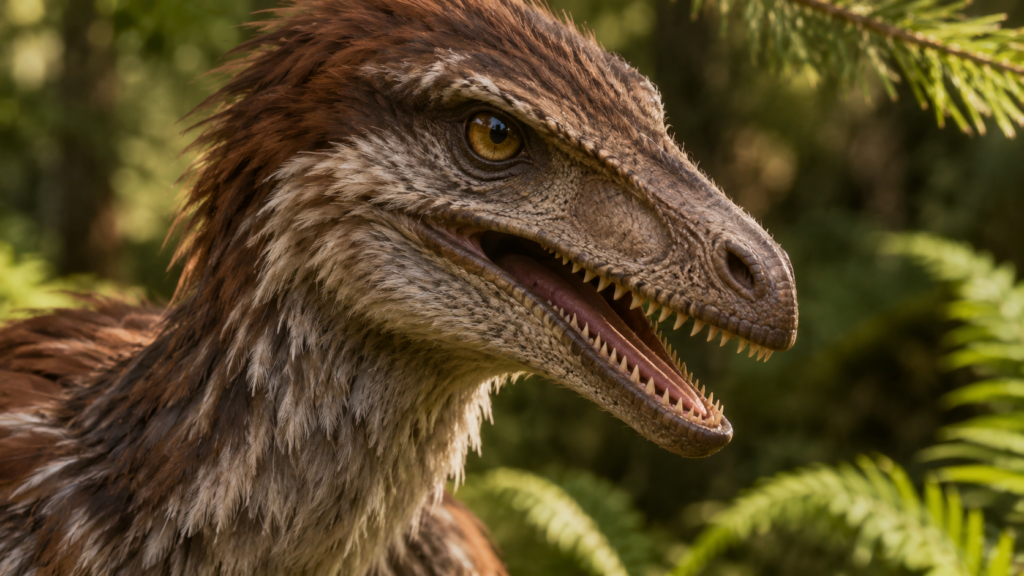
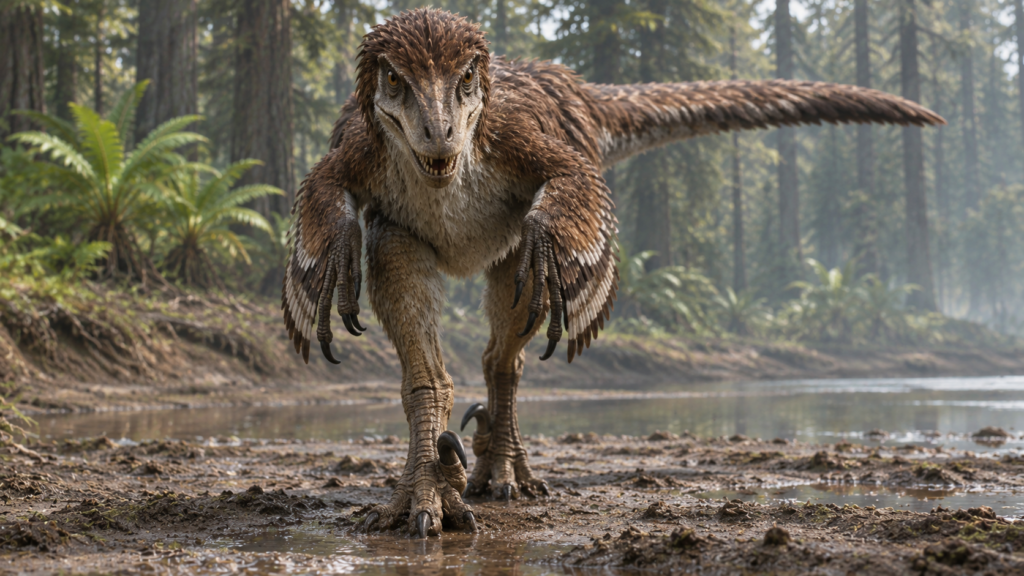
Deinonychus walked on two legs and balanced its body with a long tail. The tail bones were wrapped in long, thin rods of bone that made the tail stiff like a pole, and the species name, “counterbalancing,” refers to this tail. The arms were long, with sharp claws on three fingers. The teeth were blade-like and curved backward.
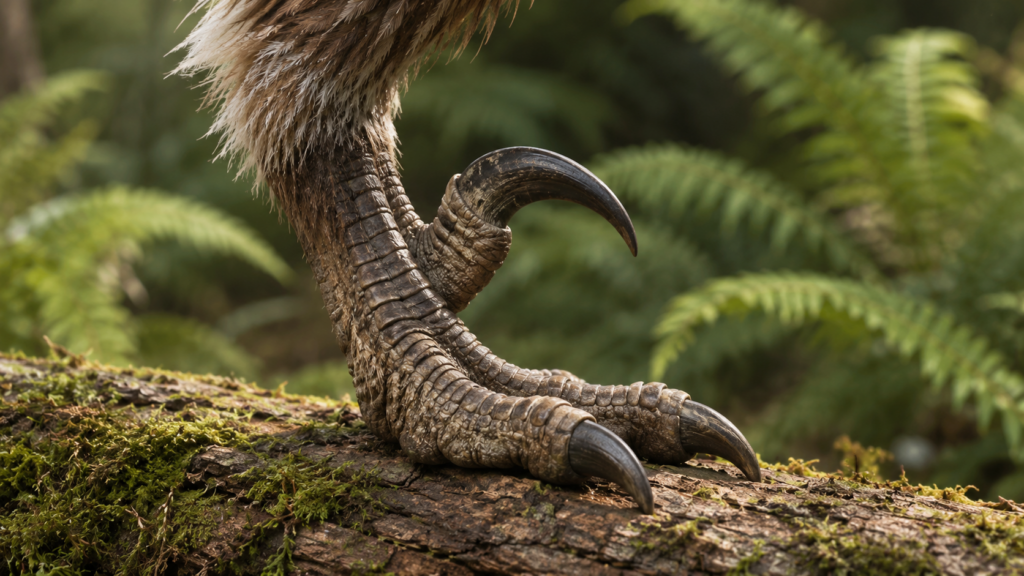
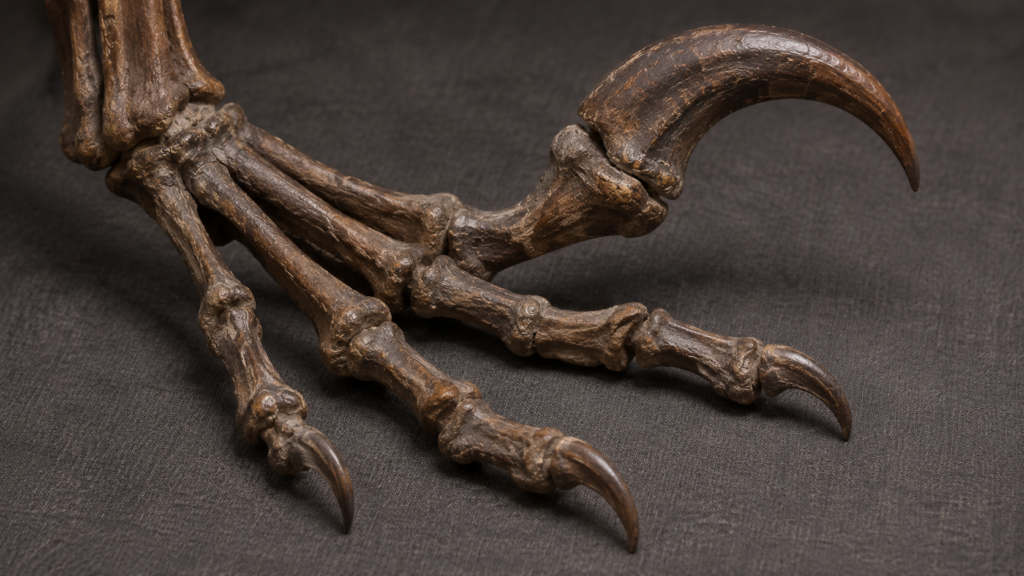
Its most striking feature is the claw on the second toe of the hind foot. The 1969 description showed that it was more than twice the size of the claws on the other toes and could be strongly flexed and extended. The animal’s weight rested on the third and fourth toes, and the second toe is thought to have been held up, off the ground. In 2011, Denver Fowler and colleagues proposed that the claw was not a blade for slashing prey but a tool for standing on prey, pinning it down and keeping it from escaping, much as modern birds of prey hold their catch with their feet.
No Deinonychus fossil with traces of feathers has been found yet. However, its close relative Velociraptor has marks on its arm bones where feathers were anchored, so Deinonychus very likely had feathers too. In 2006, a piece of eggshell found in contact with the belly bones of a Deinonychus was reported, raising the possibility that the parent sat on its eggs.
The same rocks often contain the medium-sized plant-eating dinosaur Tenontosaurus, and Deinonychus teeth and bones are sometimes found with its skeletons. In 1995, Ostrom and a colleague interpreted these finds as the remains of pack attacks on Tenontosaurus, but a 2007 study challenged the idea that Deinonychus hunted in cooperative packs.
The claw that changed the image of “sluggish dinosaurs”
The first bones of Deinonychus were found in August 1964 near Bridger in southern Montana by John Ostrom and Grant Meyer of the Peabody Museum of Natural History at Yale University. Over the next two summers they dug out more than 1,000 bones from at least three individuals. Ostrom named the new dinosaur in February 1969 and published a detailed account of its skeleton the same year. His first paper carried a reconstruction drawn by Robert Bakker, then a student.
At the time, dinosaurs were thought of as large, slow, cold-blooded reptiles. From the shape and function of the leg bones, Ostrom concluded that Deinonychus walked with its legs held straight beneath its body and was an active predator that attacked prey with its sickle-like claws. He also suggested that an animal capable of such movement might have had a high metabolic rate and been warm-blooded.
Ostrom’s work reached as far as the origin of birds. In 1970 he realized that a specimen in the Teylers Museum in the Netherlands, previously identified as a different animal, was in fact an Archaeopteryx. Comparing the skeletons of Deinonychus and Archaeopteryx, he argued in Nature in 1973 that birds evolved from small theropods, and in 1976 he set out the evidence in a long paper.
In April 1975, Bakker wrote an article titled “Dinosaur Renaissance” in Scientific American, arguing that dinosaurs were active, warm-blooded animals and that birds were their descendants. Through the 1970s and 1980s, research and reconstructions that portrayed dinosaurs as active animals spread, and this movement came to be called the “Dinosaur Renaissance.” Whether dinosaurs were warm-blooded remained under debate long afterward, but the idea that birds evolved from theropods became widely accepted after feathered dinosaurs began turning up in China from the 1990s onward.
At the same time, details of Deinonychus itself have been revised. The image of a claw slashing open prey is giving way to the idea of a claw that pinned it down, and many researchers now think it was not especially fast compared with other dinosaurs.
Related products
You can find books and products related to this article on Amazon.
If you buy through the links above, this blog may earn a commission.
About the images
The images in this article are illustrations created with AI (ChatGPT), and you are welcome to use them. If you do, we would appreciate a link back to this article as the source.
Sources
Ostrom, J. H. (1969). A new theropod dinosaur from the Lower Cretaceous of Montana. Postilla 128, 1–17. https://archive.org/details/postilla128peab
Ostrom, J. H. (1969). Osteology of Deinonychus antirrhopus, an unusual theropod from the Lower Cretaceous of Montana. Peabody Museum of Natural History Bulletin 30. https://elischolar.library.yale.edu/peabody_museum_natural_history_bulletin/30
Ostrom, J. H. (1973). The ancestry of birds. Nature 242, 136. https://doi.org/10.1038/242136a0
Ostrom, J. H. (1976). Archaeopteryx and the origin of birds. Biological Journal of the Linnean Society 8, 91–182. https://doi.org/10.1111/j.1095-8312.1976.tb00244.x
Bakker, R. T. (1975). Dinosaur renaissance. Scientific American 232(4), 58–79. https://doi.org/10.1038/scientificamerican0475-58
Fowler, D. W., Freedman, E. A., Scannella, J. B. & Kambic, R. E. (2011). The predatory ecology of Deinonychus and the origin of flapping in birds. PLoS ONE 6, e28964. https://doi.org/10.1371/journal.pone.0028964
Turner, A. H., Makovicky, P. J. & Norell, M. A. (2007). Feather quill knobs in the dinosaur Velociraptor. Science 317, 1721. https://doi.org/10.1126/science.1145076
Grellet-Tinner, G. & Makovicky, P. (2006). A possible egg of the dromaeosaur Deinonychus antirrhopus: phylogenetic and biological implications. Canadian Journal of Earth Sciences 43, 705–719. https://doi.org/10.1139/e06-033
Maxwell, W. D. & Ostrom, J. H. (1995). Taphonomy and paleobiological implications of Tenontosaurus–Deinonychus associations. Journal of Vertebrate Paleontology 15, 707–712. https://doi.org/10.1080/02724634.1995.10011256
Roach, B. T. & Brinkman, D. L. (2007). A reevaluation of cooperative pack hunting and gregariousness in Deinonychus antirrhopus and other nonavian theropod dinosaurs. Bulletin of the Peabody Museum of Natural History 48, 103–138. https://doi.org/10.3374/0079-032X(2007)48[103:AROCPH]2.0.CO;2
Yale News (2019). A Yale scientist’s research changed our understanding of dinosaurs. https://news.yale.edu/2019/06/03/yale-scientists-research-changed-our-understanding-dinosaurs
Natural History Museum, London. Dino Directory: Deinonychus. https://www.nhm.ac.uk/discover/dino-directory/deinonychus.html

コメント