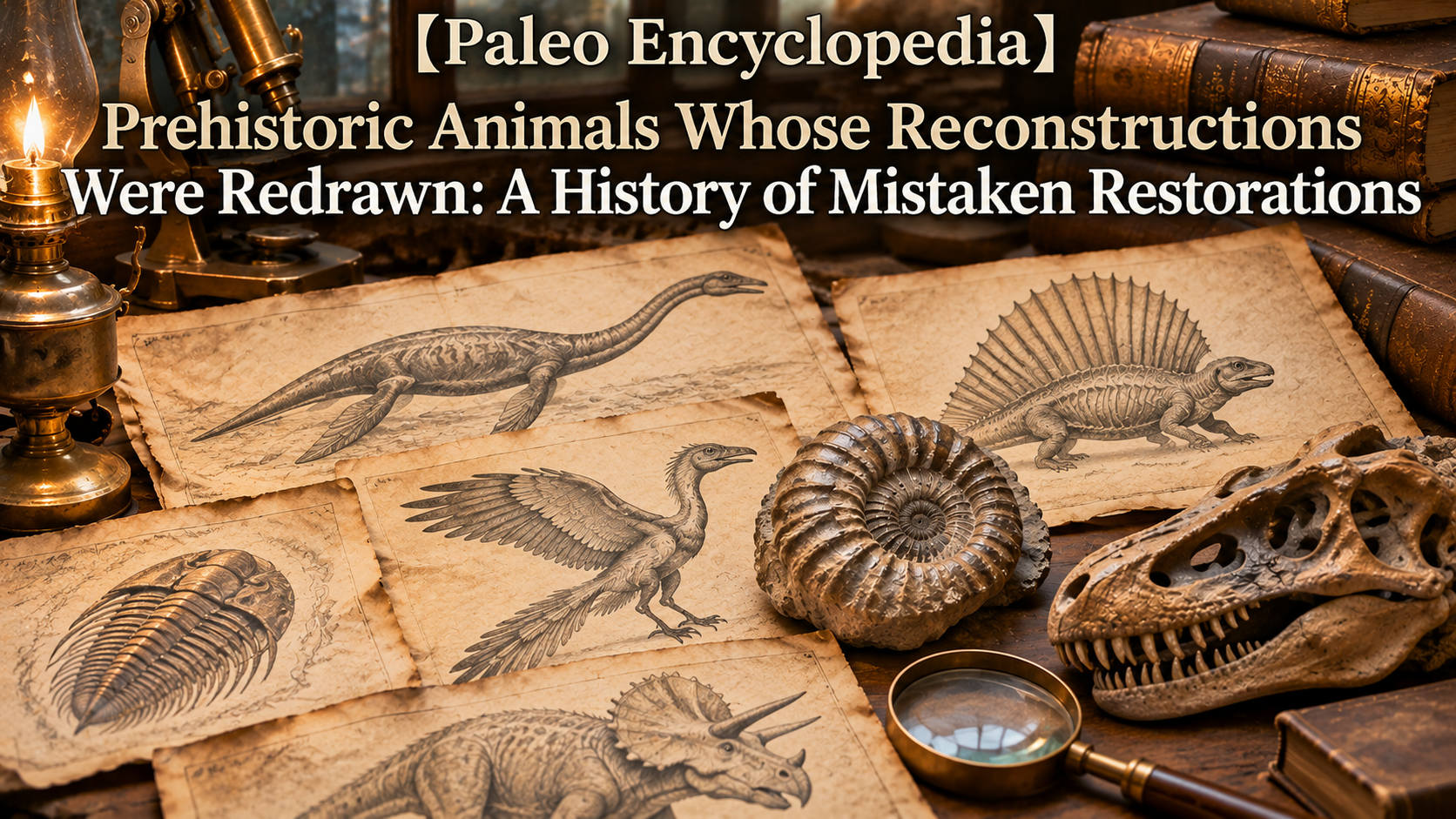
This page lists the animals covered in the Paleo Encyclopedia whose first reconstructions later proved wrong and were redrawn. They are arranged from oldest to youngest, with the earlier reconstruction, the current view, and what prompted the correction. Select a name to go to its encyclopedia article.
The accounts are based on the papers and museum materials cited in each article. The “Sources” column links to the studies that corrected the reconstructions. Rows will be added as new encyclopedia articles are published.
List in Chronological Order
| Name | Period | Earlier reconstruction | Current view | When and how it was corrected | Sources |
|---|---|---|---|---|---|
| Hallucigenia | Cambrian | In 1977 it was reconstructed as an animal standing on the seafloor on seven pairs of spines used as stilt-like legs, with a single row of tentacles along its back and a swollen blob taken to be the head | The spines are defensive and run along the back, and the legs are in two rows. The head is at the opposite, slender end, with a pair of simple eyes and a mouth | In 1991–92, comparison with Microdictyon from Chengjiang, and a second row of legs exposed by cutting into the rock, showed it had been drawn upside down. In 2015, eyes and a mouth were found among 132 specimens, confirming that it had also been drawn back to front | Royal Ontario Museum, Smith & Caron (2015) |
| Anomalocaris | Middle Cambrian | Its parts were described separately: the frontal appendage as the body of a shrimp (1892), the mouth as a jellyfish and the body as a sea cucumber (1911) | A predator with large compound eyes, a pair of frontal appendages and a ring-shaped mouth, swimming by undulating its side flaps | In the early 1980s, cutting gradually into a specimen revealed appendages and a mouth attached to a single body. The parts were united as one animal in 1985. In 2012 the “jellyfish” mouth was reassigned to a different radiodont | Royal Ontario Museum, Daley & Edgecombe (2014) |
| Hurdia | Middle Cambrian | In 1912 the central carapace element was described as a crustacean shell. The lateral elements were described as a different organism in 1962. Whole-body specimens were regarded as a kind of Anomalocaris | A relative of Anomalocaris (a radiodont) with three carapace elements projecting in front of its head | After several hundred specimens were compared, a reconstruction uniting the carapace, appendages, mouth and trunk as one animal was published in March 2009, 97 years after the name was given | Daley et al. (2009), Royal Ontario Museum (2009) |
| Birkenia | Middle Silurian | The 1899 plate showed it with back and belly reversed, with the hooked spines along the underside | The hooked spines run along the back, and the lower lobe of the tail fin is the larger | In 1924, well-preserved related fossils from Norway showed the positions of the pineal opening, which opens only on the upper side, and the nostril. It was redescribed the right way up in 1928 | Traquair (1899), JNCC, Slot Burn |
| Megarachne | Latest Carboniferous | Described in 1980 as a giant spider with a body 33.9 cm long (a mygalomorph, the group that includes tarantulas), and regarded as the largest spider ever | A sea scorpion that walked along the bottom, about 54 cm long | The original specimen, kept in a bank vault, passed to a museum, and a second specimen was found. In 2005 a restudy that included the original describer showed from the arrangement of the eyes and other features that it was a sea scorpion | Selden et al. (2005), ScienceDaily (2005) |
| Helicoprion | Permian | In 1899 the tooth whorl was reconstructed curling upward from the tip of the upper jaw over the snout. Later proposals placed it on the back, the tail, beneath the jaw, or at the tip of the lower jaw | A single whorl sits in the midline of the lower jaw, set into it along the jaw’s whole length | In 2013 a specimen found in Idaho in 1950 was CT-scanned, and traces of jaw cartilage were found around the whorl | Tapanila et al. (2013) |
| Chirotherium (footprints) | Triassic | The trackmaker was taken to be Labyrinthodon, an amphibian like a giant toad (1840s). Because the “thumb” was on the outside, it was also thought to have walked with its legs crossed | The “thumb” is the fifth toe. The tracks were left by an archosaur on the line leading to crocodiles, walking with its legs held beneath its body | In 1925 the identity of the toe was worked out by re-examining footprints in museums. The foot of Ticinosuchus, described in 1965, matched the tracks almost exactly | Smithsonian Magazine (2019), Lautenschlager & Desojo (2011) |
| Plateosaurus | Late Triassic | Almost every posture was proposed: bipedal with the backbone steeply upright (1907–08), sprawling on all fours, hopping like a kangaroo, and a compromise in which it walked on four legs when moving slowly | It always walked on two legs, with its back held close to horizontal and balanced by its long tail | In 2007 it was shown that the forearm bones could not rotate, so the palms could not be turned downward. In 2010 the skeleton was reassembled as three-dimensional digital data, confirming that the center of mass is stable in a bipedal posture | Mallison (2010) I, Mallison (2010) II |
| Brachiosaurus | Late Jurassic | Standing on a lake bottom with only its head and upper neck above water (as in a 1941 painting). The nostrils, opening high above the eyes, were thought to let it breathe while submerged. Its namer had written in 1904 that it was a land animal | It walked across dry plains on four upright legs and fed on the leaves of tall trees | In 1951 it was pointed out that water pressure at depth would prevent it from drawing air down its long neck. In 1975 its anatomy and the rocks it came from led to the conclusion that it was a land animal. In 2004 calculations showed its body would float and be unstable in water | Kermack (1951), Coombs (1975) |
| Iguanodon | Early Cretaceous | The conical bone in the 1834 specimen was taken for a nose horn, and the animal was shown standing on four legs like a rhinoceros (the Crystal Palace sculptures of 1853). From 1882 it was shown upright like a kangaroo, resting its tail on the ground | The conical bone is a spike on the thumb. It walked mainly on four legs and sometimes ran on its hind legs alone (how much it moved on two legs is debated) | In the dozens of skeletons excavated from the Bernissart coal mine from 1878, the conical bone was always at the end of the hand. A restudy of the skeletons in 1980 concluded that the backbone was held nearly horizontal | Natural History Museum, London, Norman (1980) |
| Elasmosaurus | Late Cretaceous | In 1868–69 it was reconstructed with a short neck and the head at the end of a long tail | A small head at the end of a neck about 7 m long, made up of 72 vertebrae | In March 1870 it was pointed out that the end taken to be the tail carried the first two neck vertebrae (the atlas and axis), which join the skull | Davidson (2002), Sachs et al. (2013) |
| Ankylosaurus | Latest Cretaceous | The 1908 restoration had no tail club; the tail tapered to a point. Later, large shoulder spikes were added, mistakenly borrowed from another armored dinosaur, Edmontonia | It has a club at the end of its tail and no large shoulder spikes | In 1910 a second specimen found in Alberta revealed the tail club | Arbour & Mallon (2017) |
Animals Still Being Redrawn
Some animals have had their reconstructions corrected once, but their appearance has still not settled on a single version.
- Spinosaurus (early Late Cretaceous): The 1915 description gave a two-legged dinosaur with a long, narrow snout and a sail on its back. The specimen was destroyed in an air raid in 1944, and for nearly 70 years the animal was drawn from the published figures. In 2014 bones from Morocco suggested a four-legged, semi-aquatic animal, and in 2020 it was proposed that it swam by sweeping its tail from side to side, but in 2022 it was presented as walking on two legs along the shore and ambushing fish in shallow water. Sources: Ibrahim et al. (2014), Sereno et al. (2022)
- Desmostylus (Neogene, Miocene): The complete skeleton from Sakhalin reported in 1935 was mounted standing with its limbs bent at right angles. In 1984 a posture with the elbows and knees splayed sideways and the trunk held low was proposed, and skeletons in several museums were remounted. In 2002 it was argued that it walked with its limbs held straight beneath the trunk, and the question remains unsettled. Sources: Inuzuka (2009), Domning (2002)
How to Read the Table
- “Earlier reconstruction” includes drawings, mounted skeletons and the interpretation given when the animal was described. The source of the error differs from one animal to another: fossils read the wrong way round, parts found separately treated as different organisms, or analogies drawn when little evidence was available.
- Chirotherium is a name given to fossil footprints. The “Earlier reconstruction” and “Current view” columns describe the animal that made the tracks.
How long the earlier reconstructions stayed in use, and who corrected them and how, are covered in detail in each article.

コメント