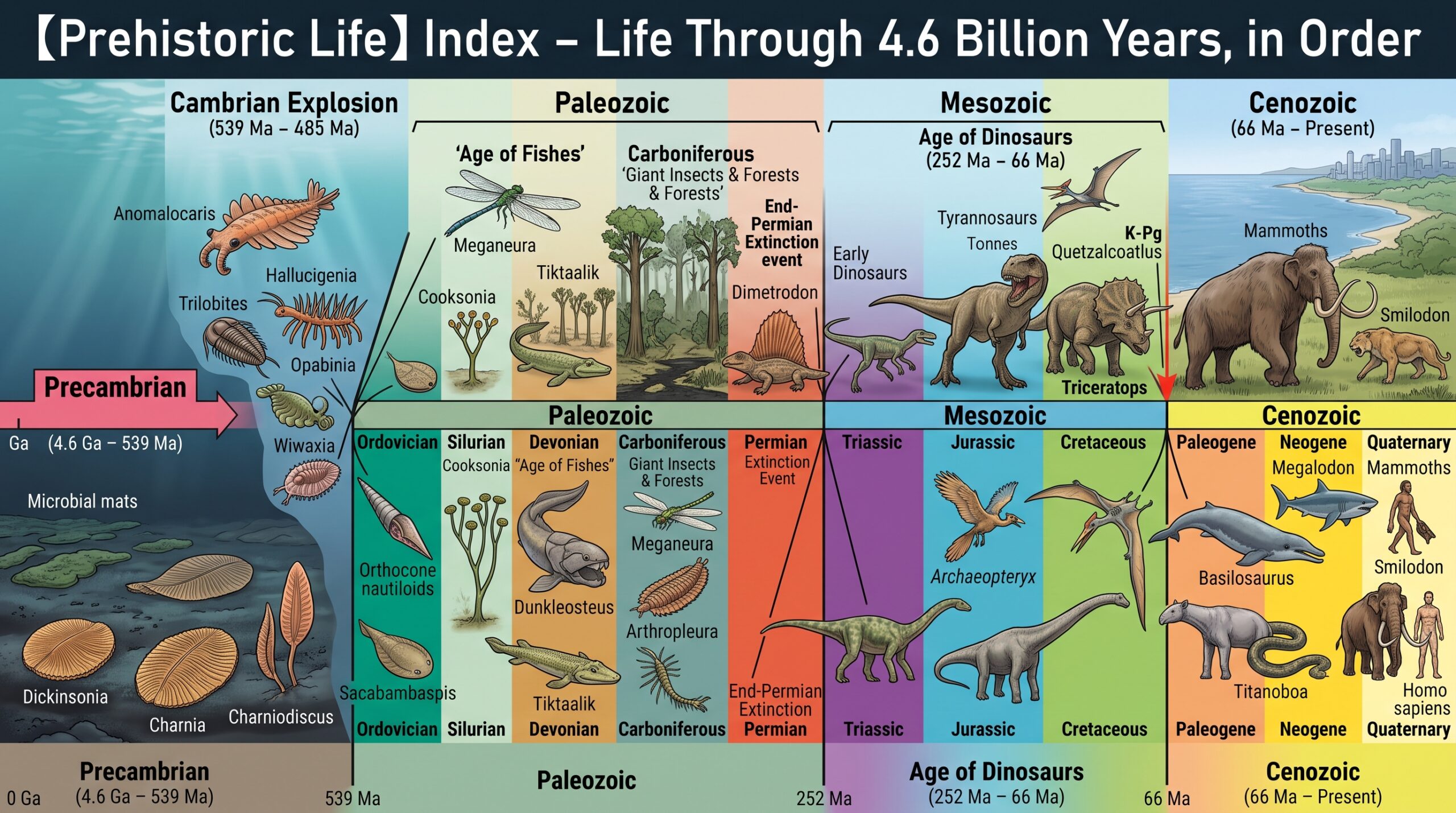

This page is the index by geological period for Prehistoric Life, a series introducing extinct organisms one at a time. It follows the history of Earth from oldest to youngest, so you can see at a glance what was living in each period. New entries are added here as each article is published.
The divisions and dates follow the International Chronostratigraphic Chart of the International Commission on Stratigraphy (ICS). The periods themselves are covered in detail in the Earth Timeline series.
Precambrian (about 4.6 billion to 539 million years ago)
Just over four billion years, from the birth of Earth to the eve of the explosive increase in animals — close to 90 percent of Earth’s history. The leading players are microbes invisible to the eye, and only toward the end do organisms of visible size such as Dickinsonia appear. The cyanobacteria that filled the planet with oxygen are residents of this time as well.
| Charnia | A frond anchored to the seafloor about 560 million years ago. The first fossil formally accepted as Precambrian |
| Charniodiscus | A frond-like organism standing on a lightless seafloor, anchored by a disc. Not a plant |
| Cloudina | A small animal living inside a calcium carbonate tube about 550 million years ago. Among the oldest shells built by animals, and some carry holes drilled by predators |
| Cyanobacteria | The bacteria that filled Earth’s atmosphere with oxygen. Alive from about two billion years ago to the present |
| Dickinsonia | A flat oval organism lying on the Ediacaran seafloor. Identified as an animal from fat molecules preserved in the fossils |
| The Francevillian biota | Disc-shaped structures with radial folds from about 2.1 billion years ago. A candidate for the oldest multicellular life — if it is life at all, which is undecided |
| Grypania | A coiled ribbon from about 1.87 billion years ago. Among the oldest fossils visible to the naked eye, though whether it is an alga or a bacterium is undecided |
| Kimberella | A slug-like crawling animal from about 555 million years ago. The fan-shaped grazing marks it left on the seafloor were decisive in making it a candidate mollusk ancestor |
| Spriggina | A segmented animal a few centimeters long from about 550 million years ago. It looks bilaterally symmetrical, but the segments are offset by half a step, and its affinity is undecided |
| Tribrachidium | A hemispherical organism from about 550 million years ago with three arms curling into a spiral. Its triradial symmetry matches no animal alive today |
Cambrian (about 539 to 485 million years ago)
The Cambrian explosion, when the basic body plans of animals appeared all at once. Trilobites with hard shells and compound eyes crawled the seafloor while the predator Anomalocaris swam above them. This is also the period of the strange cast — Hallucigenia, Opabinia — that kept researchers arguing over how to reconstruct them.
| Anomalocaris | One of the largest predators in the sea about 508 million years ago. Its appendages were described as a shrimp, its mouth as a jellyfish and its body as a sea cucumber; assembling them into one animal took 90 years |
| Aysheaia | A soft animal with ten pairs of legs, thought to have gripped sponges about 508 million years ago. The orientation of its reconstruction has not changed since 1911, yet its affinity is still undecided |
| Haikouichthys | A jawless fish about 2.5 cm long from about 518 million years ago. Regarded as among the oldest vertebrates, and reported in 2026 to have had four eyes |
| Halkieria | A slug-shaped animal in an armor of scales from about 518 million years ago, with a shell-like plate at the front and rear of the body. Only the scales were known for a long time; the whole animal came to light in 1989 |
| Hallucigenia | A small lobopodian from about 508 million years ago, with seven pairs of spines on its back and ten pairs of legs gripping sponges. The 1977 reconstruction was upside down and back to front, and took nearly 40 years to correct |
| Leanchoilia | An arthropod from about 505 million years ago with six long whips extending from the arms in front of its head. Taken for an eyeless mud-eater until re-examination showed a predator with eyes |
| Marrella | One of the first fossils found in the Burgess Shale, about 508 million years old. There are over 25,000 specimens, yet which arthropod lineage it belongs to is still undecided |
| Myllokunmingia | A jawless fish about 3 cm long from about 518 million years ago. It appears in textbooks as among the oldest vertebrates, yet only one reliable fossil exists |
| Nectocaris | A flattened predator with stalked eyes and a pair of tentacles, swimming the Burgess Shale sea about 508 million years ago. Read as a shrimp, a fish and a squid in turn, and in 2025 proposed as close to the ancestry of arrow worms |
| Opabinia | A small swimmer with five eyes from about 508 million years ago, grasping prey with a long claw-tipped proboscis. When the reconstruction was shown at a conference, the room laughed |
| Ottoia | A priapulid worm buried in the seafloor mud about 508 million years ago. Shells of what it ate remain in its gut, showing its diet directly |
| Pikaia | A small chordate about 4 cm long from the Burgess Shale, about 508 million years ago. Long called the oldest human ancestor, it gave up the title when older fish were found |
| Saccorhytus | A sack-like animal 1 mm long from about 535 million years ago. Announced as the oldest human ancestor, it was reclassified among the ecdysozoans five years later |
| Trilobites | Arthropods that appeared about 521 million years ago and flourished in the sea for nearly 270 million years. Their eyes were built of calcite crystal |
| Wiwaxia | A slug-shaped animal covered in scales and spines about 508 million years ago. Its mouth resembles a mollusk’s and its scales an annelid’s, and which group it belongs to is undecided |
| Yunnanozoon | A fish-shaped animal a few centimeters long from about 518 million years ago. Its classification has swung between chordate and vertebrate stem lineage for over thirty years and is still unsettled |
Ordovician (about 485 to 444 million years ago)
A period in which marine life diversified further. Giant orthocone nautiloids with straight conical shells stood at the top, while jawless fish swam near the seafloor. Sacabambaspis, which became an internet favorite in recent years, is a fish of this period.
| Arandaspis | A jawless fish from about 465 million years ago. Its head was enclosed in bony shields, but no bone remains in the fossils — only molds pressed into sandstone |
| Crinoids | Relatives of sea urchins and starfish that stand on the seabed like flowers. They appeared about 480 million years ago and still live in the deep sea |
| Horseshoe Crab | A chelicerate lineage running from about 480 million years ago to today. Fossils 445 million years old already look almost the same as the four living species, one of which is found in Japan |
| Isotelus | A large trilobite from the seas of Ordovician North America. The largest species reached about 72 cm, the largest trilobite ever found complete |
| Nautilus | A cephalopod that controls its buoyancy with a chambered shell. Its relatives with the same shell design ruled the Ordovician seas, but the modern genus is a relatively young lineage that appeared in the Cretaceous |
| Orthoceras | A cephalopod with a straight conical shell. Famous by name from the black souvenir fossil plates, but the true genus is confined to the Middle Ordovician of the Baltic |
Silurian (about 444 to 419 million years ago)
The period when life began moving onto land in earnest. Sea scorpions flourished in the water, while on land the earliest plants, a few centimeters tall, stood up as Cooksonia. This is also when Prototaxites, the enigmatic column eight meters high, towered over the landscape.
| (Articles for this period are in preparation) |
Devonian (about 419 to 359 million years ago)
The Age of Fishes. Dunkleosteus, its head sheathed in bony armor, ruled the sea, and Tiktaalik, with arm bones inside its fins, took a step toward land. Earth’s first forests also date from the Devonian.
| (Articles for this period are in preparation) |
Carboniferous (about 359 to 299 million years ago)
The age of giant forests and giant insects. Meganeura, a dragonfly the size of a crow, flew overhead, and the millipede Arthropleura, over two meters long, crawled the ground. The forests of this period became the coal of later ages.
| (Articles for this period are in preparation) |
Permian (about 299 to 252 million years ago)
The close of the Paleozoic. Lineages leading to mammals were the leading players on land, including the sail-backed Dimetrodon. At the end came the largest mass extinction in history, replacing the cast of living things root and branch.
| (Articles for this period are in preparation) |
Triassic (about 252 to 201 million years ago)
A fresh start after the great extinction. The earliest dinosaurs such as Eoraptor, about a meter long, appeared, while ichthyosaurs 17 meters long were already swimming in the sea. The first pterosaurs and the ancestors of mammals also arrived in this period.
| (Articles for this period are in preparation) |
Jurassic (about 201 to 145 million years ago)
The period when dinosaurs grew large. Long-necked, long-tailed sauropods walked the land at over 20 meters, and Archaeopteryx, with feathered wings, appeared in the sky. The sea belonged to ichthyosaurs and plesiosaurs.
| (Articles for this period are in preparation) |
Cretaceous (about 145 to 66 million years ago)
The climax of the age of dinosaurs. Tyrannosaurus and Triceratops on land, mosasaurs and ammonites in the sea, and the giraffe-sized pterosaur Quetzalcoatlus in the air. It all ended with an asteroid impact.
| Ankylosaurus | A fully armored plant-eater from the end-Cretaceous of North America. Its tail club was long seen as a weapon against predators, but research suggests it was used mainly in fights between members of its own species |
| Spinosaurus | A large fish-eating dinosaur with a sail on its back that lived in North Africa about 95 million years ago. It is still reconstructed both as a swimmer and as a wader |
| Triceratops | A large horned dinosaur of 68–66 million years ago, with three horns and a bony frill. Whether its close relative Torosaurus, with holes in its frill, was simply an aged Triceratops is still undecided |
| Tyrannosaurus | A 12–13 m carnivorous dinosaur of North America, about 68–66 million years ago. It had one of the most powerful bites of any land animal and vanished in the end-Cretaceous mass extinction |
| Velociraptor | A turkey-sized feathered predator from Mongolia, about 75 million years ago. The movie raptor was modeled on a different genus, Deinonychus |
Paleogene (about 66 to 23 million years ago)
Mammals filling the seats left empty in a world without dinosaurs. The ancestors of whales returned from land to the sea as four-legged walkers and grew into Basilosaurus, 15 meters long. Paraceratherium, the largest land mammal in history, and Titanoboa, a 13-meter snake, also date from this period.
| (Articles for this period are in preparation) |
Neogene (about 23 to 2.58 million years ago)
The period in which today’s cast of living things came together. In the sea, Megalodon, among the largest sharks ever. On land, grasslands spread and horses ran across them, and in Africa the story of human ancestry began to move.
| (Articles for this period are in preparation) |
Quaternary (about 2.58 million years ago to the present)
Our own period, cycling between glacials and interglacials. Woolly mammoths and Smilodon walked the ice-age landscape, and Homo sapiens spread across the world. This is also the period when other humans lived alongside us — Neanderthals and Denisovans.
| (Articles for this period are in preparation) |
Sources
The divisions and dates follow the International Chronostratigraphic Chart of the International Commission on Stratigraphy (ICS).
・International Chronostratigraphic Chart (ICS): https://stratigraphy.org/chart
コメント